Kaou Maroua H, Furkó Mónika, Balázsi Katalin, Balázsi Csaba
Centre for Energy Research, Institute of Technical Physics and Materials Science, Konkoly-Thege M. Str. 29-33, 1121 Budapest, Hungary.
Doctoral School of Materials Science and Technologies, Óbuda University, Bécsi Str. 96/B, 1030 Budapest, Hungary.
Nanomaterials (Basel). 2023 Aug 9;13(16):2287. doi: 10.3390/nano13162287.
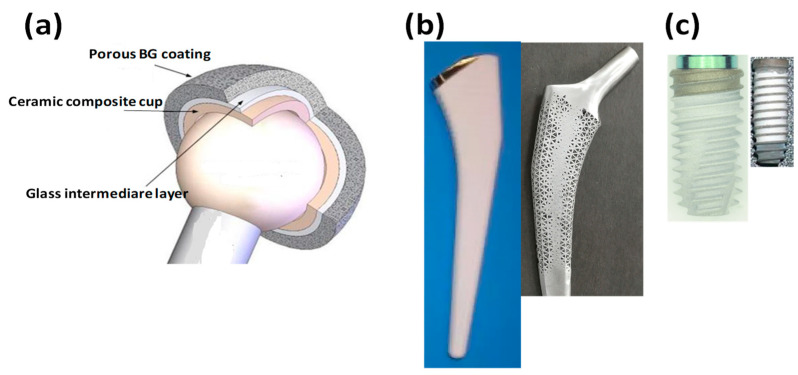
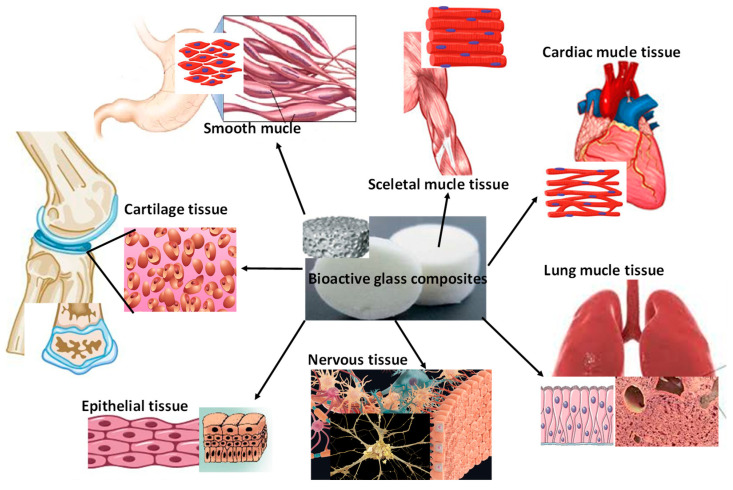
Bioactive glasses (BGs) are especially useful materials in soft and bone tissue engineering and even in dentistry. They can be the solution to many medical problems, and they have a huge role in the healing processes of bone fractures. Interestingly, they can also promote skin regeneration and wound healing. Bioactive glasses are able to attach to the bone tissues and form an apatite layer which further initiates the biomineralization process. The formed intermediate apatite layer makes a connection between the hard tissue and the bioactive glass material which results in faster healing without any complications or side effects. This review paper summarizes the most recent advancement in the preparation of diverse types of BGs, such as silicate-, borate- and phosphate-based bioactive glasses. We discuss their physical, chemical, and mechanical properties detailing how they affect their biological performances. In order to get a deeper insight into the state-of-the-art in this area, we also consider their medical applications, such as bone regeneration, wound care, and dental/bone implant coatings.
生物活性玻璃(BGs)在软组织和骨组织工程乃至牙科领域都是特别有用的材料。它们可以成为解决许多医学问题的方案,并且在骨折愈合过程中发挥着巨大作用。有趣的是,它们还能促进皮肤再生和伤口愈合。生物活性玻璃能够附着于骨组织并形成磷灰石层,进而启动生物矿化过程。形成的中间磷灰石层在硬组织与生物活性玻璃材料之间建立连接,从而实现更快愈合且无任何并发症或副作用。这篇综述文章总结了不同类型生物活性玻璃(如硅酸盐基、硼酸盐基和磷酸盐基生物活性玻璃)制备方面的最新进展。我们讨论了它们的物理、化学和机械性能,详细阐述了这些性能如何影响其生物学性能。为了更深入了解该领域的最新状况,我们还考虑了它们的医学应用,如骨再生、伤口护理以及牙科/骨植入物涂层。