Nørgård Mikkel Ø, Lund Philip M, Kalisi Nazmie, Andresen Thomas L, Larsen Jannik B, Vogel Stefan, Svenningsen Per
Department of Molecular Medicine, Cardiovascular and Renal Research University of Southern Denmark Odense Denmark.
Department of Health Technology, Center for Intestinal Absorption and Transport of Biopharmaceuticals Technical University of Denmark Kongens Lyngby Denmark.
FASEB Bioadv. 2023 Jun 27;5(9):355-366. doi: 10.1096/fba.2023-00053. eCollection 2023 Sep.
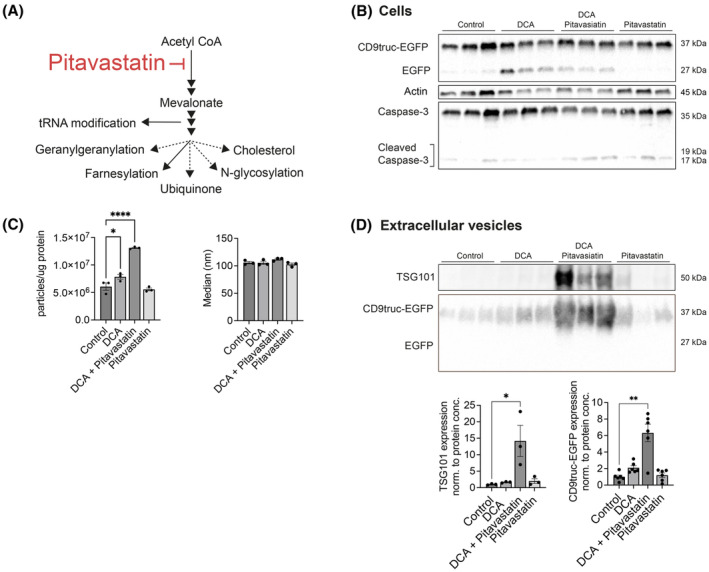
Extracellular vesicle (EV) secretion rate is stimulated by hypoxia that causes increased reactive oxygen species (ROS) production by the mitochondrial electron transport chain (ETC) and hypoxia-induced factor (HIF)-1 signaling; however, their contribution to the increased EV secretion rate is unknown. We found that the EV marker secretion rate in our EV reporter cell line CD9truc-EGFP was unaffected by the HIF-1α stabilizer roxadustat; yet, ETC stimulation by dichloroacetic acid (DCA) significantly increased EV secretion. The DCA-induced EV secretion was blocked by the antioxidant TEMPO and rotenone, an inhibitor of the ETC's Complex I. Under hypoxic conditions, the limited oxygen reduction impedes the ETC's Complex III. To mimic this, we inhibited Complex III with antimycin A, which increased ROS-dependent EV secretion. The electron transport between Complex I and III is accomplished by coenzyme Q created by the mevalonate pathway and tyrosine metabolites. Blocking an early step in the mevalonate pathway using pitavastatin augmented the DCA-induced EV secretion, and 4-nitrobenzoate-an inhibitor of the condensation of the mevalonate pathway with tyrosine metabolites-increased ROS-dependent EV secretion. Our findings indicate that hypoxia-mimetics targeting the ETC modify EV secretion and that ROS produced by the ETC is a potent stimulus for EV secretion.
细胞外囊泡(EV)分泌率受缺氧刺激,缺氧会导致线粒体电子传递链(ETC)产生的活性氧(ROS)增加以及缺氧诱导因子(HIF)-1信号传导;然而,它们对EV分泌率增加的贡献尚不清楚。我们发现,在我们的EV报告细胞系CD9truc-EGFP中,EV标志物分泌率不受HIF-1α稳定剂罗沙司他的影响;然而,二氯乙酸(DCA)对ETC的刺激显著增加了EV分泌。DCA诱导的EV分泌被抗氧化剂TEMPO和鱼藤酮(ETC复合体I的抑制剂)阻断。在缺氧条件下,有限的氧还原会阻碍ETC的复合体III。为了模拟这一点,我们用抗霉素A抑制复合体III,这增加了ROS依赖性的EV分泌。复合体I和III之间的电子传递是由甲羟戊酸途径和酪氨酸代谢产物产生的辅酶Q完成的。使用匹伐他汀阻断甲羟戊酸途径的早期步骤增强了DCA诱导的EV分泌,而4-硝基苯甲酸(甲羟戊酸途径与酪氨酸代谢产物缩合的抑制剂)增加了ROS依赖性的EV分泌。我们的研究结果表明,靶向ETC的缺氧模拟物会改变EV分泌,并且ETC产生的ROS是EV分泌的有效刺激因素。