Department of Chemical Engineering, National Taiwan University of Science and Technology, Taipei, Taiwan.
Health Policy Research Center, Health Institute, Shiraz University of Medica Sciences, Shiraz, Iran.
Sci Rep. 2023 Oct 13;13(1):17326. doi: 10.1038/s41598-023-44135-1.
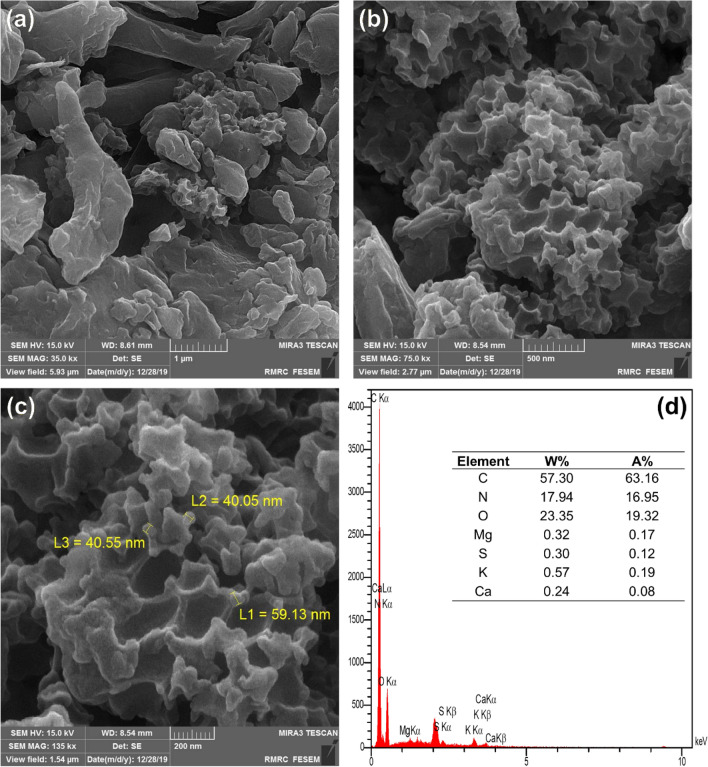
Ganoderma lucidum methanolic extract (GLME) has attracted tremendous attention due to its exceptional antimicrobial and anticancer properties that can be delicately tuned by controlling the initial extraction's content and concentration. Herein, we detailed the characterization, antimicrobial, and cytotoxic performance of GLME as a potential multi-functional therapeutic agent. Accordingly, FTIR, XRD, FESEM, EDX, and HPLC analyses were employed to assess the samples, followed by disc diffusion and microdilution broth methods to test its antibacterial effects against four Gram-positive and Gram-negative bacterial strains, viz., Enterococcus faecalis, Staphylococcus aureus, Escherichia coli, and Pseudomonas aeruginosa. MTT assay was applied to determine the cytotoxic activity of GLME against PDL and Hek-293 normal cell lines and MCF-7 and K-562 cancer cell lines. The IC50 values of 598 µg mL and 291 µg mL were obtained for MCF-7 and K-562 cancer cell lines, which confirmed the stronger anticancer activity of the GLME against blood cancer cells than breast cancer cells. This is while the IC50 of normal Hek-293 cells is 751 µg mL, and the lowest toxicity was observed for normal PDL cells with more than 57% survival at a concentration of 3000 µg mL. The results showed that the antibacterial property of this product against E.coli bacteria was higher than streptomycin, so the zone of inhibition was observed as 44 ± 0.09 mm and 30 ± 0.11 mm, respectively. These data provide valuable insights into the therapeutic usage of GLME for treating breast and blood cancers. This work is motivated by research studies looking for pharmacological products to address chronic and acute diseases, where further resources and studies are required to explore such products' adverse effects and toxicity.
灵芝甲醇提取物(GLME)因其具有出色的抗菌和抗癌特性而备受关注,通过控制初始提取的含量和浓度,可以精细地调节这些特性。在这里,我们详细描述了 GLME 的特性、抗菌和细胞毒性性能,将其作为一种有潜力的多功能治疗剂。相应地,采用傅里叶变换红外光谱(FTIR)、X 射线衍射(XRD)、场发射扫描电子显微镜(FESEM)、能谱(EDX)和高效液相色谱(HPLC)分析来评估样品,随后采用圆盘扩散和微量稀释肉汤法来测试其对四种革兰氏阳性和革兰氏阴性细菌菌株(即粪肠球菌、金黄色葡萄球菌、大肠杆菌和铜绿假单胞菌)的抗菌效果。MTT 测定法用于确定 GLME 对 PDL 和 Hek-293 正常细胞系以及 MCF-7 和 K-562 癌细胞系的细胞毒性活性。对于 MCF-7 和 K-562 癌细胞系,获得了 598 µg mL 和 291 µg mL 的 IC50 值,这证实了 GLME 对血癌细胞的抗癌活性强于乳腺癌细胞。而正常 Hek-293 细胞的 IC50 为 751 µg mL,在浓度为 3000 µg mL 时,正常 PDL 细胞的毒性最低,存活率超过 57%。结果表明,该产品对大肠杆菌的抗菌性能高于链霉素,因此观察到的抑菌圈分别为 44 ± 0.09 mm 和 30 ± 0.11 mm。这些数据为 GLME 治疗乳腺癌和血癌的治疗用途提供了有价值的见解。这项工作的动机是寻找治疗慢性和急性疾病的药理学产品的研究,需要进一步的资源和研究来探索这些产品的不良反应和毒性。