Department of Neurology, The First People's Hospital of Linhai, Taizhou, 317000, Zhejiang Province, China.
Department of Neurology, Affiliated Yueqing Hospital, Wenzhou Medical University, Wenzhou, 325000, Zhejiang Province, China.
Nutr J. 2023 Oct 30;22(1):54. doi: 10.1186/s12937-023-00886-1.
Population-based studies have shown that adequate magnesium intake is associated with a lower risk of stroke and all-cause mortality. Whether adequate magnesium intake is important for reducing all-cause mortality risk after stroke remains unclear.
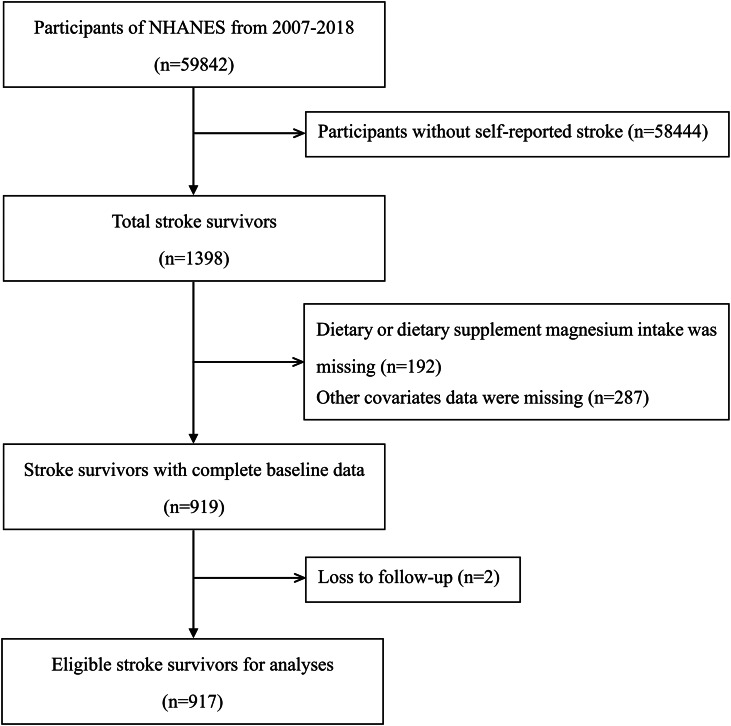
We analyzed data from 917 patients with a self-reported history of stroke from the National Health and Nutrition Examination Survey (NHANES) 2007-2018. The total magnesium intake was calculated by summing the magnesium intake from dietary and dietary supplements, and then adjusting for total energy intake according to the nutrient density method. Mortality status was determined using public-use linked mortality files from 2019. Cox regression model and restricted cubic splines were used to explore the relationship between magnesium intake and all-cause mortality.
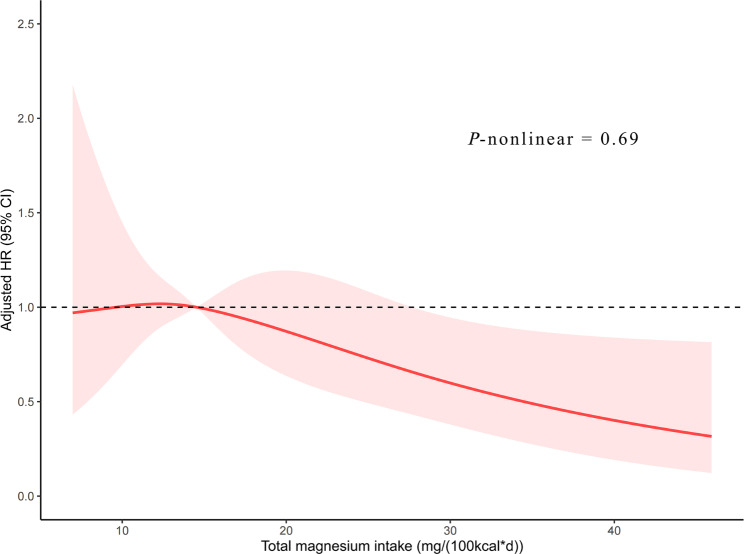
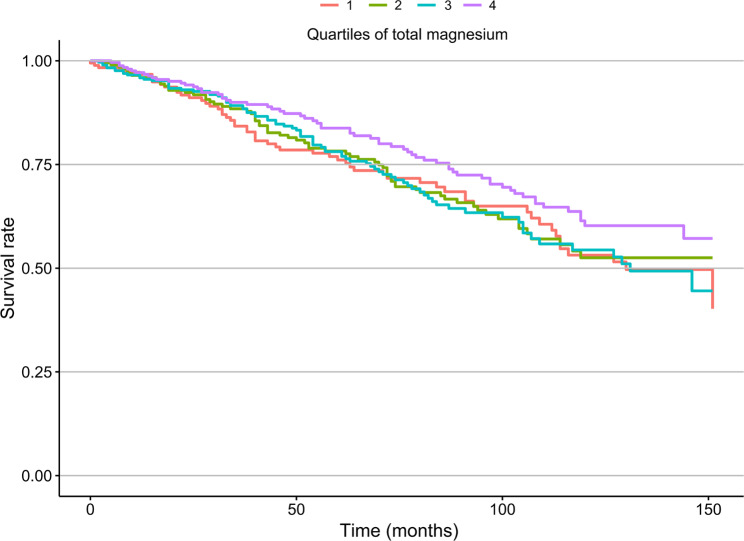
The average total magnesium intake across all patients was 251.0 (184.5-336.5) mg/d, and 321 (70.2%) males and 339 (73.7%) females had insufficient magnesium intake. During a median follow-up period of 5.3 years, 277 deaths occurred. After fully adjusting for confounding factors, total magnesium intake levels were inversely associated with all-cause mortality risk (HR per 1-mg/(100 kcald) increase, 0.97; 95% CI, 0.94-1.00; p = 0.017). Participants with the highest quartile of total magnesium intake (≥ 18.5 mg/(100 kcald)) had a 40% reduction in all-cause mortality risk compared to those with the lowest quartile (≤ 12.0 mg/(100 kcal*d)) (HR, 0.60; 95% CI, 0.38-0.94; p = 0.024). Stratified analyses showed that this inverse association was statistically significant in those who were older, female, without hypertension, and had smoking, normal renal function, and adequate energy intake. Dietary magnesium intake alone might be not related to all-cause mortality.
Stroke survivors who consumed adequate amounts of magnesium from diet and supplements had a lower risk of all-cause mortality.
基于人群的研究表明,摄入足够的镁与降低中风和全因死亡率的风险有关。摄入足够的镁是否对降低中风后全因死亡率风险很重要尚不清楚。
我们分析了来自 2007 年至 2018 年国家健康和营养检查调查(NHANES)的 917 名有中风自述史的患者的数据。总镁摄入量通过将膳食和膳食补充剂中的镁摄入量相加,并根据营养素密度法根据总能量摄入量进行调整来计算。使用 2019 年公共使用链接死亡率文件确定死亡率状况。使用 Cox 回归模型和限制性立方样条来探讨镁摄入量与全因死亡率之间的关系。
所有患者的平均总镁摄入量为 251.0(184.5-336.5)mg/d,321 名(70.2%)男性和 339 名(73.7%)女性镁摄入量不足。在中位随访 5.3 年期间,发生了 277 例死亡。在充分调整混杂因素后,总镁摄入量水平与全因死亡率风险呈负相关(每增加 1 毫克/(100 千卡/天),HR 为 0.97;95%CI,0.94-1.00;p=0.017)。总镁摄入量最高四分位数(≥18.5mg/(100 千卡/天))的参与者全因死亡率风险降低 40%,而总镁摄入量最低四分位数(≤12.0mg/(100 千卡/天))的参与者(HR,0.60;95%CI,0.38-0.94;p=0.024)。分层分析表明,这种负相关在年龄较大、女性、无高血压、吸烟、肾功能正常和能量摄入充足的患者中具有统计学意义。单独的膳食镁摄入量可能与全因死亡率无关。
从饮食和补充剂中摄入足够镁的中风幸存者全因死亡率较低。