Morales-Dorantes Verónica, Domínguez-Pérez Rubén Abraham, Pérez-Serrano Rosa Martha, Solís-Sainz Juan Carlos, García-Solís Pablo, Espinosa-Cristóbal León Francisco, Cabeza-Cabrera Claudia Verónica, Ayala-Herrera José Luis
Laboratory of Multidisciplinary Dentistry Research, Faculty of Medicine, Universidad Autónoma de Querétaro, Santiago de Querétaro 76176, Mexico.
Laboratorio de Genética y Biología Molecular, Faculty of Medicine, Universidad Autónoma de Querétaro, Santiago de Querétaro 76176, Mexico.
Trop Med Infect Dis. 2023 Nov 16;8(11):499. doi: 10.3390/tropicalmed8110499.
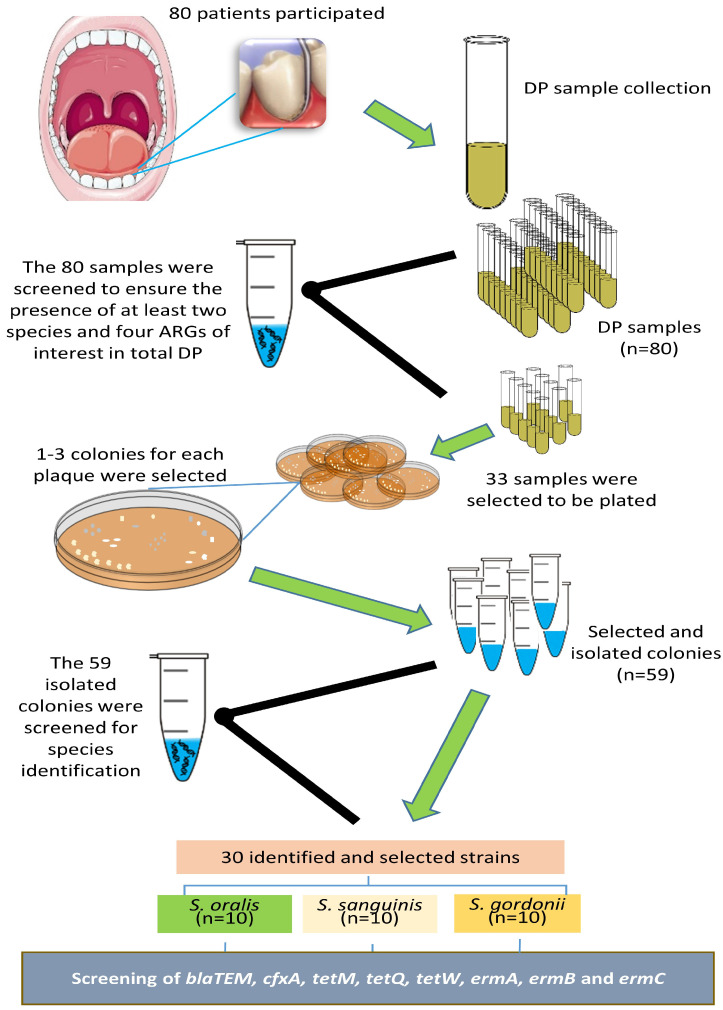
It has been proposed that oral commensal bacteria are potential reservoirs of a wide variety of antimicrobial resistance genes (ARGs) and could be the source of pathogenic bacteria; however, there is scarce information regarding this. In this study, three common streptococci of the mitis group (, , and ) isolated from dental plaque (DP) were screened to identify if they were frequent reservoirs of specific ARGs (, , , , , , , and ). DP samples were collected from 80 adults; one part of the sample was cultured, and from the other part DNA was obtained for first screening of the three streptococci species and the ARGs of interest. Selected samples were plated and colonies were selected for molecular identification. Thirty identified species were screened for the presence of the ARGs. From those selected, all of the and carried at least three, while only 30% of strains carried three or more. The most prevalent were in 73%, and and both in 66.6%. On the other hand, and were not present. Oral streptococci from the mitis group could be considered frequent reservoirs of specifically , , and . In contrast, these three species appear not to be reservoirs of and .
有人提出,口腔共生细菌是多种抗菌抗性基因(ARGs)的潜在储存库,可能是病原菌的来源;然而,关于这方面的信息却很匮乏。在本研究中,对从牙菌斑(DP)中分离出的轻链菌属的三种常见链球菌(、和)进行筛选,以确定它们是否是特定ARGs(、、、、、、和)的常见储存库。从80名成年人中收集DP样本;一部分样本进行培养,另一部分提取DNA,用于初步筛选这三种链球菌物种和感兴趣的ARGs。将选定的样本进行平板接种,并挑选菌落进行分子鉴定。对30种已鉴定的物种进行ARGs存在情况的筛选。在所选样本中,所有的和至少携带三种,而只有30%的菌株携带三种或更多。最普遍的是在73%的样本中存在,和在66.6%的样本中都存在。另一方面,和不存在。轻链菌属的口腔链球菌可被视为、和的常见储存库。相比之下,这三个物种似乎不是和的储存库。