Department of Medicine, School of Medicine and Public Health, University of Wisconsin, Madison, WI, USA.
University of Wisconsin Carbone Cancer Center, 1111 Highland Ave, WIMR 4137, Madison, WI, USA.
Stem Cell Res Ther. 2024 Mar 13;15(1):72. doi: 10.1186/s13287-024-03688-2.
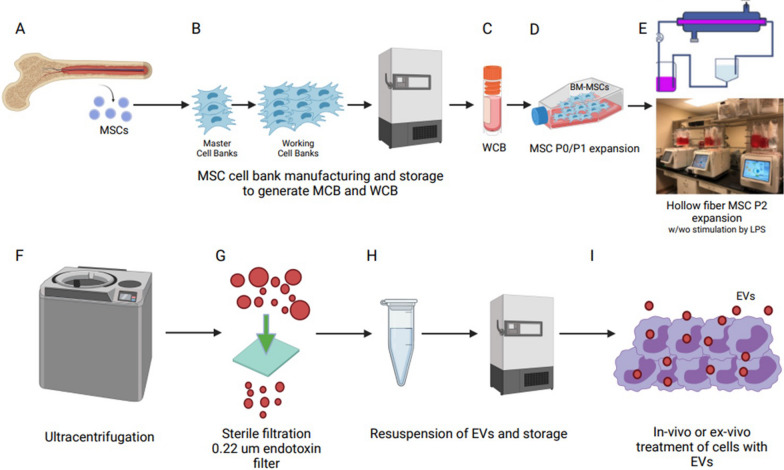
Hematopoietic acute radiation syndrome (H-ARS) occurring after exposure to ionizing radiation damages bone marrow causing cytopenias, increasing susceptibility to infections and death. We and others have shown that cellular therapies like human mesenchymal stromal cells (MSCs), or monocytes/macrophages educated ex-vivo with extracellular vesicles (EVs) from MSCs were effective in a lethal H-ARS mouse model. However, given the complexity of generating cellular therapies and the potential risks of using allogeneic products, development of an "off-the-shelf" cell-free alternative like EVs may have utility in conditions like H-ARS that require rapid deployment of available therapeutics. The purpose of this study was to determine the feasibility of producing MSC-derived EVs at large scale using a bioreactor and assess critical quality control attributes like identity, sterility, and potency in educating monocytes and promoting survival in a lethal H-ARS mouse model.
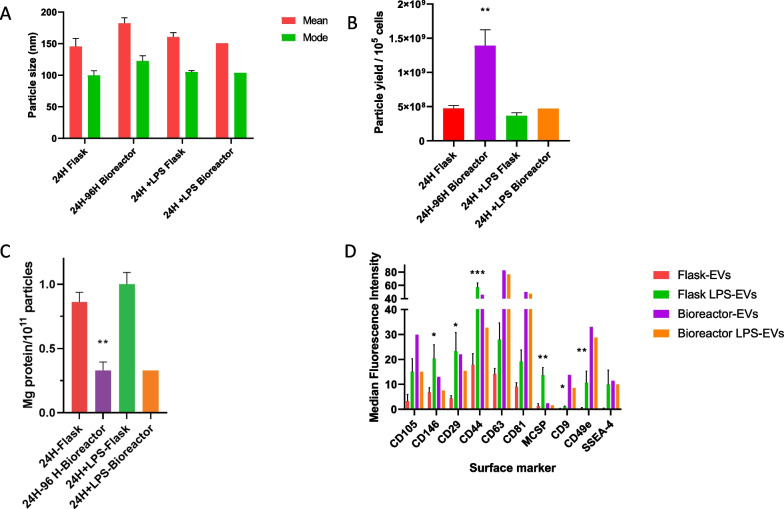
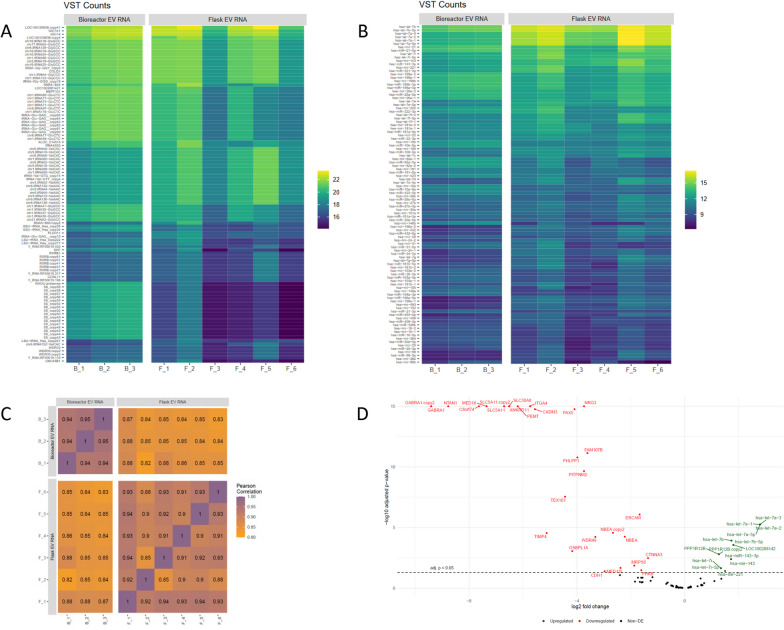
EVs were isolated by ultracentrifugation from unprimed and lipopolysaccharide (LPS)-primed MSCs grown at large scale using a hollow fiber bioreactor and compared to a small scale system using flasks. The physical identity of EVs included a time course assessment of particle diameter, yield, protein content and surface marker profile by flow-cytometry. Comparison of the RNA cargo in EVs was determined by RNA-seq. Capacity of EVs to generate exosome educated monocytes (EEMos) was determined by qPCR and flow cytometry, and potency was assessed in vivo using a lethal ARS model with NSG mice.
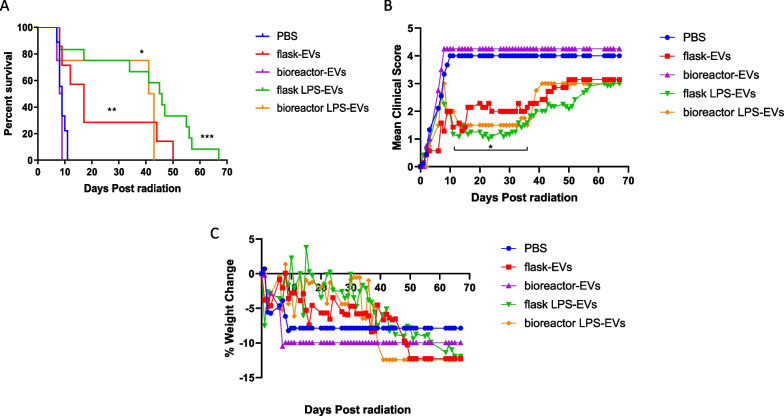
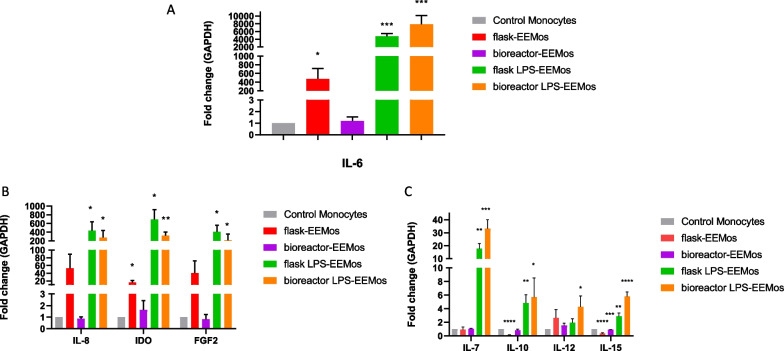
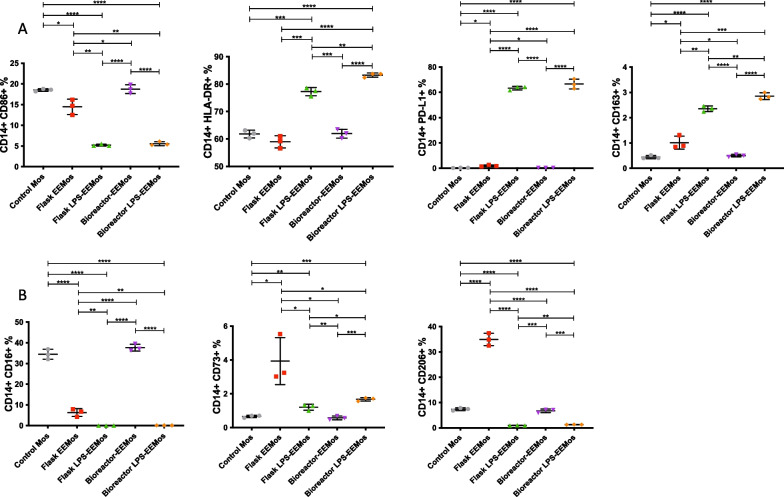
Physical identity of EVs at both scales were similar but yields by volume were up to 38-fold more using a large-scale bioreactor system. RNA-seq indicated that flask EVs showed upregulated let-7 family and miR-143 micro-RNAs. EEMos educated with LPS-EVs at each scale were similar, showing increased gene expression of IL-6, IDO, FGF-2, IL-7, IL-10, and IL-15 and immunophenotyping consistent with a PD-L1 , CD16 , and CD86 cell surface expression. Treatment with LPS-EVs manufactured at both scales were effective in the ARS model, improving survival and clinical scores through improved hematopoietic recovery. EVs from unprimed MSCs were less effective than LPS-EVs, with flask EVs providing some improved survival while bioreactor EVs provide no survival benefit.
LPS-EVs as an effective treatment for H-ARS can be produced using a scale-up development manufacturing process, representing an attractive off-the-shelf, cell-free therapy.
电离辐射暴露后发生的造血急性辐射综合征(H-ARS)会损害骨髓,导致细胞减少症,增加感染和死亡的易感性。我们和其他人已经表明,细胞疗法,如人基质细胞(MSCs)或通过 MSC 来源的细胞外囊泡(EVs)体外教育的单核细胞/巨噬细胞,在致死性 H-ARS 小鼠模型中是有效的。然而,鉴于细胞疗法的复杂性和使用同种异体产品的潜在风险,开发一种类似于 EVs 的“现成的”无细胞替代物可能在需要快速部署现有治疗方法的 H-ARS 等情况下具有实用性。本研究的目的是使用生物反应器大规模生产 MSC 衍生的 EVs,并评估其关键质量控制属性,如身份、无菌性和效力,以教育单核细胞并促进致死性 H-ARS 小鼠模型中的存活。
通过超速离心从未预刺激和脂多糖(LPS)预刺激的 MSC 中分离 EVs,这些 MSC 是在使用中空纤维生物反应器的大规模培养和使用培养瓶的小规模系统中生长的,并进行比较。EVs 的物理特征包括通过流式细胞术评估粒径、产量、蛋白质含量和表面标志物谱的时间过程。通过 RNA-seq 确定 EVs 的 RNA 货物。通过 qPCR 和流式细胞术确定 EVs 生成外泌体教育单核细胞(EEMos)的能力,并在 NSG 小鼠的致死性 ARS 模型中评估效力。
两种规模的 EVs 的物理特征相似,但使用大规模生物反应器系统的产量高达 38 倍。RNA-seq 表明,培养瓶 EVs 显示上调的 let-7 家族和 miR-143 微 RNA。在每个规模上用 LPS-EVs 教育的 EEMos 相似,表现出更高的 IL-6、IDO、FGF-2、IL-7、IL-10 和 IL-15 基因表达,免疫表型与 PD-L1、CD16 和 CD86 细胞表面表达一致。两种规模制造的 LPS-EVs 在 ARS 模型中均有效,通过改善造血恢复提高存活率和临床评分。未刺激 MSC 的 EVs 不如 LPS-EVs 有效,培养瓶 EVs 提供了一些改善的存活率,而生物反应器 EVs 则没有提供生存获益。
LPS-EVs 作为治疗 H-ARS 的有效治疗方法,可以使用扩大开发制造工艺生产,代表一种有吸引力的现成的、无细胞治疗方法。