Division of Obstetrics and Gynecology, Department of Clinical Science, Intervention and Technology, Karolinska Institutet, Stockholm, Sweden.
Biomolecular Medicine, Clinical Research Center, Department of Laboratory Medicine, Karolinska Institutet, Stockholm, Sweden.
Stem Cell Res Ther. 2024 Mar 13;15(1):77. doi: 10.1186/s13287-024-03683-7.
Mesenchymal stem/stromal cells (MSCs) can regenerate tissues through engraftment and differentiation but also via paracrine signalling via extracellular vesicles (EVs). Fetal-derived MSCs (fMSCs) have been shown, both in vitro and in animal studies, to be more efficient than adult MSC (aMSCs) in generating bone and muscle but the underlying reason for this difference has not yet been clearly elucidated. In this study, we aimed to systematically investigate the differences between fetal and adult MSCs and MSC-derived EVs at the phenotypic, RNA, and protein levels.
We carried out a detailed and comparative characterization of culture-expanded fetal liver derived MSCs (fMSCs) and adult bone marrow derived MSCs (aMSCs) phenotypically, and the MSCs and MSC-derived EVs were analysed using transcriptomics and proteomics approaches with RNA Sequencing and Mass Spectrometry.
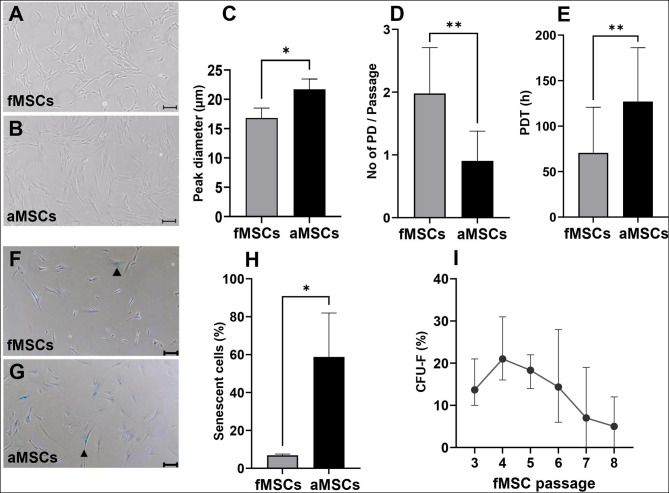
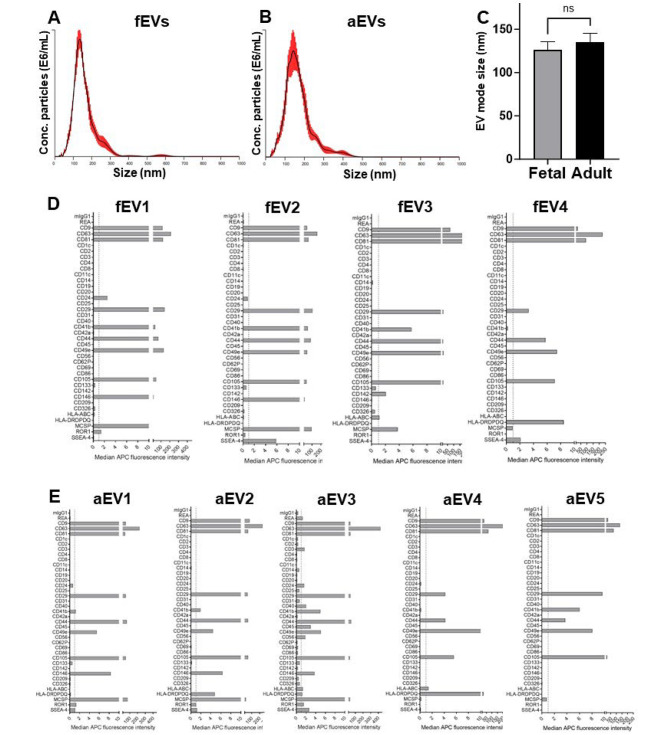
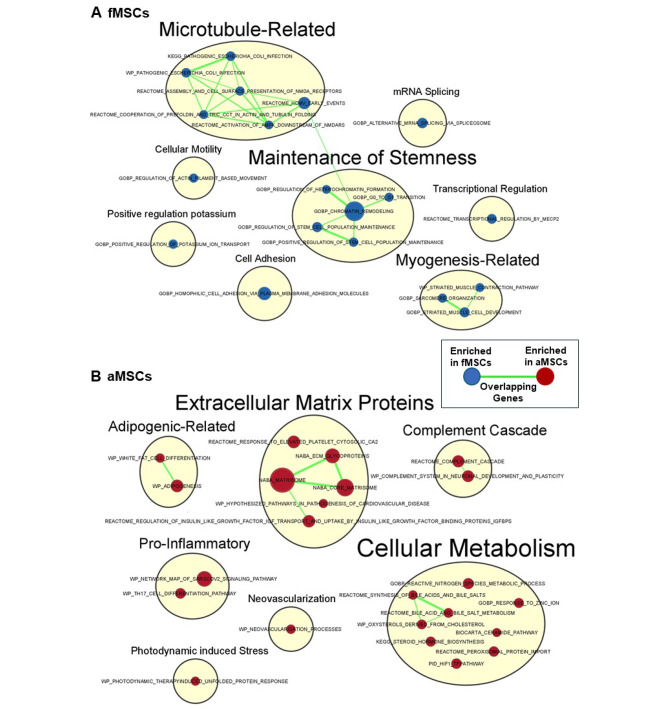
Fetal MSCs were smaller, exhibited increased proliferation and colony-forming capacity, delayed onset of senescence, and demonstrated superior osteoblast differentiation capability compared to their adult counterparts. Gene Ontology analysis revealed that fMSCs displayed upregulated gene sets such as "Positive regulation of stem cell populations", "Maintenance of stemness" and "Muscle cell development/contraction/Myogenesis" in comparison to aMSCs. Conversely, aMSCs displayed upregulated gene sets such as "Complement cascade", "Adipogenesis", "Extracellular matrix glycoproteins" and "Cellular metabolism", and on the protein level, "Epithelial cell differentiation" pathways. Signalling entropy analysis suggested that fMSCs exhibit higher signalling promiscuity and hence, higher potency than aMSCs. Gene ontology comparisons revealed that fetal MSC-derived EVs (fEVs) were enriched for "Collagen fibril organization", "Protein folding", and "Response to transforming growth factor beta" compared to adult MSC-derived EVs (aEVs), whereas no significant difference in protein expression in aEVs compared to fEVs could be detected.
This study provides detailed and systematic insight into the differences between fMSCs and aMSCs, and MSC-derived EVs. The key finding across phenotypic, transcriptomic and proteomic levels is that fMSCs exhibit higher potency than aMSCs, meaning they are in a more undifferentiated state. Additionally, fMSCs and fMSC-derived EVs may possess greater bone forming capacity compared to aMSCs. Therefore, using fMSCs may lead to better treatment efficacy, especially in musculoskeletal diseases.
间充质干细胞(MSCs)可以通过植入和分化来再生组织,但也可以通过细胞外囊泡(EVs)的旁分泌信号传递来实现。与成体 MSC(aMSCs)相比,胎源 MSCs(fMSCs)在体外和动物研究中都显示出更有效地生成骨骼和肌肉的能力,但这种差异的根本原因尚未得到明确阐明。在这项研究中,我们旨在系统地研究胎儿和成人 MSCs 以及 MSC 衍生的 EVs 在表型、RNA 和蛋白质水平上的差异。
我们对培养的胎肝来源 MSCs(fMSCs)和成人骨髓来源 MSCs(aMSCs)进行了详细的比较表型特征描述,并通过 RNA 测序和质谱分析进行了 MSC 和 MSC 衍生的 EVs 的转录组学和蛋白质组学分析。
与成人 MSC 相比,胎源 MSCs 体积较小,增殖和集落形成能力增强,衰老起始延迟,成骨细胞分化能力更强。GO 分析显示,与 aMSCs 相比,fMSCs 上调了“干细胞群体的正调控”、“维持干细胞特性”和“肌肉细胞发育/收缩/成肌”等基因集。相反,aMSCs 上调了“补体级联”、“脂肪生成”、“细胞外基质糖蛋白”和“细胞代谢”等基因集,并且在蛋白质水平上,“上皮细胞分化”途径。信号熵分析表明,fMSCs 表现出更高的信号混杂性,因此比 aMSCs 具有更高的效力。GO 比较显示,与 aMSC 衍生的 EVs(aEVs)相比,胎源 MSC 衍生的 EVs(fEVs)富含“胶原纤维组织”、“蛋白质折叠”和“对转化生长因子-β的反应”,而 aEVs 与 fEVs 之间的蛋白质表达没有显著差异。
本研究提供了 fMSCs 和 aMSCs 以及 MSC 衍生的 EVs 之间差异的详细和系统的见解。表型、转录组学和蛋白质组学水平的关键发现是,fMSCs 比 aMSCs 具有更高的效力,这意味着它们处于更未分化的状态。此外,fMSCs 和 fMSC 衍生的 EVs 可能比 aMSCs 具有更大的成骨能力。因此,使用 fMSCs 可能会带来更好的治疗效果,特别是在肌肉骨骼疾病中。