Rosati Diletta, Palmieri Maria, Brunelli Giulia, Morrione Andrea, Iannelli Francesco, Frullanti Elisa, Giordano Antonio
Department of Medical Biotechnologies, University of Siena, 53100 Siena, Italy.
Cancer Genomics & Systems Biology Lab, Dept. of Medical Biotechnologies, University of Siena, 53100 Siena, Italy.
Comput Struct Biotechnol J. 2024 Mar 1;23:1154-1168. doi: 10.1016/j.csbj.2024.02.018. eCollection 2024 Dec.
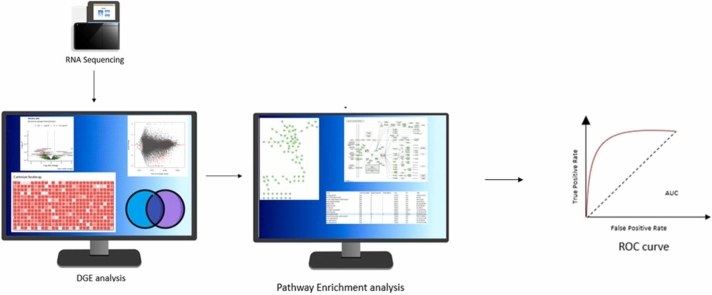
In recent years, the role of bioinformatics and computational biology together with omics techniques and transcriptomics has gained tremendous importance in biomedicine and healthcare, particularly for the identification of biomarkers for precision medicine and drug discovery. Differential gene expression (DGE) analysis is one of the most used techniques for RNA-sequencing (RNA-seq) data analysis. This tool, which is typically used in various RNA-seq data processing applications, allows the identification of differentially expressed genes across two or more sample sets. Functional enrichment analyses can then be performed to annotate and contextualize the resulting gene lists. These studies provide valuable information about disease-causing biological processes and can help in identifying molecular targets for novel therapies. This review focuses on differential gene expression (DGE) analysis pipelines and bioinformatic techniques commonly used to identify specific biomarkers and discuss the advantages and disadvantages of these techniques.
近年来,生物信息学和计算生物学与组学技术及转录组学相结合,在生物医学和医疗保健领域发挥了极其重要的作用,特别是在识别精准医学和药物研发的生物标志物方面。差异基因表达(DGE)分析是RNA测序(RNA-seq)数据分析中最常用的技术之一。该工具通常用于各种RNA-seq数据处理应用,可识别两个或多个样本集之间差异表达的基因。然后可以进行功能富集分析,以注释和关联所得的基因列表。这些研究提供了有关致病生物学过程的宝贵信息,并有助于识别新疗法的分子靶点。本综述重点关注用于识别特定生物标志物的差异基因表达(DGE)分析流程和生物信息学技术,并讨论这些技术的优缺点。