
医疗保健获取障碍和污名化体验:一项共同开展的长新冠病例发现研究的结果。
Barriers to healthcare access and experiences of stigma: Findings from a coproduced Long Covid case-finding study.
机构信息
School of Primary Care, Population Sciences and Medical Education, University of Southampton, Southampton, UK.
Institute of Health Informatics, University College London, London, UK.
出版信息
Health Expect. 2024 Apr;27(2):e14037. doi: 10.1111/hex.14037.
BACKGROUND AND AIM
Long Covid is often stigmatised, particularly in people who are disadvantaged within society. This may prevent them from seeking help and could lead to widening health inequalities. This coproduced study with a Community Advisory Board (CAB) of people with Long Covid aimed to understand healthcare and wider barriers and stigma experienced by people with probable Long Covid.
METHODS
An active case finding approach was employed to find adults with probable, but not yet clinically diagnosed, Long Covid in two localities in London (Camden and Merton) and Derbyshire, England. Interviews explored the barriers to care and the stigma faced by participants and were analysed thematically. This study forms part of the STIMULATE-ICP Collaboration.
FINDINGS
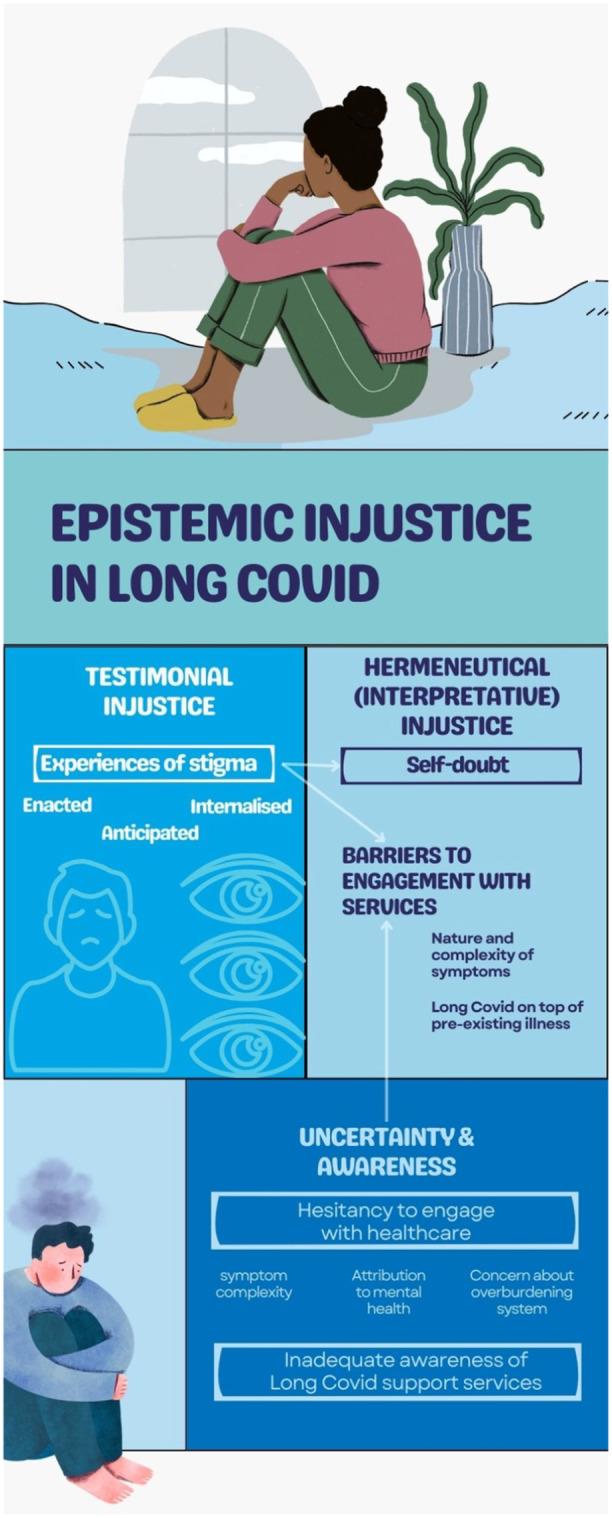
Twenty-three interviews were completed. Participants reported limited awareness of what Long Covid is and the available pathways to management. There was considerable self-doubt among participants, sometimes reinforced by interactions with healthcare professionals (HCPs). Participants questioned their deservedness in seeking healthcare support for their symptoms. Hesitancy to engage with healthcare services was motivated by fear of needing more investigation and concerns regarding judgement about the ability to carry out caregiving responsibilities. It was also motivated by the complexity of the clinical presentation and fear of all symptoms being attributed to poor mental health. Participants also reported trying to avoid overburdening the health system. These difficulties were compounded by experiences of stigma and discrimination. The emerging themes reaffirmed a framework of epistemic injustice in relation to Long Covid, where creating, interpreting and conveying knowledge has varied credibility based on the teller's identity characteristics and/or the level of their interpretive resources.
CONCLUSION
We have codeveloped recommendations based on the findings. These include early signposting to services, dedicating protected time to listening to people with Long Covid, providing a holistic approach in care pathways, and working to mitigate stigma. Regardless of the diagnosis, people experiencing new symptoms must be encouraged to seek timely medical help. Clear public health messaging is needed among communities already disadvantaged by epistemic injustice to raise awareness of Long Covid, and to share stories that encourage seeking care and to illustrate the adverse effects of stigma.
PATIENT OR PUBLIC CONTRIBUTION
This study was coproduced with a CAB made up of 23 members including HCPs, people with lived experience of Long Covid and other stakeholders.
背景和目的
长新冠常被污名化,尤其是在社会中处于不利地位的人群。这可能会阻止他们寻求帮助,并导致健康不平等加剧。本研究与一个由长新冠患者组成的社区咨询委员会(CAB)合作,旨在了解患有长新冠的患者所经历的医疗保健和更广泛的障碍和污名。
方法
采用主动病例发现方法,在英格兰伦敦的卡姆登和默顿以及德比郡两个地方寻找患有可能但尚未临床诊断的长新冠的成年人。访谈探讨了参与者面临的护理障碍和污名,并进行了主题分析。本研究是 STIMULATE-ICP 合作的一部分。
结果
完成了 23 次访谈。参与者报告说,他们对长新冠是什么以及可用的管理途径知之甚少。参与者之间存在相当大的自我怀疑,有时会受到与医疗保健专业人员(HCPs)的互动的强化。参与者质疑自己是否有资格因症状寻求医疗支持。他们对接受更多调查的恐惧以及对履行护理责任能力的担忧,促使他们对参与医疗服务犹豫不决。这也受到临床表现的复杂性以及担心所有症状都归因于心理健康不佳的影响。参与者还报告说,他们试图避免给医疗系统带来过重负担。这些困难因污名化和歧视的经历而更加复杂。出现的主题重申了与长新冠相关的认识不公正框架,即根据讲述者的身份特征和/或他们的解释资源,创造、解释和传达知识的可信度各不相同。
结论
我们根据研究结果制定了建议。这些建议包括向服务机构早期转介、专门留出时间倾听长新冠患者的意见、在护理途径中提供整体方法,以及努力减轻污名化。无论诊断如何,必须鼓励出现新症状的人及时寻求医疗帮助。需要在已经受到认识不公正影响的社区中开展明确的公共卫生宣传,提高对长新冠的认识,并分享鼓励寻求护理的故事,说明污名化的不良影响。
患者或公众贡献
这项研究是与一个由 23 名成员组成的 CAB 共同完成的,成员包括医疗保健专业人员、有长新冠经历的患者和其他利益相关者。


 Zotero 插件