Department of Ophthalmology, Guangdong Eye Institute, Guangdong Provincial People's Hospital (Guangdong Academy of Medical Sciences), Southern Medical University.
Centre for Eye Research Australia, Royal Victorian Eye and Ear Hospital, East Melbourne, VIC, Australia.
Int J Surg. 2024 Apr 1;110(4):2300-2312. doi: 10.1097/JS9.0000000000001105.
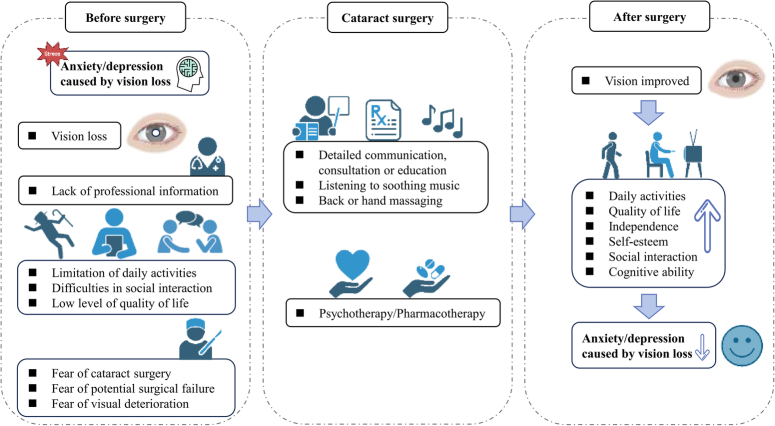
Although cataract surgery has been proposed as a potentially modifiable protective factor for enhancing emotional well-being in cataract patients, studies examining the relationship between anxiety or depression and cataract surgery have yielded inconsistent findings. This review summarizes existing evidence to establish whether cataract surgery is associated with depression and anxiety in older adults.
A literature search was conducted across PubMed, Medline, Web of Science, and Embase databases. An initial screening by abstracts and titles was performed, followed by a review and assessment of the methodological quality of the relevant full papers, and final inclusion of 44 studies were deemed eligible for inclusion in this review.
Among 44 included studies, 36 studies (81.8%) were observational studies concerning the association of cataract surgery or cataracts with anxiety or depression, four studies (9.1%) were interventional studies, and four studies (9.1%) were reviews. Cataract surgery notably enhances the mental health of individuals with impaired vision. However, the multifaceted nature of psychological well-being, influenced by various factors, suggests that cataract surgery may not address all aspects comprehensively. Additionally, preoperative anxiety and depression significantly impact cataract surgery outcomes.
Vision impairment in older adults is closely associated with increased symptoms of depression and anxiety. While surgical intervention for cataracts improves these symptoms, it might be less effective for mental disorders with multifactorial causes. Notably, anxiety or depression poses challenges to successful preoperative and intraoperative cataract surgeries.
尽管白内障手术被认为是一种潜在的可改变的保护因素,可以增强白内障患者的情绪幸福感,但研究焦虑或抑郁与白内障手术之间的关系的结果并不一致。本综述总结了现有证据,以确定白内障手术是否与老年人的抑郁和焦虑有关。
对 PubMed、Medline、Web of Science 和 Embase 数据库进行了文献检索。首先对摘要和标题进行了初步筛选,然后对相关全文的方法学质量进行了审查和评估,最终有 44 项研究被认为符合纳入本综述的标准。
在纳入的 44 项研究中,36 项(81.8%)为观察性研究,涉及白内障手术或白内障与焦虑或抑郁的关系,4 项(9.1%)为干预性研究,4 项(9.1%)为综述。白内障手术显著改善了视力受损个体的心理健康。然而,心理健康的多面性受多种因素影响,这表明白内障手术可能无法全面解决所有问题。此外,术前焦虑和抑郁显著影响白内障手术的结果。
老年人视力受损与抑郁和焦虑症状的增加密切相关。虽然白内障手术可以改善这些症状,但对于具有多因素病因的精神障碍,其效果可能较差。值得注意的是,焦虑或抑郁对白内障手术的术前和术中成功构成挑战。