• 文献检索
  • 文档翻译
  • 深度研究
  • 学术资讯
  • Suppr Zotero 插件Zotero 插件
  • 邀请有礼
  • 套餐&价格
  • 历史记录
应用&插件
Suppr Zotero 插件Zotero 插件浏览器插件Mac 客户端Windows 客户端微信小程序
定价
高级版会员购买积分包购买API积分包
服务
文献检索文档翻译深度研究API 文档MCP 服务
关于我们
关于 Suppr公司介绍联系我们用户协议隐私条款
关注我们

Suppr 超能文献

核心技术专利:CN118964589B侵权必究
粤ICP备2023148730 号-1Suppr @ 2026

文献检索

告别复杂PubMed语法,用中文像聊天一样搜索,搜遍4000万医学文献。AI智能推荐,让科研检索更轻松。

立即免费搜索

文件翻译

保留排版,准确专业,支持PDF/Word/PPT等文件格式,支持 12+语言互译。

免费翻译文档

深度研究

AI帮你快速写综述,25分钟生成高质量综述,智能提取关键信息,辅助科研写作。

立即免费体验

用于胸部 X 射线图像中呼吸疾病检测和严重程度评估的多阶段框架。

A multistage framework for respiratory disease detection and assessing severity in chest X-ray images.

机构信息

Department of Computer Science & Engineering, Indian Institute of Technology Patna, Patna, 801106, India.

Maharaja Surajmal Institute of Technology, Delhi, India.

出版信息

Sci Rep. 2024 May 29;14(1):12380. doi: 10.1038/s41598-024-60861-6.

DOI:10.1038/s41598-024-60861-6
PMID:38811599
原文链接:https://pmc.ncbi.nlm.nih.gov/articles/PMC11137152/
Abstract

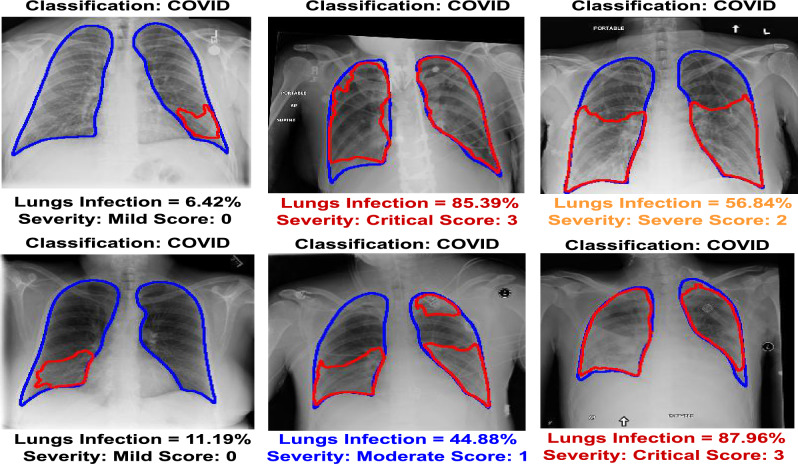
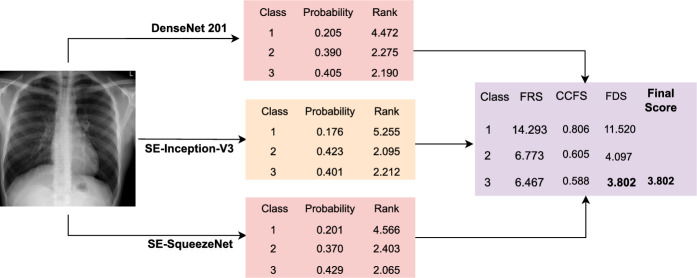
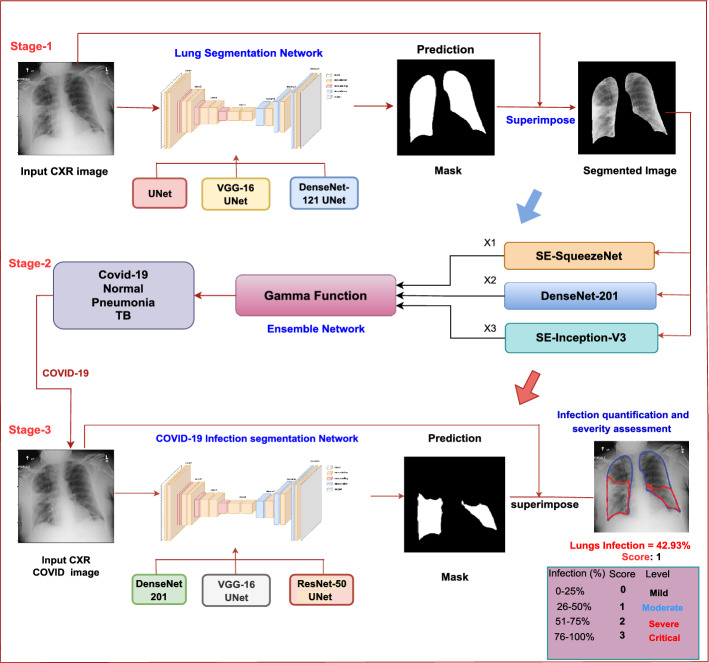
Chest Radiography is a non-invasive imaging modality for diagnosing and managing chronic lung disorders, encompassing conditions such as pneumonia, tuberculosis, and COVID-19. While it is crucial for disease localization and severity assessment, existing computer-aided diagnosis (CAD) systems primarily focus on classification tasks, often overlooking these aspects. Additionally, prevalent approaches rely on class activation or saliency maps, providing only a rough localization. This research endeavors to address these limitations by proposing a comprehensive multi-stage framework. Initially, the framework identifies relevant lung areas by filtering out extraneous regions. Subsequently, an advanced fuzzy-based ensemble approach is employed to categorize images into specific classes. In the final stage, the framework identifies infected areas and quantifies the extent of infection in COVID-19 cases, assigning severity scores ranging from 0 to 3 based on the infection's severity. Specifically, COVID-19 images are classified into distinct severity levels, such as mild, moderate, severe, and critical, determined by the modified RALE scoring system. The study utilizes publicly available datasets, surpassing previous state-of-the-art works. Incorporating lung segmentation into the proposed ensemble-based classification approach enhances the overall classification process. This solution can be a valuable alternative for clinicians and radiologists, serving as a secondary reader for chest X-rays, reducing reporting turnaround times, aiding clinical decision-making, and alleviating the workload on hospital staff.

摘要

胸部 X 光摄影是一种用于诊断和管理慢性肺部疾病的非侵入性成像方式,涵盖了肺炎、肺结核和 COVID-19 等疾病。虽然它对于疾病定位和严重程度评估至关重要,但现有的计算机辅助诊断 (CAD) 系统主要侧重于分类任务,往往忽略了这些方面。此外,流行的方法依赖于类激活或显着性映射,仅提供大致的定位。本研究通过提出一个全面的多阶段框架来解决这些限制。首先,该框架通过过滤掉无关区域来识别相关的肺部区域。然后,采用先进的基于模糊的集成方法将图像分类为特定的类别。在最后阶段,该框架识别感染区域,并量化 COVID-19 病例中的感染程度,根据感染的严重程度分配 0 到 3 的严重程度评分。具体来说,COVID-19 图像根据改良的 RALE 评分系统分为不同的严重程度级别,如轻度、中度、重度和危重度。该研究利用了公开可用的数据集,超过了以前的最先进的工作。将肺部分割纳入基于集成的分类方法中,增强了整体分类过程。该解决方案可以为临床医生和放射科医生提供有价值的替代方案,作为胸部 X 光的辅助读者,减少报告周转时间,辅助临床决策,并减轻医院工作人员的工作量。
https://cdn.ncbi.nlm.nih.gov/pmc/blobs/a2b9/11137152/0b7495fab428/41598_2024_60861_Fig3_HTML.jpg
https://cdn.ncbi.nlm.nih.gov/pmc/blobs/a2b9/11137152/e34a5d2a8389/41598_2024_60861_Fig1_HTML.jpg
https://cdn.ncbi.nlm.nih.gov/pmc/blobs/a2b9/11137152/f76076d612f7/41598_2024_60861_Fig2_HTML.jpg
https://cdn.ncbi.nlm.nih.gov/pmc/blobs/a2b9/11137152/0b7495fab428/41598_2024_60861_Fig3_HTML.jpg
https://cdn.ncbi.nlm.nih.gov/pmc/blobs/a2b9/11137152/e34a5d2a8389/41598_2024_60861_Fig1_HTML.jpg
https://cdn.ncbi.nlm.nih.gov/pmc/blobs/a2b9/11137152/f76076d612f7/41598_2024_60861_Fig2_HTML.jpg
https://cdn.ncbi.nlm.nih.gov/pmc/blobs/a2b9/11137152/0b7495fab428/41598_2024_60861_Fig3_HTML.jpg

相似文献

1
A multistage framework for respiratory disease detection and assessing severity in chest X-ray images.用于胸部 X 射线图像中呼吸疾病检测和严重程度评估的多阶段框架。
Sci Rep. 2024 May 29;14(1):12380. doi: 10.1038/s41598-024-60861-6.
2
Disease Localization and Severity Assessment in Chest X-Ray Images using Multi-Stage Superpixels Classification.基于多阶段超像素分类的胸部 X 光图像疾病定位和严重程度评估。
Comput Methods Programs Biomed. 2022 Jul;222:106947. doi: 10.1016/j.cmpb.2022.106947. Epub 2022 Jun 9.
3
Improving the performance of CNN to predict the likelihood of COVID-19 using chest X-ray images with preprocessing algorithms.利用预处理算法提高卷积神经网络预测胸部 X 光图像中 COVID-19 可能性的性能。
Int J Med Inform. 2020 Dec;144:104284. doi: 10.1016/j.ijmedinf.2020.104284. Epub 2020 Sep 23.
4
COVID-19 severity detection using chest X-ray segmentation and deep learning.使用胸部 X 光分割和深度学习检测 COVID-19 严重程度。
Sci Rep. 2024 Aug 27;14(1):19846. doi: 10.1038/s41598-024-70801-z.
5
Pneumonia detection in chest X-ray images using an ensemble of deep learning models.使用深度学习模型集成进行胸部 X 射线图像中的肺炎检测。
PLoS One. 2021 Sep 7;16(9):e0256630. doi: 10.1371/journal.pone.0256630. eCollection 2021.
6
A review on lung boundary detection in chest X-rays.胸部 X 光片中肺边界检测的综述。
Int J Comput Assist Radiol Surg. 2019 Apr;14(4):563-576. doi: 10.1007/s11548-019-01917-1. Epub 2019 Feb 7.
7
Chest X-ray image phase features for improved diagnosis of COVID-19 using convolutional neural network.基于卷积神经网络的胸部 X 射线图像相位特征提高 COVID-19 诊断性能
Int J Comput Assist Radiol Surg. 2021 Feb;16(2):197-206. doi: 10.1007/s11548-020-02305-w. Epub 2021 Jan 9.
8
[Spatial and temporal distribution and predictive value of chest CT scoring in patients with COVID-19].新型冠状病毒肺炎患者胸部CT评分的时空分布及预测价值
Zhonghua Jie He He Hu Xi Za Zhi. 2021 Mar 12;44(3):230-236. doi: 10.3760/cma.j.cn112147-20200522-00626.
9
Covid-MANet: Multi-task attention network for explainable diagnosis and severity assessment of COVID-19 from CXR images.新冠疫情肺部X光影像可解释诊断与严重程度评估的多任务注意力网络(Covid-MANet)
Pattern Recognit. 2022 Nov;131:108826. doi: 10.1016/j.patcog.2022.108826. Epub 2022 Jun 6.
10
COVID-19 identification in chest X-ray images on flat and hierarchical classification scenarios.基于平面和分层分类场景的胸部 X 射线图像中的 COVID-19 识别。
Comput Methods Programs Biomed. 2020 Oct;194:105532. doi: 10.1016/j.cmpb.2020.105532. Epub 2020 May 8.

本文引用的文献

1
Ensemble learning for multi-class COVID-19 detection from big data.基于大数据的多类别 COVID-19 检测的集成学习。
PLoS One. 2023 Oct 11;18(10):e0292587. doi: 10.1371/journal.pone.0292587. eCollection 2023.
2
Development and validation of a hybrid deep learning-machine learning approach for severity assessment of COVID-19 and other pneumonias.开发和验证一种混合深度学习-机器学习方法,用于评估 COVID-19 和其他肺炎的严重程度。
Sci Rep. 2023 Aug 17;13(1):13420. doi: 10.1038/s41598-023-40506-w.
3
Coronavirus covid-19 detection by means of explainable deep learning.
利用可解释深度学习进行冠状病毒 covid-19 检测。
Sci Rep. 2023 Jan 10;13(1):462. doi: 10.1038/s41598-023-27697-y.
4
CovidConvLSTM: A fuzzy ensemble model for COVID-19 detection from chest X-rays.新冠卷积长短期记忆网络(CovidConvLSTM):一种用于从胸部X光片中检测新冠肺炎的模糊集成模型。
Expert Syst Appl. 2022 Nov 15;206:117812. doi: 10.1016/j.eswa.2022.117812. Epub 2022 Jun 16.
5
Covid-MANet: Multi-task attention network for explainable diagnosis and severity assessment of COVID-19 from CXR images.新冠疫情肺部X光影像可解释诊断与严重程度评估的多任务注意力网络(Covid-MANet)
Pattern Recognit. 2022 Nov;131:108826. doi: 10.1016/j.patcog.2022.108826. Epub 2022 Jun 6.
6
Deep learning model for the automatic classification of COVID-19 pneumonia, non-COVID-19 pneumonia, and the healthy: a multi-center retrospective study.深度学习模型自动分类 COVID-19 肺炎、非 COVID-19 肺炎和健康人群:一项多中心回顾性研究。
Sci Rep. 2022 May 17;12(1):8214. doi: 10.1038/s41598-022-11990-3.
7
COVID-19 Detection Through Transfer Learning Using Multimodal Imaging Data.利用多模态成像数据通过迁移学习进行新冠病毒疾病检测
IEEE Access. 2020 Aug 14;8:149808-149824. doi: 10.1109/ACCESS.2020.3016780. eCollection 2020.
8
Secondary Pulmonary Tuberculosis Identification Via pseudo-Zernike Moment and Deep Stacked Sparse Autoencoder.基于伪泽尼克矩和深度堆叠稀疏自编码器的继发性肺结核识别
J Grid Comput. 2022;20(1):1. doi: 10.1007/s10723-021-09596-6. Epub 2021 Dec 16.
9
COVID-19 infection localization and severity grading from chest X-ray images.通过胸部X光图像进行COVID-19感染定位及严重程度分级
Comput Biol Med. 2021 Dec;139:105002. doi: 10.1016/j.compbiomed.2021.105002. Epub 2021 Oct 30.
10
COVID-19 detection from lung CT-Scans using a fuzzy integral-based CNN ensemble.基于模糊积分的卷积神经网络集成从肺部CT扫描中检测新型冠状病毒肺炎
Comput Biol Med. 2021 Nov;138:104895. doi: 10.1016/j.compbiomed.2021.104895. Epub 2021 Oct 1.