Guangdong Provincial Hospital of Chinese Medicine, Guangdong Provincial Academy of Chinese Medical Sciences, and The Second Clinical College, Guangzhou University of Chinese Medicine, Guangzhou, China.
Singapore Institute for Clinical Sciences, Agency for Science, Technology and Research, Singapore, Singapore.
Front Cell Infect Microbiol. 2024 May 16;14:1395267. doi: 10.3389/fcimb.2024.1395267. eCollection 2024.
Traditional Chinese medicine (TCM) comprising herbal formulas has been used for millennia to treat various diseases, such as insomnia, based on distinct syndrome types. Although TCM has been proposed to be effective in insomnia through gut microbiota modulation in animal models, human studies remain limited. Therefore, this study employs machine learning and integrative network techniques to elucidate the role of the gut microbiome in the efficacies of two TCM formulas - center-supplementing and qi-boosting decoction (CSQBD) and spleen-tonifying and yin heat-clearing decoction (STYHCD) - in treating insomnia patients diagnosed with spleen qi deficiency and spleen qi deficiency with stomach heat.
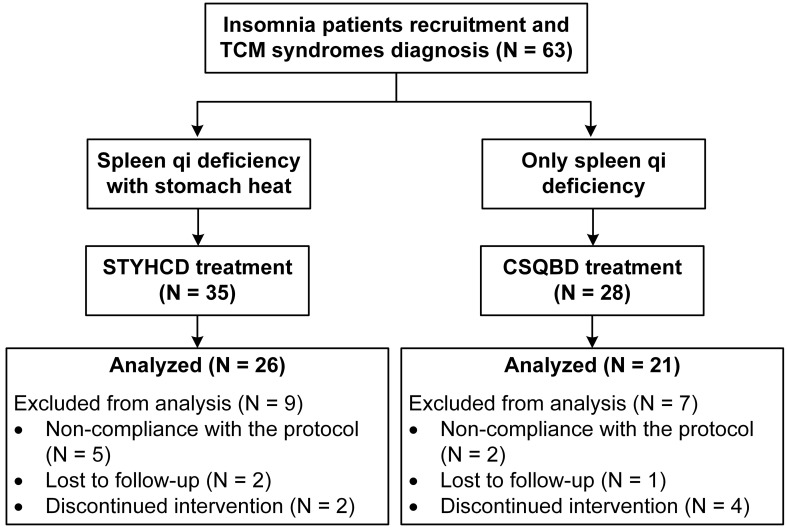
Sixty-three insomnia patients with these two specific TCM syndromes were enrolled and treated with CSQBD or STYHCD for 4 weeks. Sleep quality was assessed using the Pittsburgh Sleep Quality Index (PSQI) and Insomnia Severity Index (ISI) every 2 weeks. In addition, variations in gut microbiota were evaluated through 16S rRNA gene sequencing. Stress and inflammatory markers were measured pre- and post-treatment.
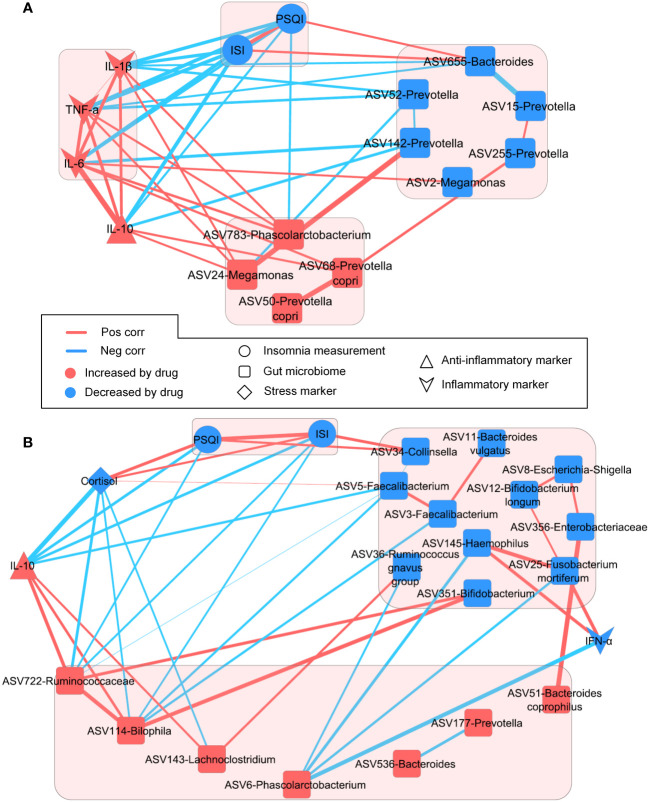
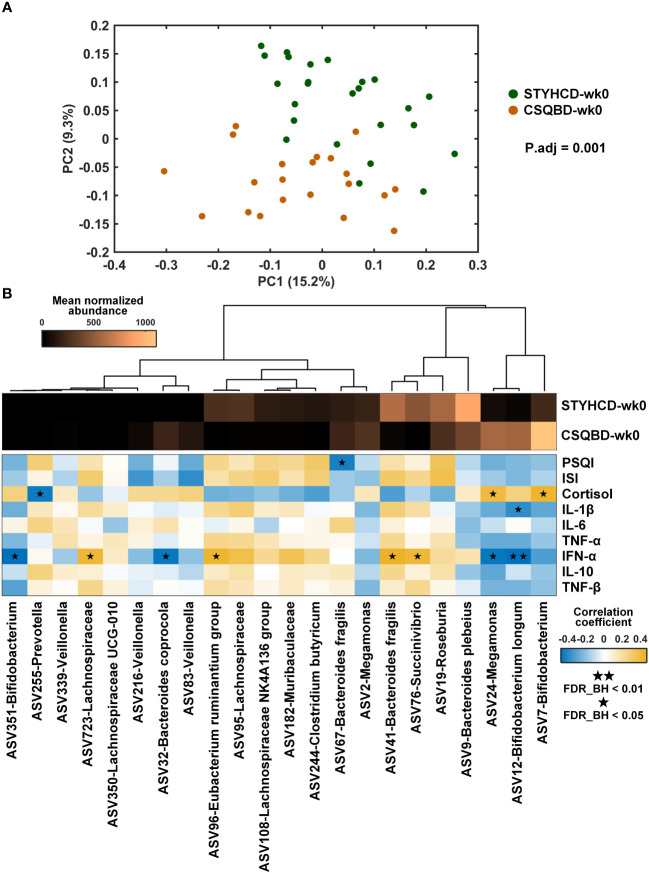
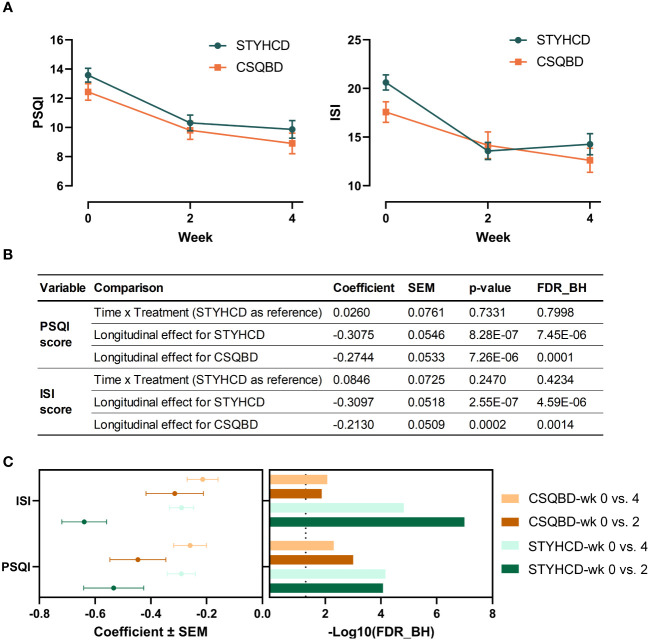
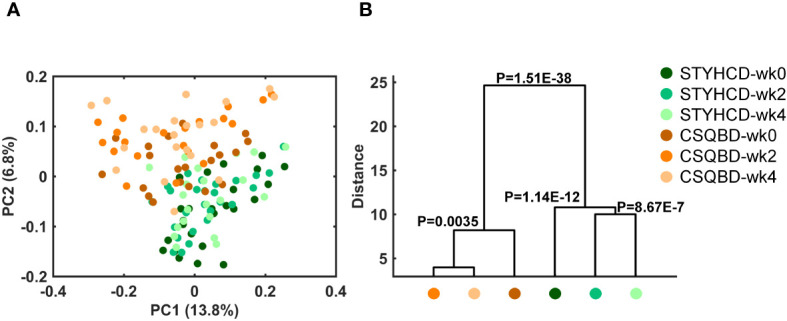
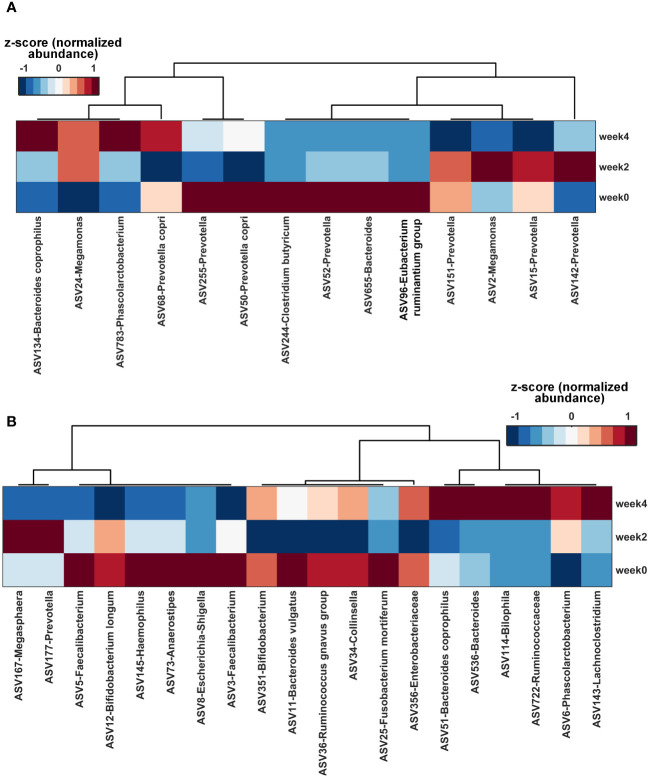
At baseline, patients exhibiting only spleen qi deficiency showed slightly lesser severe insomnia, lower IFN-α levels, and higher cortisol levels than those with spleen qi deficiency with stomach heat. Both TCM syndromes displayed distinct gut microbiome profiles despite baseline adjustment of PSQI, ISI, and IFN-α scores. The nested stratified 10-fold cross-validated random forest classifier showed that patients with spleen qi deficiency had a higher abundance of than those with spleen qi deficiency with stomach heat, negatively associated with plasma IFN-α concentration. Both CSQBD and STYHCD treatments significantly improved sleep quality within 2 weeks, which lasted throughout the study. Moreover, the gut microbiome and inflammatory markers were significantly altered post-treatment. The longitudinal integrative network analysis revealed interconnections between sleep quality, gut microbes, such as and Ruminococcaceae, and inflammatory markers.
This study reveals distinct microbiome profiles associated with different TCM syndrome types and underscores the link between the gut microbiome and efficacies of Chinese herbal formulas in improving insomnia. These findings deepen our understanding of the gut-brain axis in relation to insomnia and pave the way for precision treatment approaches leveraging TCM herbal remedies.
基于不同的证候类型,中医(TCM)包括草药方剂,已被用于治疗失眠等各种疾病数千年。尽管有研究提出 TCM 通过调节动物模型中的肠道微生物群来治疗失眠,但人类研究仍然有限。因此,本研究采用机器学习和整合网络技术来阐明肠道微生物群在两种 TCM 方剂——补中益气汤(CSQBD)和健脾滋阴清热汤(STYHCD)治疗诊断为脾虚和脾虚胃热的失眠患者中的作用。
纳入 63 例具有这两种特定 TCM 证候的失眠患者,分别用 CSQBD 或 STYHCD 治疗 4 周。每 2 周使用匹兹堡睡眠质量指数(PSQI)和失眠严重程度指数(ISI)评估睡眠质量。此外,通过 16S rRNA 基因测序评估肠道微生物群的变化。治疗前后测量应激和炎症标志物。
基线时,仅表现为脾虚的患者的严重失眠程度略低,IFN-α水平较低,皮质醇水平较高。尽管对 PSQI、ISI 和 IFN-α 评分进行了基线调整,但两种 TCM 证候均表现出明显不同的肠道微生物群特征。嵌套分层 10 倍交叉验证随机森林分类器显示,脾虚患者的丰度高于脾虚胃热患者,与血浆 IFN-α浓度呈负相关。CSQBD 和 STYHCD 治疗均能在 2 周内显著改善睡眠质量,并持续整个研究过程。此外,治疗后肠道微生物群和炎症标志物均发生显著变化。纵向综合网络分析揭示了睡眠质量、肠道微生物群(如 和 Ruminococcaceae)和炎症标志物之间的相互关系。
本研究揭示了与不同 TCM 证候类型相关的不同微生物群特征,并强调了肠道微生物群与改善失眠的中药方剂疗效之间的联系。这些发现加深了我们对与失眠相关的肠道-大脑轴的理解,并为利用 TCM 草药疗法进行精准治疗方法铺平了道路。