Graduate School of Science, Kyoto University, Kyoto 606-8502, Japan.
Graduate School of Chemical Sciences and Engineering, Hokkaido University, Sapporo 060-0810, Japan.
Sci Adv. 2024 May 31;10(22):eadn4490. doi: 10.1126/sciadv.adn4490.
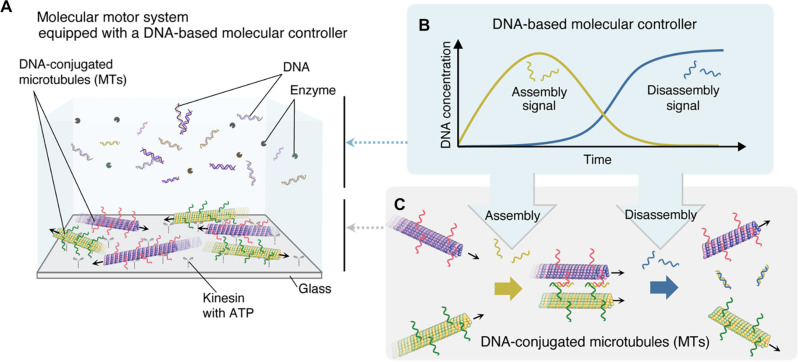
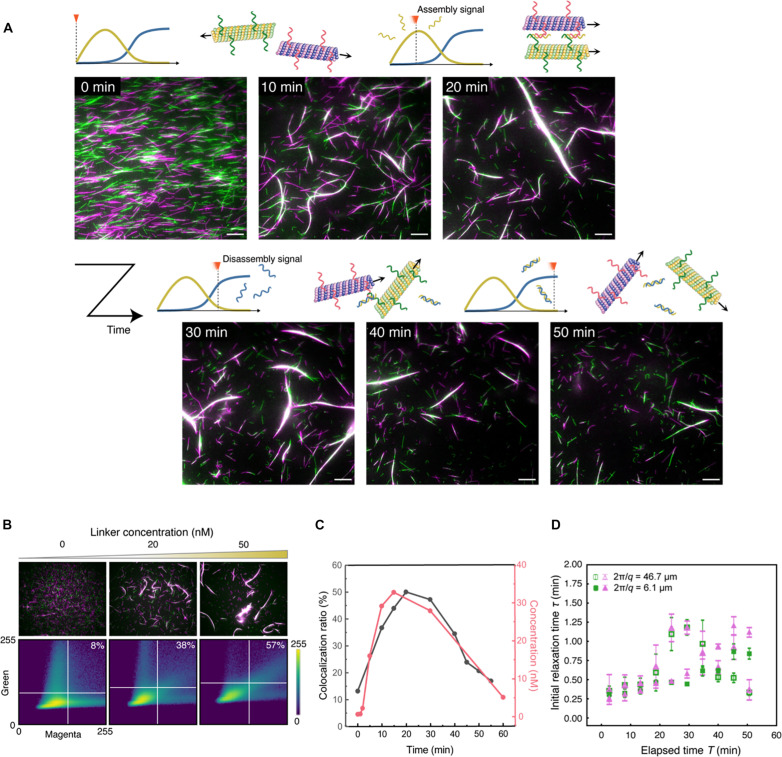
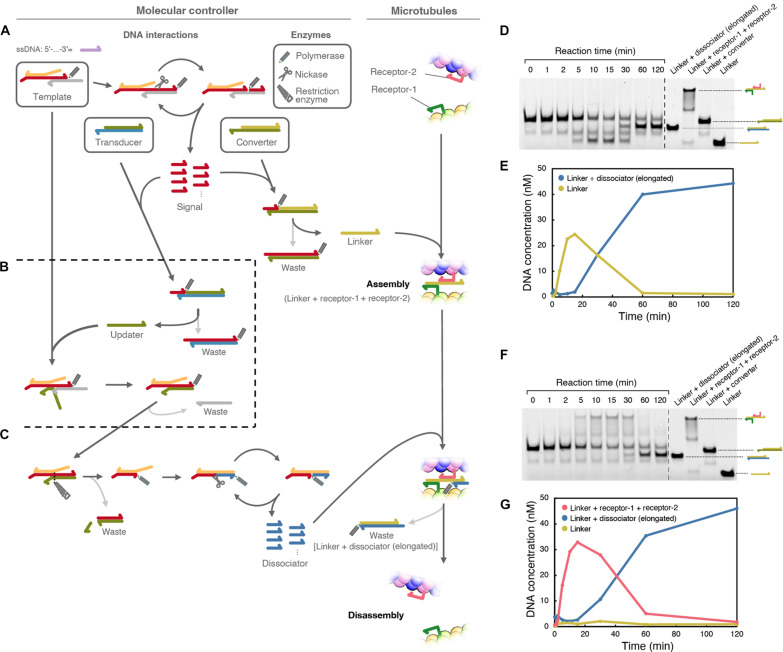
In recent years, there has been a growing interest in engineering dynamic and autonomous systems with robotic functionalities using biomolecules. Specifically, the ability of molecular motors to convert chemical energy to mechanical forces and the programmability of DNA are regarded as promising components for these systems. However, current systems rely on the manual addition of external stimuli, limiting the potential for autonomous molecular systems. Here, we show that DNA-based cascade reactions can act as a molecular controller that drives the autonomous assembly and disassembly of DNA-functionalized microtubules propelled by kinesins. The DNA controller is designed to produce two different DNA strands that program the interaction between the microtubules. The gliding microtubules integrated with the controller autonomously assemble to bundle-like structures and disassemble into discrete filaments without external stimuli, which is observable by fluorescence microscopy. We believe this approach to be a starting point toward more autonomous behavior of motor protein-based multicomponent systems with robotic functionalities.
近年来,人们越来越感兴趣的是使用生物分子来设计具有机器人功能的动态和自主系统。具体来说,分子马达将化学能转化为机械力的能力以及 DNA 的可编程性被认为是这些系统有前途的组成部分。然而,目前的系统依赖于手动添加外部刺激,限制了自主分子系统的潜力。在这里,我们表明基于 DNA 的级联反应可以作为分子控制器,驱动由驱动蛋白推动的 DNA 功能化微管的自主组装和拆卸。DNA 控制器设计用于产生两种不同的 DNA 链,这些 DNA 链编程微管之间的相互作用。与控制器集成的滑行微管自主组装成束状结构,并在没有外部刺激的情况下分解成离散的细丝,这可以通过荧光显微镜观察到。我们相信,这种方法是朝着具有机器人功能的基于运动蛋白的多组分系统的更自主行为迈出的第一步。