Department of Veterinary Diagnostic and Production Animal Medicine, College of Veterinary Medicine, Iowa State University, Ames, IA, USA.
Emerg Microbes Infect. 2024 Dec;13(1):2380421. doi: 10.1080/22221751.2024.2380421. Epub 2024 Jul 24.
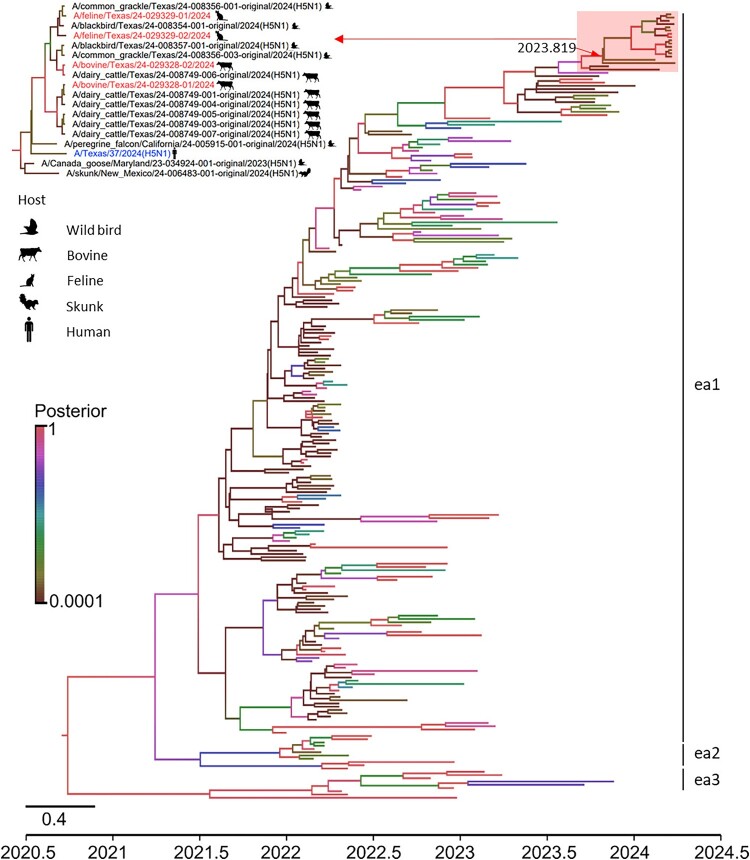
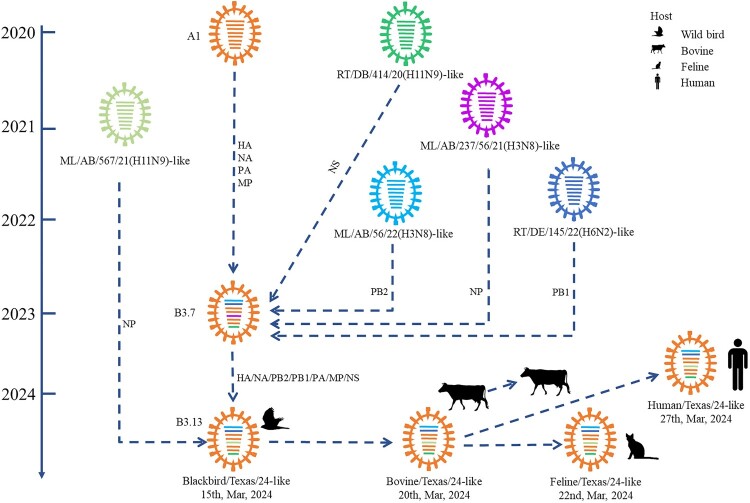
In March 2024, the emergence of highly pathogenic avian influenza (HPAI) A (H5N1) infections in dairy cattle was detected in the United Sates for the first time. We genetically characterize HPAI viruses from dairy cattle showing an abrupt drop in milk production, as well as from two cats, six wild birds, and one skunk. They share nearly identical genome sequences, forming a new genotype B3.13 within the 2.3.4.4b clade. B3.13 viruses underwent two reassortment events since 2023 and exhibit critical mutations in HA, M1, and NS genes but lack critical mutations in PB2 and PB1 genes, which enhance virulence or adaptation to mammals. The PB2 E627 K mutation in a human case associated with cattle underscores the potential for rapid evolution post infection, highlighting the need for continued surveillance to monitor public health threats.
2024 年 3 月,美国首次发现了高致病性禽流感(HPAI)A(H5N1)感染奶牛。我们对产奶量突然下降的奶牛以及两只猫、六只野生鸟类和一只臭鼬中的 HPAI 病毒进行了基因特征分析。它们共享几乎相同的基因组序列,在 2.3.4.4b 分支内形成了一个新的基因型 B3.13。自 2023 年以来,B3.13 病毒经历了两次重组事件,在 HA、M1 和 NS 基因中表现出关键突变,但在 PB2 和 PB1 基因中缺乏关键突变,这些突变增强了病毒的毒力或对哺乳动物的适应性。与牛有关的人类病例中 PB2 E627 K 突变突显了感染后快速进化的潜力,强调需要持续监测以监测公共卫生威胁。