Bhattarai Urza, Bashyal Bijaya, Shrestha Anu, Koirala Binu, Sharma Sanjib Kumar
Department of Internal Medicine B.P. Koirala Institute of Health Sciences Dharan Nepal.
B.P. Koirala Institute of Health Sciences Dharan Nepal.
Aging Med (Milton). 2024 Aug 12;7(4):510-515. doi: 10.1002/agm2.12349. eCollection 2024 Aug.
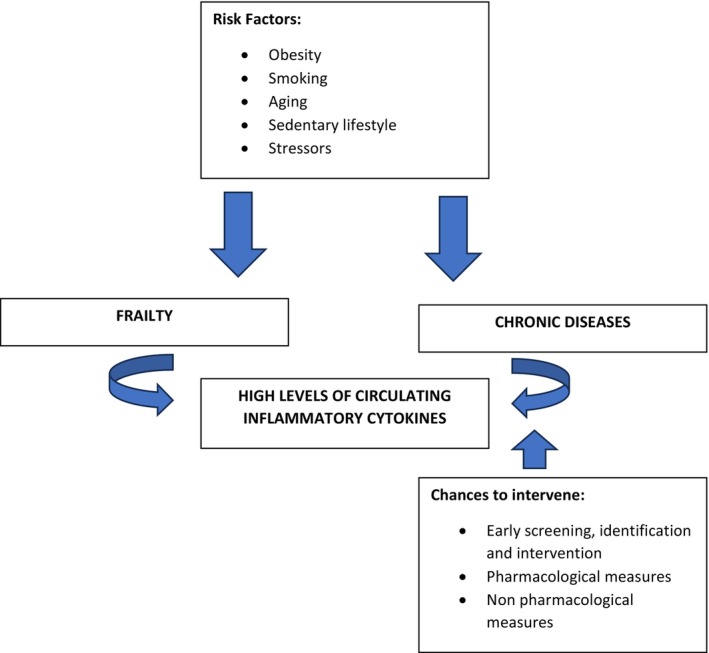
Frailty is a multidimensional syndrome associated with a decline in reserve capacity across multiple organ systems involving physical, psychological, and social aspects. Weakness is the earliest indicator of the frailty process. Multi-morbidity is the state of presence of two or more chronic diseases. Frailty and chronic diseases are interlinked as frail individuals are more prone to develop chronic diseases and multi-morbid individuals may present with frailty. They share common risk factors, pathogenesis, progression, and outcomes. Significant risk factors include obesity, smoking, aging, sedentary, and stressful lifestyle. Pathophysiological mechanisms involve high levels of circulating inflammatory cytokines as seen in individuals with frailty and chronic diseases such as hypertension, cardiovascular diseases, type 2 diabetes mellitus, chronic kidney disease, and anemia. Hence, frailty and chronic diseases go hand in hand and it is of utmost importance to identify them and intervene during early stages. Screening frailty and treating multi-morbidity incorporate both pharmacological and majorly non- pharmacological measures, such as physical activities, nutrition, pro-active care, minimizing polypharmacy and addressing reversible medical conditions. The purpose of this mini-review is to highlight the interrelation of frailty and chronic diseases through the discussion of their predictors and outcomes and how timely interventions are essential to prevent the progression of one to the other.
衰弱是一种多维度综合征,与多个器官系统储备能力下降相关,涉及身体、心理和社会方面。虚弱是衰弱过程的最早指标。多病共存是指存在两种或更多种慢性疾病的状态。衰弱与慢性疾病相互关联,因为衰弱个体更容易患慢性疾病,而多病共存个体可能表现出衰弱。它们有共同的危险因素、发病机制、进展和结局。重要的危险因素包括肥胖、吸烟、衰老、久坐不动和压力大的生活方式。病理生理机制涉及循环炎症细胞因子水平升高,这在衰弱个体以及患有高血压、心血管疾病、2型糖尿病、慢性肾脏病和贫血等慢性疾病的个体中都有体现。因此,衰弱和慢性疾病密切相关,识别它们并在早期进行干预至关重要。筛查衰弱和治疗多病共存包括药物治疗和主要是非药物措施,如体育活动、营养、积极护理、尽量减少多重用药以及处理可逆转的医疗状况。本综述的目的是通过讨论衰弱和慢性疾病的预测因素和结局,以及及时干预对于预防两者相互进展的重要性,来突出它们之间的相互关系。