Price Ilan, Sanchez-Gonzalez Alvaro, Alet Ferran, Andersson Tom R, El-Kadi Andrew, Masters Dominic, Ewalds Timo, Stott Jacklynn, Mohamed Shakir, Battaglia Peter, Lam Remi, Willson Matthew
Google DeepMind, London, UK.
Nature. 2025 Jan;637(8044):84-90. doi: 10.1038/s41586-024-08252-9. Epub 2024 Dec 4.
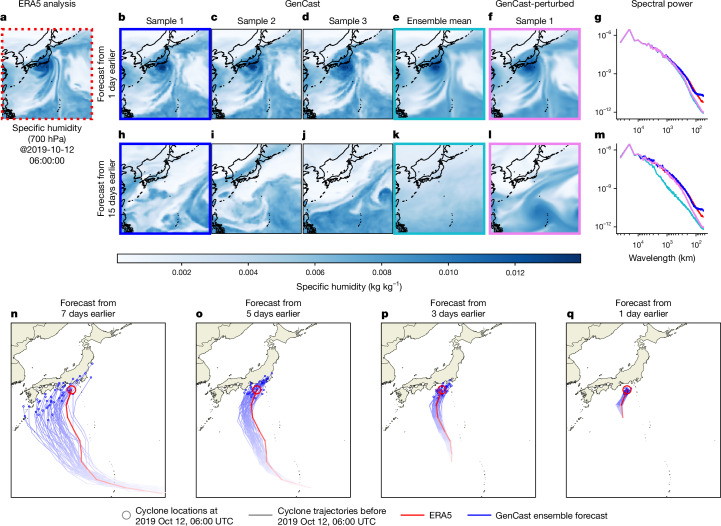
Weather forecasts are fundamentally uncertain, so predicting the range of probable weather scenarios is crucial for important decisions, from warning the public about hazardous weather to planning renewable energy use. Traditionally, weather forecasts have been based on numerical weather prediction (NWP), which relies on physics-based simulations of the atmosphere. Recent advances in machine learning (ML)-based weather prediction (MLWP) have produced ML-based models with less forecast error than single NWP simulations. However, these advances have focused primarily on single, deterministic forecasts that fail to represent uncertainty and estimate risk. Overall, MLWP has remained less accurate and reliable than state-of-the-art NWP ensemble forecasts. Here we introduce GenCast, a probabilistic weather model with greater skill and speed than the top operational medium-range weather forecast in the world, ENS, the ensemble forecast of the European Centre for Medium-Range Weather Forecasts. GenCast is an ML weather prediction method, trained on decades of reanalysis data. GenCast generates an ensemble of stochastic 15-day global forecasts, at 12-h steps and 0.25° latitude-longitude resolution, for more than 80 surface and atmospheric variables, in 8 min. It has greater skill than ENS on 97.2% of 1,320 targets we evaluated and better predicts extreme weather, tropical cyclone tracks and wind power production. This work helps open the next chapter in operational weather forecasting, in which crucial weather-dependent decisions are made more accurately and efficiently.
天气预报本质上是不确定的,因此预测可能的天气情况范围对于重要决策至关重要,从向公众发出恶劣天气警告到规划可再生能源利用。传统上,天气预报基于数值天气预报(NWP),它依赖于基于物理的大气模拟。基于机器学习(ML)的天气预报(MLWP)的最新进展产生了基于ML的模型,其预测误差比单一的NWP模拟更小。然而,这些进展主要集中在单一的确定性预测上,无法体现不确定性和估计风险。总体而言,MLWP的准确性和可靠性仍低于最先进的NWP集合预报。在此,我们介绍GenCast,这是一种概率天气模型,其技能和速度比世界顶级业务中期天气预报——欧洲中期天气预报中心的集合预报ENS更高。GenCast是一种基于ML的天气预报方法,在数十年的再分析数据上进行训练。GenCast能在8分钟内,以12小时步长和0.25°经纬度分辨率,生成超过80个地面和大气变量的15天全球随机预报集合。在我们评估的1320个目标中,它在97.2%的目标上比ENS具有更高的技能,并且能更好地预测极端天气、热带气旋路径和风力发电。这项工作有助于开启业务天气预报的新篇章,使依赖天气的关键决策能更准确、高效地做出。