Wilczyńska Dominika, Walczak-Kozłowska Tamara, Alarcón David, Arenilla María José, Jaenes Jose Carlos, Hejła Marcelina, Lipowski Mariusz, Nestorowicz Joanna, Olszewski Henryk
Faculty of Social and Humanities, University WSB Merito, 80-266 Gdańsk, Poland.
Department of Neuropsychology, Institute of Psychology, University of Gdansk, 80-309 Gdańsk, Poland.
Brain Sci. 2024 Dec 26;15(1):14. doi: 10.3390/brainsci15010014.
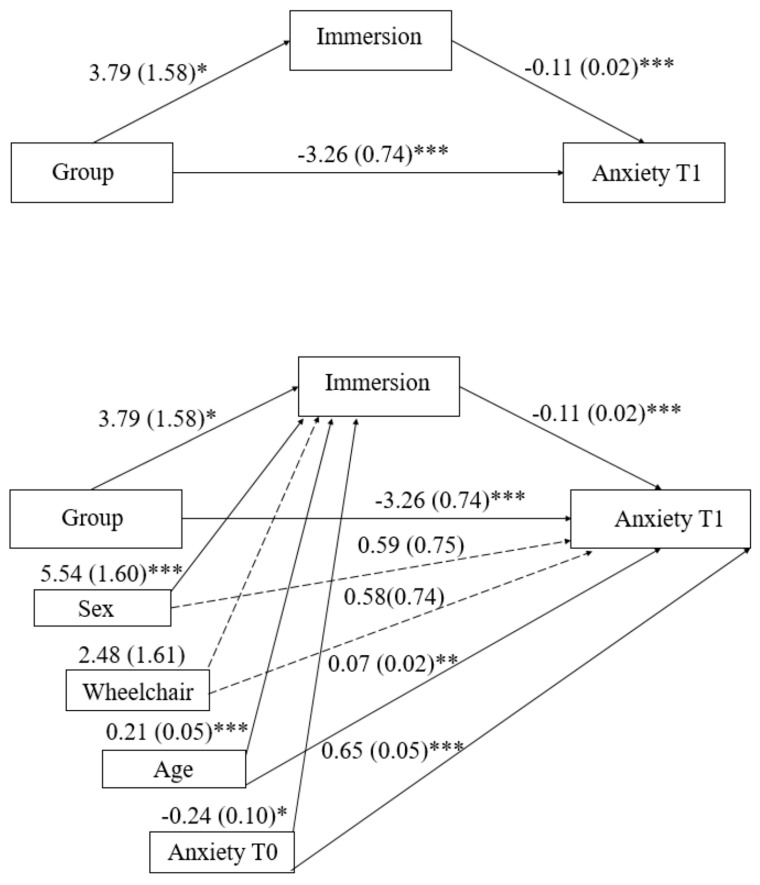
BACKGROUND/OBJECTIVES: Virtual reality (VR) is an innovative technology with the potential to transform digital experiences, particularly in relation to mental health concerns such as anxiety. Therefore, this study investigates the potential of a newly designed VR experience to alleviate anxiety by focusing on the mediating role of VR-induced immersion.
The study included 419 individuals aged 10 to 80 years, with 29 aged 10-15 years and 390 above 15 years, who were randomly assigned to experimental and control groups on the basis of project-defined criteria, including a random allocation to the wheelchair-using group. Both groups used goggles for virtual space navigation, with the experimental group employing a multijoint arm mounted on an aluminum frame and special algorithms to navigate without controllers. We assessed immersion in VR using the Polish adaptation of the Immersion Questionnaire and anxiety using the Polish adaptations of the State-Trait Anxiety Inventory (STAI-X1) and its early adolescent version, the State-Trait Anxiety Inventory-Children (STAI-C1).
The results indicate that individuals using the new VR device demonstrated increased immersion and reduced post-test anxiety levels, highlighting the significance of immersion in enhancing positive affect, mitigating the negative effects of VR technology, and offering insights for future development and refinement of VR solutions.
背景/目的:虚拟现实(VR)是一项创新技术,有潜力改变数字体验,尤其是在与焦虑等心理健康问题相关的方面。因此,本研究通过关注VR诱发的沉浸感的中介作用,调查一种新设计的VR体验缓解焦虑的潜力。
该研究纳入了419名年龄在10至80岁之间的个体,其中29名年龄在10 - 15岁之间,390名年龄在15岁以上,根据项目定义的标准将他们随机分配到实验组和对照组,包括随机分配到使用轮椅的组。两组都使用护目镜进行虚拟空间导航,实验组使用安装在铝框架上的多关节手臂和特殊算法在没有控制器的情况下进行导航。我们使用波兰语改编的《沉浸问卷》评估VR中的沉浸感,使用波兰语改编的《状态 - 特质焦虑量表》(STAI - X1)及其青少年早期版本《状态 - 特质焦虑量表 - 儿童版》(STAI - C1)评估焦虑。
结果表明,使用新VR设备的个体表现出更高的沉浸感和更低的测试后焦虑水平,突出了沉浸感在增强积极情绪、减轻VR技术负面影响以及为未来VR解决方案的开发和改进提供见解方面的重要性。