Ömeroğlu Merve Kütük, Çam Melek, Doğruer Işıl, Kaynar Zeynep Buket
Faculty of Dentistry, Department of Restorative Dentistry, Istanbul Okan University, Istanbul, Turkey.
BMC Oral Health. 2025 Mar 29;25(1):459. doi: 10.1186/s12903-025-05807-8.
The aim of this study is to evaluate the effect of different surface treatments and adhesives on shear bond strength (SBS) in the repair of composite resin restorations.
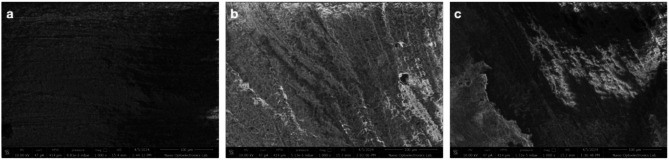
In this study, 60 discs (2 mm x 10 mm) were prepared using a universal nanohybrid composite resin (GrandioSo, Voco, Germany). The discs were aged by exposure to 5000 thermal cycles between 5 and 55 °C for 30 s with an immersion procedure. Then samples were divided into 3 groups (n:20) according to the surface treatments (Group 1: no surface treatment, Group 2: roughening by bur, Group 3: roughening by Er, Cr: YSGG laser). Subsequently, the specimens were classified into two groups (n:10) according to the adhesive systems; a two-step self-etch adhesive (Clearfil SE bond (SE)), or a universal adhesive (Scotchbond Universal Plus (SB)). After surface treatments and adhesive applications, the same universal nanohybrid composite resin with a height of 2 mm and a diameter of 3 mm was placed in the center of the samples. The samples were then submitted to the SBS test using universal testing equipment (Autograph AGS-X; Shimadzu, Kyoto, Japan) with a crosshead speed of 1 mm/min. The failure modes were examined using a stereomicroscope. The surface topography of the roughened and fractured surfaces resin composite (n = 1) was assessed using scanning electron microscopy (SEM). Analyses were performed using IBM SPSS 25 programme (p < 0.05).
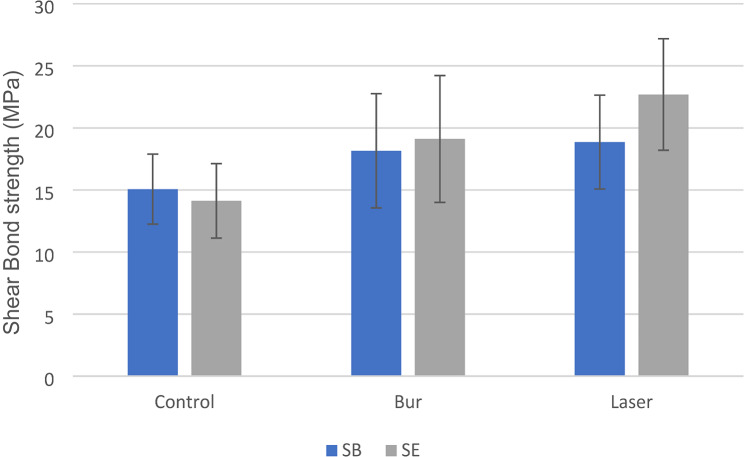
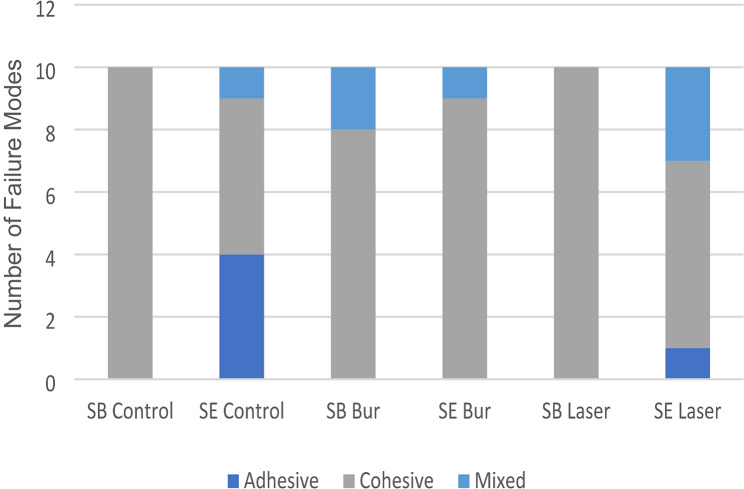
The highest bond strength was observed in the laser + SE group (22.69 ± 4.49), while the lowest was recorded in the control + SE group (14.12 ± 3.00). In the SE adhesive group, no significant difference was found between the laser + SE and bur + SE groups (p > 0.05). Similarly, in the SB adhesive group, there were no significant differences among the surface roughening procedures (p = 0.078). Additionally, no significant differences were observed between the adhesives according to various surface roughening procedures. The failure mode was predominantly cohesive in old composites.
The bond strength can be improved by surface treatments such as diamond burs, Er, Cr: YSGG laser application for better bonding strategies in the repair of nanohybrid resin composite restorations. There was no statistically significant difference in bond strength between the adhesives tested in this study.
本研究旨在评估不同表面处理和粘结剂对复合树脂修复体修复中剪切粘结强度(SBS)的影响。
在本研究中,使用通用纳米混合复合树脂(德国Voco公司的GrandioSo)制备60个圆盘(2毫米×10毫米)。通过浸入法在5至55°C之间进行5000次热循环对圆盘进行老化处理30秒。然后根据表面处理将样本分为3组(每组n = 20);第1组:不进行表面处理,第2组:用车针 roughening,第3组:用Er, Cr: YSGG激光 roughening。随后,根据粘结系统将样本分为两组(每组n = 10);一种两步自酸蚀粘结剂(Clearfil SE bond (SE))或一种通用粘结剂(Scotchbond Universal Plus (SB))。在进行表面处理和应用粘结剂后,将高度为2毫米、直径为3毫米的相同通用纳米混合复合树脂放置在样本中心。然后使用通用测试设备(Autograph AGS-X;日本京都岛津公司)以1毫米/分钟的十字头速度对样本进行SBS测试。使用体视显微镜检查失败模式。使用扫描电子显微镜(SEM)评估 roughened和断裂表面树脂复合材料(n = 1)的表面形貌。使用IBM SPSS 25程序进行分析(p < 0.05)。
在激光 + SE组中观察到最高粘结强度(22.69±4.49),而在对照组 + SE组中记录到最低粘结强度(14.12±3.00)。在SE粘结剂组中,激光 + SE组和车针 + SE组之间未发现显著差异(p > 0.05)。同样,在SB粘结剂组中,表面 roughening程序之间没有显著差异(p = 0.078)。此外,根据各种表面 roughening程序,粘结剂之间未观察到显著差异。在旧复合材料中,失败模式主要是内聚破坏。
通过诸如金刚石车针、Er, Cr: YSGG激光等表面处理可以提高粘结强度,以便在纳米混合树脂复合材料修复体修复中采用更好的粘结策略。本研究中测试的粘结剂之间在粘结强度上没有统计学上的显著差异。