Yu Yanmei, Sun Jianan, Wang Dandan, Xing Miaomiao, Yang Yanqi
The Fourth School of Clinical Medicine, Harbin Medical University, Harbin, China.
School of Mechatronics Engineering, Harbin Institute of Technology, Harbin, China.
Front Nutr. 2025 Mar 26;12:1549948. doi: 10.3389/fnut.2025.1549948. eCollection 2025.
Composite dietary antioxidant index (CDAI) has been found protective to women's health. However, the association between CDAI level and the risk of endometriosis in women is unclear.
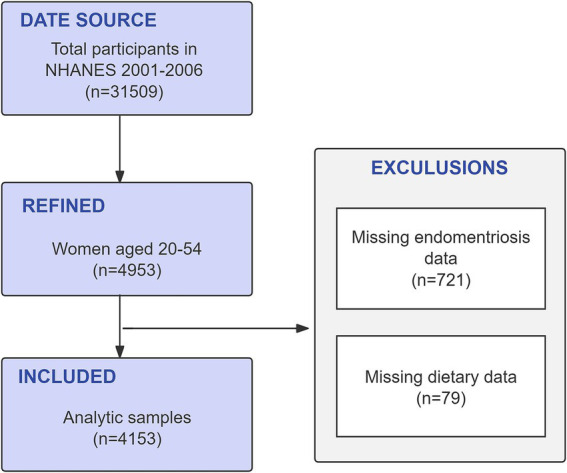
A total of 4,153 women from the National Health and Nutrition Examination Survey (NHANES) 2001-2006 were included in this cross-sectional study. We evaluated the association between CDAI level and the risk of endometriosis using three logistic regression models and restricted cubic spline. Stratified and sensitivity analyses were also performed.
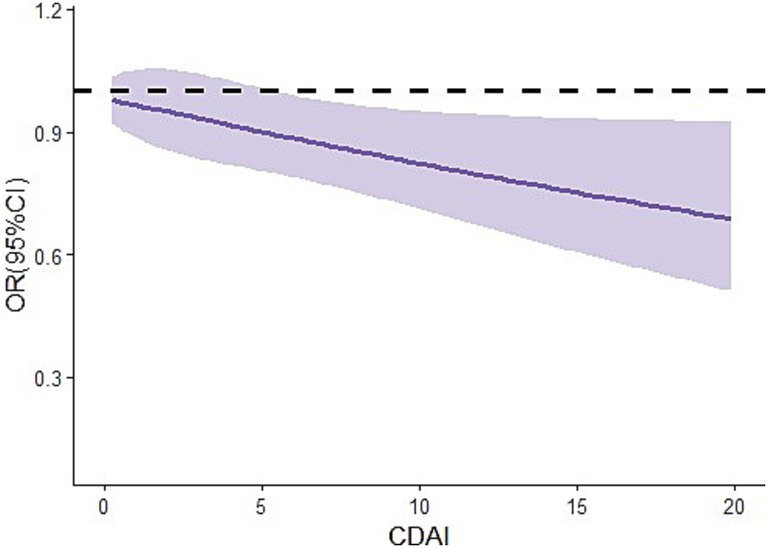
Logistic regression analysis found that CDAI level was inversely associated with the development of endometriosis. The associated odds ratio (OR) for each SD increase in CDAI was 0.98 [95%CI: 0.96-0.99]. After dividing the CDAI level into four quartiles, we found that compared with the CDAI level in Q1 (-1.89, -1.79), the ORs [95%CI] associated with endometriosis in Q2 (-1.79, -0.69), Q3 (-0.69, 1.42) and Q4 (1.42, 47.92) were 0.94 [0.87, 1.03], 0.95 [0.88, 1.04] and 0.83 [0.77, 0.91], respectively, with p trend<0.001. Restricted cubic spline showed a negative dose-response relationship between CDAI level and endometriosis risk. In addition, the protective effect of CDAI on endometriosis was more obvious in women aged 30-39 years (OR = 0.83, 95% CI = 0.69-0.99), gave relatively more births (OR = 0.82, 95% CI = 071-0.93), lower family income (OR = 0.69, 95% CI = 0.54-0.88), Non-Hispanic Black (OR = 0.72, 95% CI = 0.58-0.89), less educated (OR = 0.69, 95% CI = 0.52-0.91), smoker (OR = 0.74, 95% CI = 0.61-0.89), alcohol drinker (OR = 0.86, 95% CI = 0.77-0.97), overweight or obese (OR = 0.76, 95% CI = 0.60-0.97), and hypertensive (OR = 0.72, 95% CI = 0.60-0.87).
Our findings may provide valuable insights into the primary prevention of endometriosis in women and further prospective studies are warranted.
复合膳食抗氧化指数(CDAI)已被发现对女性健康具有保护作用。然而,CDAI水平与女性子宫内膜异位症风险之间的关联尚不清楚。
本横断面研究纳入了2001 - 2006年美国国家健康与营养检查调查(NHANES)中的4153名女性。我们使用三个逻辑回归模型和受限立方样条评估了CDAI水平与子宫内膜异位症风险之间的关联。还进行了分层分析和敏感性分析。
逻辑回归分析发现,CDAI水平与子宫内膜异位症的发生呈负相关。CDAI每增加一个标准差,相关的比值比(OR)为0.98 [95%置信区间:0.96 - 0.99]。将CDAI水平分为四个四分位数后,我们发现,与第一四分位数(-1.89,-1.79)的CDAI水平相比,第二四分位数(-1.79,-0.69)、第三四分位数(-0.69,1.42)和第四四分位数(1.42,47.92)中与子宫内膜异位症相关的OR [95%置信区间]分别为0.94 [0.87,1.03]、0.95 [0.88,1.04]和0.83 [0.77,0.91],趋势p<0.001。受限立方样条显示CDAI水平与子宫内膜异位症风险之间存在负剂量反应关系。此外,CDAI对子宫内膜异位症的保护作用在30 - 39岁的女性中更明显(OR = 0.83,95%置信区间 = 0.69 - 0.99)、生育次数相对较多的女性中(OR = 0.82,95%置信区间 = 0.71 - 0.93)、家庭收入较低的女性中(OR = 0.69,95%置信区间 = 0.54 - 0.88)、非西班牙裔黑人女性中(OR = 0.72,95%置信区间 = 0.58 - 0.89)、受教育程度较低的女性中(OR = 0.69,95%置信区间 = 0.52 - 0.91)、吸烟者中(OR = 0.74,95%置信区间 = 0.61 - 0.89)、饮酒者中(OR = 0.86,95%置信区间 = 0.77 - 0.