Saavedra Ramon Costa, Carvalho-Sauer Rita, Paixao Enny S, Ichihara Maria Yury Travassos, Costa Maria da Conceição Nascimento, Teixeira Maria da Glória
Bahia State Health Department, Salvador 41745-900, BA, Brazil.
London School of Hygiene and Tropical Medicine, London WC1E 7HT, UK.
Vaccines (Basel). 2025 May 15;13(5):527. doi: 10.3390/vaccines13050527.
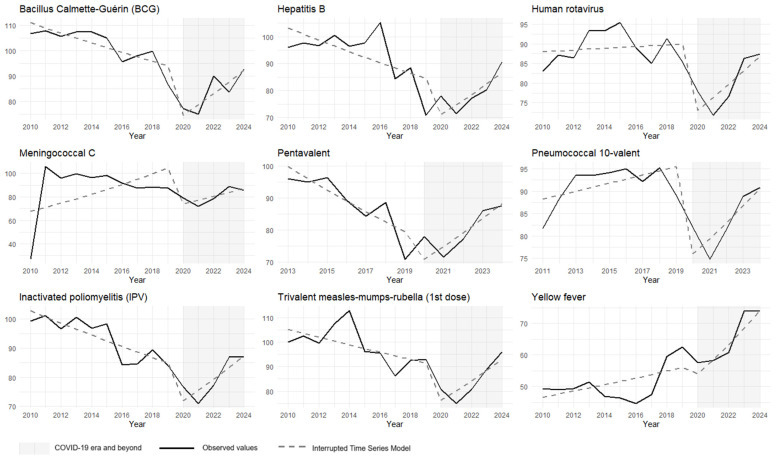
: The COVID-19 pandemic had significant impacts on healthcare systems, including the disruption of essential services such as childhood immunization. Containment measures, such as social distancing, contributed to reduced adherence to vaccination programs, increasing the risk of re-emerging vaccine-preventable diseases. We aim to assess the evolution of childhood vaccination coverage in Brazil from 2010 to 2024, identifying trends before, during, and after the COVID-19 pandemic. : An interrupted time series (ITS) study was conducted using publicly available aggregated data on vaccination coverage for children under one year of age. Prais-Winsten regression models were applied to estimate trend changes and evaluate the impact of the pandemic on immunization levels. : The findings indicate a progressive decline in vaccination coverage between 2010 and 2019, which was intensified in 2020 by the pandemic. The BCG vaccine showed the greatest decline (-24.88%, < 0.001), while pentavalent and hepatitis B vaccines decreased annually by -3.72% and -2.21%, respectively. From 2021 onwards, a gradual recovery in coverage was observed, with significant increases for BCG (+7.48% per year, < 0.001), hepatitis B (+7.45%, = 0.014), and MMR (+6.73%, = 0.017) vaccines. : The results highlight a concerning decline in childhood immunization, exacerbated by the pandemic but showing recent signs of recovery. This scenario underscores structural challenges within the National Immunization Program, requiring coordinated efforts to reverse vaccination losses and ensure system resilience in the face of future crises.
新冠疫情对医疗系统产生了重大影响,包括扰乱了诸如儿童免疫接种等基本服务。社交距离等防控措施导致疫苗接种计划的依从性降低,增加了疫苗可预防疾病再次出现的风险。我们旨在评估2010年至2024年巴西儿童疫苗接种覆盖率的变化情况,确定新冠疫情之前、期间和之后的趋势。:采用公开可得的一岁以下儿童疫苗接种覆盖率汇总数据进行了中断时间序列(ITS)研究。应用普赖斯 - 温斯顿回归模型来估计趋势变化并评估疫情对免疫接种水平的影响。:研究结果表明,2010年至2019年期间疫苗接种覆盖率呈逐步下降趋势,2020年因疫情而加剧。卡介苗的下降幅度最大(-24.88%,<0.001),而五价疫苗和乙肝疫苗的年降幅分别为-3.72%和-2.21%。从2021年起,观察到覆盖率逐渐回升,卡介苗(每年+7.48%,<0.001)、乙肝疫苗(+7.45%,=0.014)和麻腮风疫苗(+6.73%,=0.017)有显著增长。:结果凸显了儿童免疫接种令人担忧的下降情况,疫情使其加剧,但近期有恢复迹象。这种情况凸显了国家免疫规划中的结构性挑战,需要协同努力扭转疫苗接种率下降的局面,并确保系统在面对未来危机时的复原力。