Wood G S, Schaffer J M, Boni R, Dummer R, Burg G, Takeshita M, Kikuchi M
Department of Dermatology, Case Western Reserve University, Cleveland, Ohio, USA.
Am J Pathol. 1997 Feb;150(2):667-73.
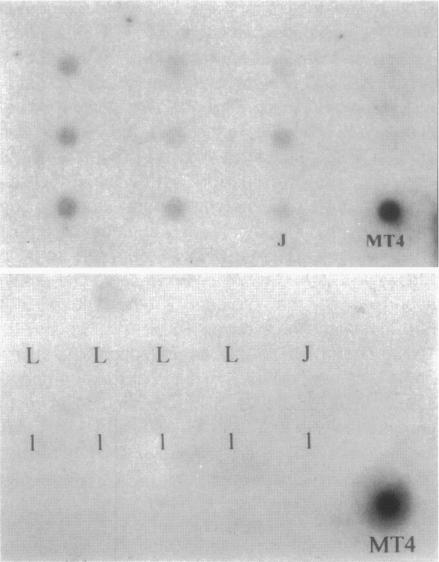
Several recent studies have reported detection of HTLV-I genetic sequences in patients with cutaneous T-cell lymphoma (CTCL) including mycosis fungoides and Sezary syndrome. The purpose of this study was to determine whether HTLV-I was detectable in lesional tissues of patients suffering from diseases known to be associated with CTCL. Thirty-five cases were obtained from diverse geographical locations including Ohio, California, Switzerland, and Japan. Six of them had concurrent CTCL. Cases were analyzed using a combination of genomic polymerase chain reaction (PCR)/ Southern blot, dot blot, and Southern blot analyses. All assays were specific for HTLV-I provirus. Sensitivity ranged from approximately 10(-6) for PCR-based studies to 10(-2) for unamplified genomic blotting. Lesional DNA from patients with lymphomatoid papulosis (fourteen cases), Hodgkin's disease (twelve cases), and CD30+ large-cell lymphoma (nine cases) was tested for the HTLV-I proviral pX region using a genomic PCR assay followed by confirmatory Southern blot analysis with a nested oligonucleotide pX probe. All cases were uniformly negative. All of the Hodgkin's disease cases, eight of the large-cell lymphoma cases, and six of the lymphomatoid papulosis cases were then subjected to dot blot analysis of genomic DNA using a full-length HTLV-I proviral DNA probe that spans all regions of the HTLV-I genome. Again, all cases were negative. Finally, eleven of the Hodgkin's disease cases were also subjected to Southern blot analysis of EcoRI-digested genomic DNA using the same full-length HTLV-I probe. Once again, all cases were negative. These findings indicated that, despite utilization of a variety of sensitive and specific molecular biological methods, HTLV-I genetic sequences were not detectable in patients with CTCL-associated lymphoproliferative disorders. These results strongly suggest that the HTLV-I retrovirus is not involved in the pathogenesis of these diseases.
最近的几项研究报告称,在皮肤T细胞淋巴瘤(CTCL)患者中检测到了HTLV-I基因序列,包括蕈样肉芽肿和塞扎里综合征。本研究的目的是确定在已知与CTCL相关的疾病患者的病变组织中是否可检测到HTLV-I。从不同地理位置获得了35例病例,包括俄亥俄州、加利福尼亚州、瑞士和日本。其中6例同时患有CTCL。使用基因组聚合酶链反应(PCR)/ Southern印迹、斑点印迹和Southern印迹分析相结合的方法对病例进行分析。所有检测均针对HTLV-I前病毒具有特异性。灵敏度范围从基于PCR的研究的约10^(-6)到未扩增基因组印迹的10^(-2)。使用基因组PCR检测法检测淋巴瘤样丘疹病(14例)、霍奇金病(12例)和CD30+大细胞淋巴瘤(9例)患者的病变DNA中的HTLV-I前病毒pX区域,随后用巢式寡核苷酸pX探针进行确证性Southern印迹分析。所有病例均呈阴性。然后,对所有霍奇金病病例、8例大细胞淋巴瘤病例和6例淋巴瘤样丘疹病病例使用跨越HTLV-I基因组所有区域的全长HTLV-I前病毒DNA探针进行基因组DNA的斑点印迹分析。同样,所有病例均为阴性。最后,对11例霍奇金病病例也使用相同的全长HTLV-I探针进行EcoRI消化的基因组DNA的Southern印迹分析。再次,所有病例均为阴性。这些发现表明,尽管使用了各种灵敏且特异的分子生物学方法,但在CTCL相关淋巴增殖性疾病患者中未检测到HTLV-I基因序列。这些结果强烈表明HTLV-I逆转录病毒不参与这些疾病的发病机制。