Bas Janssen Mathieu F, Birnie Erwin, Bonsel Gouke J
Public Health Epidemiology, Department of Social Medicine, Academic Medical Center, 22660, 1100 DD, Amsterdam, The Netherlands.
Qual Life Res. 2007 Jun;16(5):895-904. doi: 10.1007/s11136-006-9160-6. Epub 2007 Feb 10.
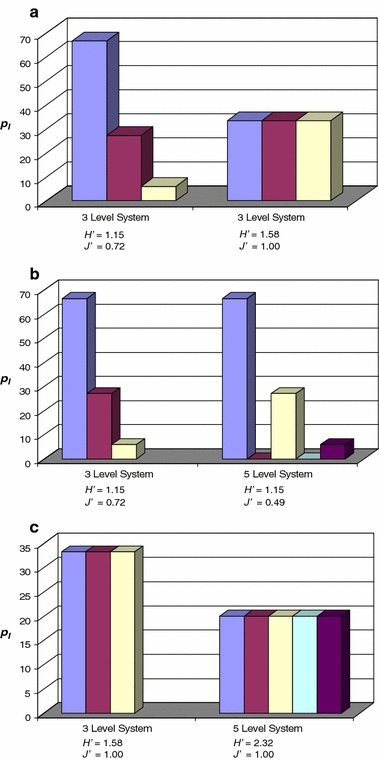
To compare quantitatively the discriminatory power of the EQ-5D, HUI2 and HUI3 in terms of absolute and relative informativity, using Shannon's indices.
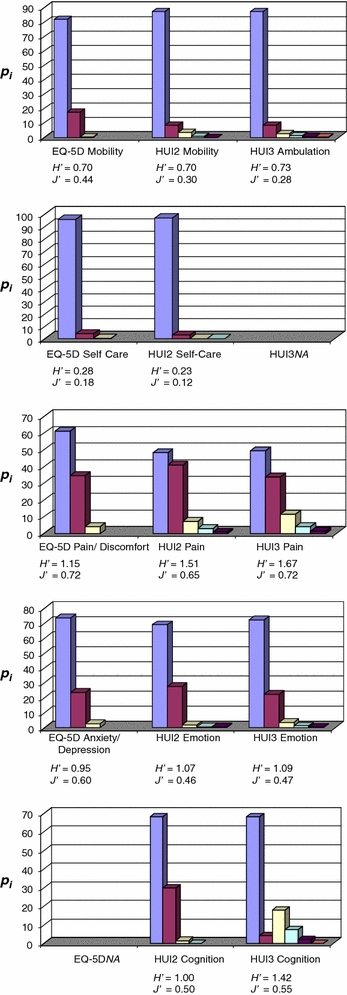
EQ-5D and HUI2/3 data completed by a sample of the general adult US population (N = 3,691) were used. Five dimensions allowed head-to-head comparison of informativity: Mobility/Ambulation; Anxiety/Depression/Emotion; Pain/Discomfort (EQ-5D; HUI2; HUI3); Self-Care (EQ-5D; HUI2); and Cognition (HUI2; HUI3). Shannon's index and Shannon's Evenness index were used to assess absolute and relative informativity, both by dimension and by instrument as a whole.
Absolute informativity was highest for HUI3, with the largest differences in Pain/Discomfort and Cognition. Relative informativity was highest for EQ-5D, with the largest differences in Mobility/Ambulation and Anxiety/Depression/Emotion. Absolute informativity by instrument was consistently highest for HUI3 and lowest for EQ-5D, and relative informativity was highest for EQ-5D and lowest for HUI3.
Performance in terms of absolute and relative informativity of the common dimensions of the three instruments varies over dimensions. Several dimensions are suboptimal: Pain/Discomfort (EQ-5D) seems too crude with only 3 levels, and the level descriptions of Ambulation (HUI3) and Self-Care (HUI2) could be improved. In absence of a formal measure, Shannon's indices provide useful measures for assessing discriminatory power of utility instruments.
使用香农指数,从绝对信息量和相对信息量方面定量比较EQ-5D、HUI2和HUI3的区分能力。
使用美国普通成年人群样本(N = 3691)完成的EQ-5D和HUI2/3数据。五个维度允许对信息量进行直接比较:移动性/步行能力;焦虑/抑郁/情绪;疼痛/不适(EQ-5D;HUI2;HUI3);自我护理(EQ-5D;HUI2);以及认知(HUI2;HUI3)。香农指数和香农均匀度指数用于按维度和按整个工具评估绝对信息量和相对信息量。
HUI3的绝对信息量最高,在疼痛/不适和认知方面差异最大。EQ-5D的相对信息量最高,在移动性/步行能力和焦虑/抑郁/情绪方面差异最大。按工具计算,HUI3的绝对信息量始终最高,EQ-5D最低,而EQ-5D的相对信息量最高,HUI3最低。
这三种工具共同维度的绝对信息量和相对信息量表现因维度而异。几个维度并不理想:疼痛/不适(EQ-5D)只有3个级别,似乎过于粗略,步行能力(HUI3)和自我护理(HUI2)的级别描述可以改进。在没有正式测量方法的情况下,香农指数为评估效用工具的区分能力提供了有用的测量方法。