Brand Donald A, Saisana Michaela, Rynn Lisa A, Pennoni Fulvia, Lowenfels Albert B
Department of Medicine, New York Medical College, Valhalla, New York, United States of America.
PLoS Med. 2007 Apr;4(4):e151. doi: 10.1371/journal.pmed.0040151.
Alcohol consumption causes an estimated 4% of the global disease burden, prompting governments to impose regulations to mitigate the adverse effects of alcohol. To assist public health leaders and policymakers, the authors developed a composite indicator-the Alcohol Policy Index-to gauge the strength of a country's alcohol control policies.
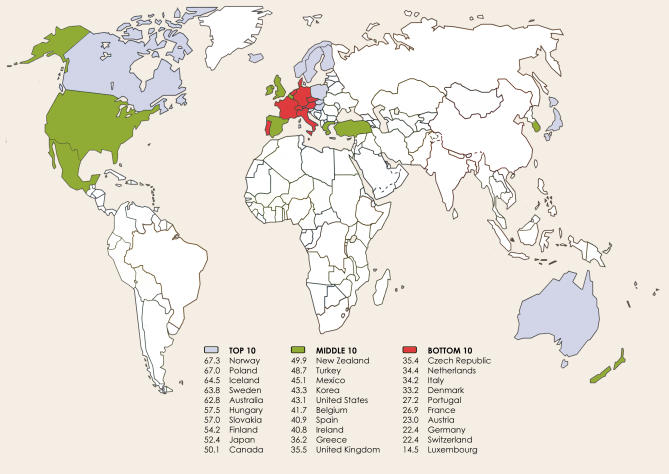
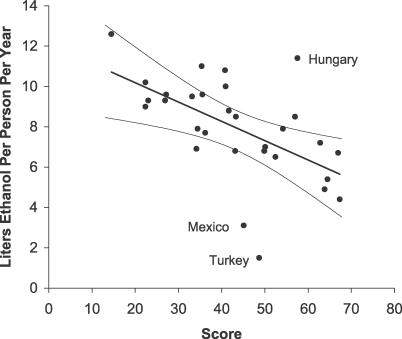
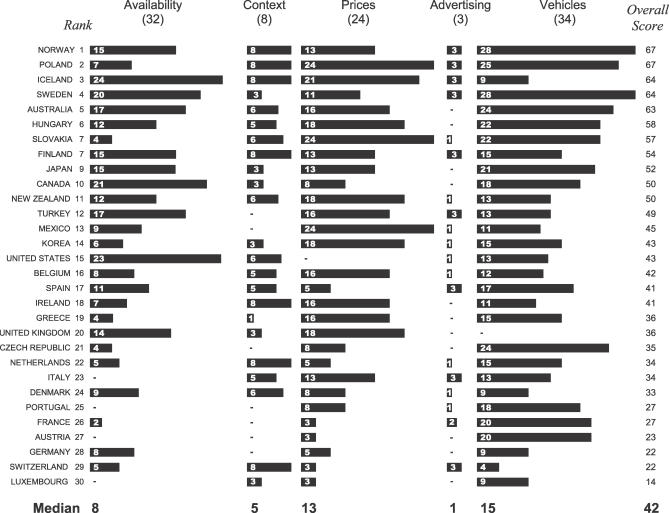
The Index generates a score based on policies from five regulatory domains-physical availability of alcohol, drinking context, alcohol prices, alcohol advertising, and operation of motor vehicles. The Index was applied to the 30 countries that compose the Organization for Economic Cooperation and Development and regression analysis was used to examine the relationship between policy score and per capita alcohol consumption. Countries attained a median score of 42.4 of a possible 100 points, ranging from 14.5 (Luxembourg) to 67.3 (Norway). The analysis revealed a strong negative correlation between score and consumption (r = -0.57; p = 0.001): a 10-point increase in the score was associated with a one-liter decrease in absolute alcohol consumption per person per year (95% confidence interval, 0.4-1.5 l). A sensitivity analysis demonstrated the robustness of the Index by showing that countries' scores and ranks remained relatively stable in response to variations in methodological assumptions.
The strength of alcohol control policies, as estimated by the Alcohol Policy Index, varied widely among 30 countries located in Europe, Asia, North America, and Australia. The study revealed a clear inverse relationship between policy strength and alcohol consumption. The Index provides a straightforward tool for facilitating international comparisons. In addition, it can help policymakers review and strengthen existing regulations aimed at minimizing alcohol-related harm and estimate the likely impact of policy changes.
饮酒估计造成全球4%的疾病负担,促使各国政府实施相关规定以减轻酒精的不良影响。为帮助公共卫生领导人及政策制定者,作者开发了一个综合指标——酒精政策指数,用以衡量一个国家酒精控制政策的力度。
该指数根据五个监管领域的政策生成一个分数,这五个领域分别是酒精的实际可获得性、饮酒环境、酒精价格、酒精广告以及机动车驾驶。该指数应用于经济合作与发展组织的30个成员国,并采用回归分析来检验政策得分与人均酒精消费量之间的关系。各国在满分100分中的中位数得分为42.4分,范围从14.5分(卢森堡)到67.3分(挪威)。分析显示得分与消费量之间存在很强的负相关(r = -0.57;p = 0.001):得分每提高10分,人均每年纯酒精消费量就减少1升(95%置信区间,0.4 - 1.5升)。敏感性分析表明,通过显示各国得分和排名在方法假设变化时相对稳定,该指数具有稳健性。
根据酒精政策指数估算,酒精控制政策的力度在欧洲、亚洲、北美和澳大利亚的30个国家中差异很大。该研究揭示了政策力度与酒精消费之间明显的负相关关系。该指数为促进国际比较提供了一个简单直接的工具。此外,它可以帮助政策制定者审查和加强旨在将与酒精相关的危害降至最低的现有规定,并估计政策变化可能产生的影响。