Functional Brain Imaging Unit, Tel Aviv Sourasky Medical Center, 6 Weizmann Street, Tel Aviv 64239, Israel.
Comput Intell Neurosci. 2007;2007:52609. doi: 10.1155/2007/52609.
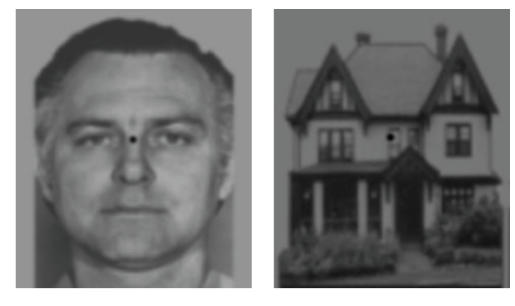
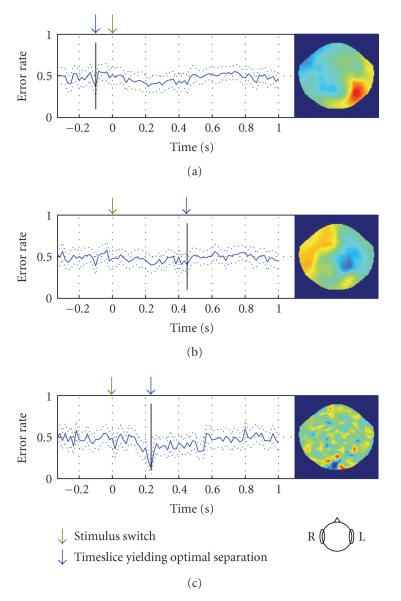
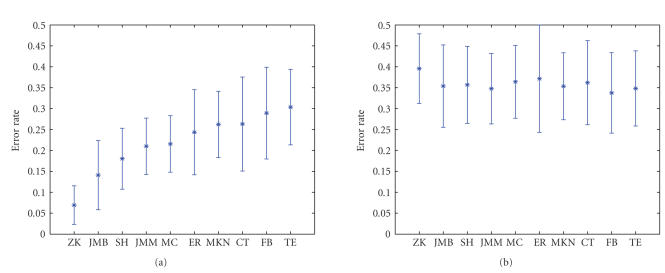
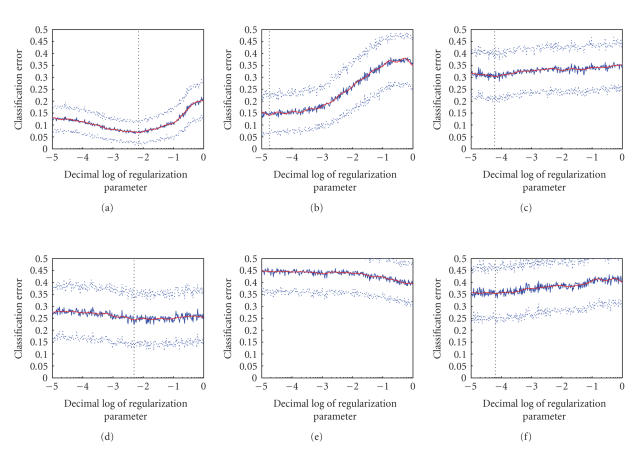
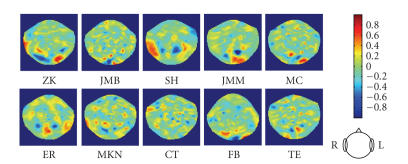
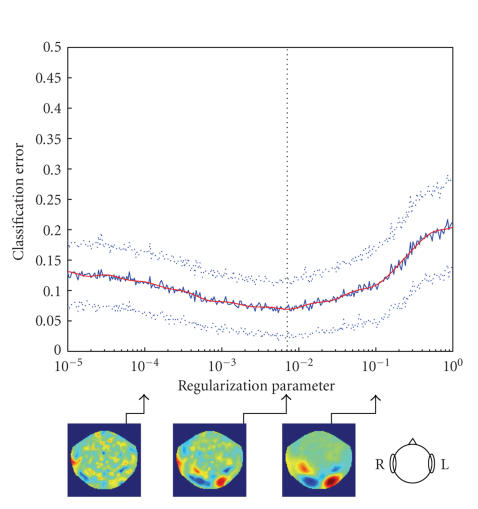
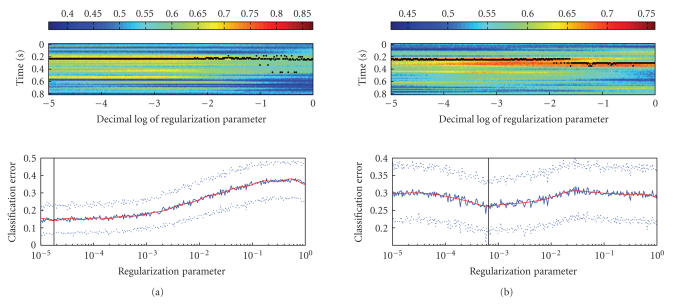
We present a framework for inferring functional brain state from electrophysiological (MEG or EEG) brain signals. Our approach is adapted to the needs of functional brain imaging rather than EEG-based brain-computer interface (BCI). This choice leads to a different set of requirements, in particular to the demand for more robust inference methods and more sophisticated model validation techniques. We approach the problem from a machine learning perspective, by constructing a classifier from a set of labeled signal examples. We propose a framework that focuses on temporal evolution of regularized classifiers, with cross-validation for optimal regularization parameter at each time frame. We demonstrate the inference obtained by this method on MEG data recorded from 10 subjects in a simple visual classification experiment, and provide comparison to the classical nonregularized approach.
我们提出了一种从电生理(MEG 或 EEG)脑信号推断功能脑状态的框架。我们的方法适应于功能脑成像的需求,而不是基于 EEG 的脑机接口(BCI)。这种选择导致了不同的需求,特别是对更稳健的推理方法和更复杂的模型验证技术的需求。我们从机器学习的角度来解决这个问题,通过从一组标记的信号示例中构建一个分类器。我们提出了一个框架,重点关注正则化分类器的时间演化,并在每个时间帧上进行交叉验证以获得最佳正则化参数。我们在一个简单的视觉分类实验中从 10 个被试的 MEG 数据中展示了该方法的推断结果,并与经典的非正则化方法进行了比较。