Mukogawa Women's University Institute for World Health Development, Nishinomiya, Hyogo, 6638143, Japan.
J Biomed Sci. 2010 Aug 24;17 Suppl 1(Suppl 1):S21. doi: 10.1186/1423-0127-17-S1-S21.
Since taurine (T) administration was proven to decrease blood pressure (BP) and stroke mortality in stroke-prone spontaneously hypertension rates (SHRSP) in the 1980's and our WHO-coordinated CARDIAC (Cardiovascular Diseases and Alimentary Comparison) Study demonstrated that among 5 diet-related factors, namely total cholesterol (T-Cho), body mass index (BMI), sodium (Na), magnesium (M), and T to creatinine (Cr) ratio in 24-hour urine (24U), both T/Cr and M/Cr were inversely related to coronary heart disease mortalities in males and females and T/Cr was inversely related to stroke mortalities in males and females. We further analyzed the associations of individual T/Cr and M/Cr levels to cardiovascular risks in the present study.
From WHO-CARDIAC Study populations, 61 populations of 25 countries in the world, Japanese populations with obviously higher 24U T excretion because of their common fish eating custom and the other populations in which both data of T and M were not available were excluded and the data of 3960 individuals from 41 WHO-CARDIAC Study populations were used for the following analyses.
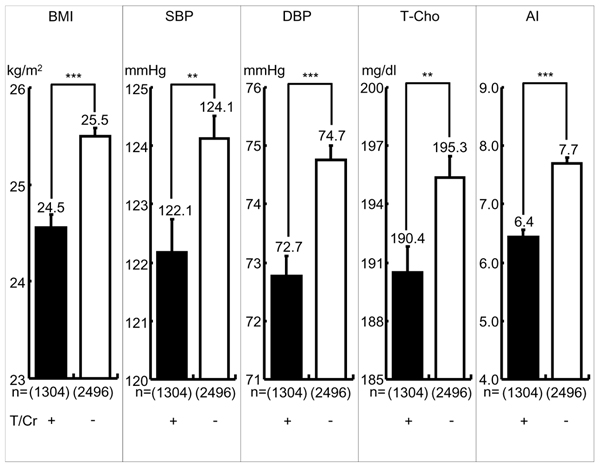
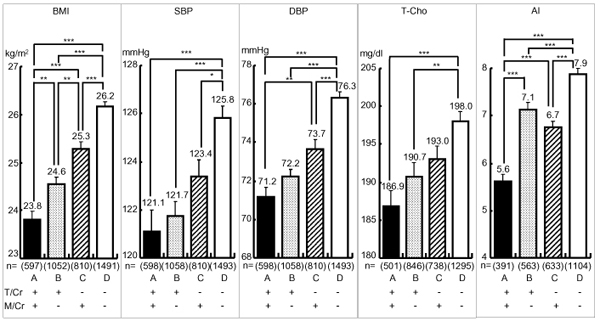
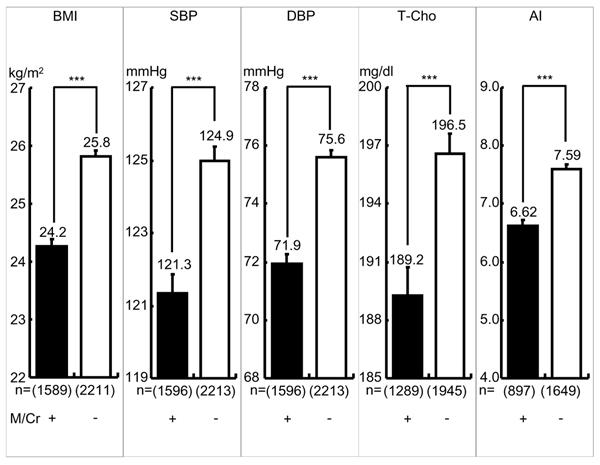
The means of 24U T/Cr and M/Cr ratios in total individual data were 639.4 and 82.8, respectively. The average of BMI, systolic and diastolic blood pressure (SBP, DBP), T-Cho and atherogenic index (AI) in the individuals with more than the means of T/Cr or M/Cr were significantly lower than those of individuals with less than the means. The CARDIAC Study participants were divided into the following 4 groups by these means: A (T/Cr and M/Cr > or = mean), B (T/Cr > or = mean, M/Cr < mean), C (T/Cr < mean, M/Cr > or = mean), D (T/Cr and M/Cr < mean). The group A showed significantly lower values compared with the group D in BMI, SBP, DBP, T-Cho, and AI.
Cardiovascular risks were proven to be highly significantly lower in individuals who were excreting both 24U T and M, more than the averages despite differences in ethnicity and genetic background. Since T and M are biomarkers for seafood, vegetables, soy, nuts, milk, etc., dietary custom to eat these food sources could be recommended for cardiovascular disease prevention.
自 20 世纪 80 年代以来,研究已证实牛磺酸(T)可降低自发性高血压大鼠(SHRSP)的血压(BP)和中风死亡率,而我们的世界卫生组织(WHO)协调的心脏疾病与饮食比较(CARDIAC)研究表明,在 5 个与饮食相关的因素中,即总胆固醇(T-Cho)、体重指数(BMI)、钠(Na)、镁(M)和 24 小时尿液中的 T 与肌酐(Cr)比值(24U)中,T/Cr 和 M/Cr 与男性和女性的冠心病死亡率呈负相关,T/Cr 与男性和女性的中风死亡率呈负相关。在本研究中,我们进一步分析了个体 T/Cr 和 M/Cr 水平与心血管风险的关系。
从 WHO-CARDIAC 研究人群中,排除了来自世界 25 个国家的 61 个群体、由于普遍食用鱼类而导致 24U T 排泄量明显增加的日本人群以及 T 和 M 数据均不可用的其他人群,然后使用来自 41 个 WHO-CARDIAC 研究人群的 3960 个人的数据进行以下分析。
总个体数据的 24U T/Cr 和 M/Cr 比值平均值分别为 639.4 和 82.8。T/Cr 或 M/Cr 平均值以上个体的 BMI、收缩压和舒张压(SBP、DBP)、T-Cho 和致动脉粥样硬化指数(AI)的平均值明显低于 T/Cr 或 M/Cr 平均值以下个体。根据这些平均值,将 CARDIAC 研究参与者分为以下 4 组:A(T/Cr 和 M/Cr≥平均值)、B(T/Cr≥平均值,M/Cr<平均值)、C(T/Cr<平均值,M/Cr≥平均值)、D(T/Cr 和 M/Cr<平均值)。与 D 组相比,A 组的 BMI、SBP、DBP、T-Cho 和 AI 值显著降低。
尽管存在种族和遗传背景差异,但 T 和 M 的排泄量均高于平均值的个体,心血管风险明显较低。由于 T 和 M 是海鲜、蔬菜、大豆、坚果、牛奶等的生物标志物,因此可以推荐食用这些食物来源的饮食方式来预防心血管疾病。