Jain PharmaBiotech, Basel, Switzerland.
BMC Med. 2010 Dec 13;8:83. doi: 10.1186/1741-7015-8-83.
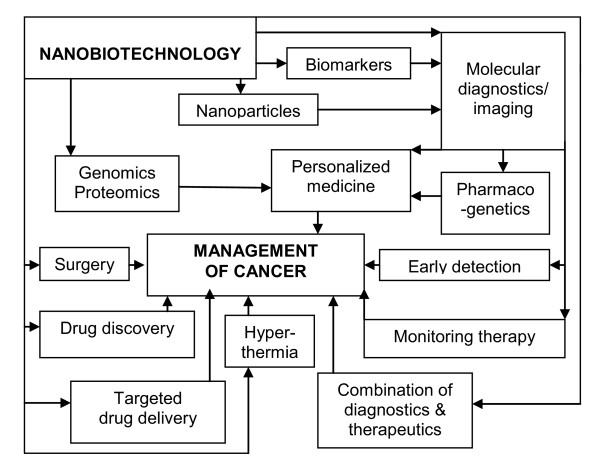
Nanooncology, the application of nanobiotechnology to the management of cancer, is currently the most important chapter of nanomedicine. Nanobiotechnology has refined and extended the limits of molecular diagnosis of cancer, for example, through the use of gold nanoparticles and quantum dots. Nanobiotechnology has also improved the discovery of cancer biomarkers, one such example being the sensitive detection of multiple protein biomarkers by nanobiosensors. Magnetic nanoparticles can capture circulating tumor cells in the bloodstream followed by rapid photoacoustic detection. Nanoparticles enable targeted drug delivery in cancer that increases efficacy and decreases adverse effects through reducing the dosage of anticancer drugs administered. Nanoparticulate anticancer drugs can cross some of the biological barriers and achieve therapeutic concentrations in tumor and spare the surrounding normal tissues from toxic effects. Nanoparticle constructs facilitate the delivery of various forms of energy for noninvasive thermal destruction of surgically inaccessible malignant tumors. Nanoparticle-based optical imaging of tumors as well as contrast agents to enhance detection of tumors by magnetic resonance imaging can be combined with delivery of therapeutic agents for cancer. Monoclonal antibody nanoparticle complexes are under investigation for diagnosis as well as targeted delivery of cancer therapy. Nanoparticle-based chemotherapeutic agents are already on the market, and several are in clinical trials. Personalization of cancer therapies is based on a better understanding of the disease at the molecular level, which is facilitated by nanobiotechnology. Nanobiotechnology will facilitate the combination of diagnostics with therapeutics, which is an important feature of a personalized medicine approach to cancer.
纳米肿瘤学,即将纳米生物技术应用于癌症的管理,是当前纳米医学最重要的篇章。纳米生物技术已经改进和扩展了癌症分子诊断的界限,例如通过使用金纳米粒子和量子点。纳米生物技术也提高了癌症生物标志物的发现,例如纳米生物传感器对多种蛋白质生物标志物的灵敏检测。磁性纳米粒子可以捕获血液中循环的肿瘤细胞,然后通过快速光声检测进行捕获。纳米粒子能够实现癌症的靶向药物输送,通过减少给予的抗癌药物剂量来提高疗效并降低不良反应。纳米颗粒载药可以穿过一些生物屏障,并在肿瘤中达到治疗浓度,同时使周围的正常组织免受毒性作用。纳米粒子构建物有助于输送各种形式的能量,用于非侵入性热破坏难以手术的恶性肿瘤。肿瘤的基于纳米粒子的光学成像以及用于增强磁共振成像检测肿瘤的对比剂可以与癌症治疗药物的输送相结合。用于诊断和癌症治疗靶向递送的单克隆抗体纳米颗粒复合物正在研究中。基于纳米粒子的化疗药物已经上市,并且有几种正在临床试验中。癌症治疗的个性化是基于对疾病在分子水平上更好的理解,这得益于纳米生物技术。纳米生物技术将促进诊断与治疗的结合,这是癌症个体化医学方法的一个重要特征。