Department of Nephrology, University Hospital Essen, University Essen-Duisburg, Hufelandstrasse, Essen, Germany.
Eur J Med Res. 2010 Oct 25;15(10):452-5. doi: 10.1186/2047-783x-15-10-452.
measuring arterial stiffness using pulse wave velocity (PWV) has become an important tool to assess vascular function and cardiovascular mortality. For subject with hypertension, end-stage renal disease and diabetes, PWV has been shown to predict cardiovascular and all-cause mortality. We hypothesize that PWV would also predict mortality in subjects who have undergone kidney transplantation.
a cohort of 330 patients with renal transplantation was studied with a mean age at entry 51.4 ± 0.75 years. Mean follow-up was 3.8 years (± 0.7 years); 16 deaths occurred during follow-up. At entry, together with standard clinical and biochemical parameters, PWV was determined from pressure tracing over carotid and femoral arteries.
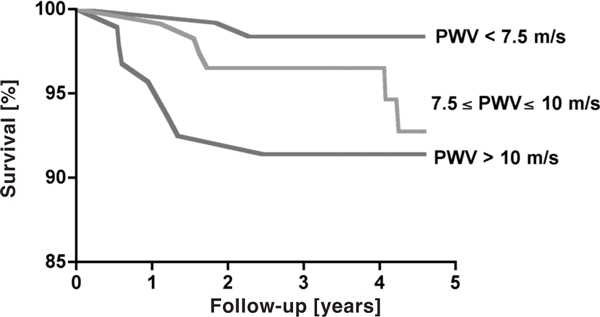
with increasing PWV, there was a significant increase in age, systolic blood pressure and pulse pressure. In addition, subjects with higher PWV also exhibited more frequently the presence of coronary heart disease. On the basis of Cox analyses, PWV and systolic blood pressure emerged as predictors of all-cause mortality.
these results provide evidence that PWV is a strong predictor of all-cause mortality in the population of renal transplant recipients.
使用脉搏波速度(PWV)测量动脉僵硬度已成为评估血管功能和心血管死亡率的重要工具。对于患有高血压、终末期肾病和糖尿病的患者,PWV 已被证明可预测心血管和全因死亡率。我们假设 PWV 也可预测接受过肾移植的患者的死亡率。
对 330 名接受肾移植的患者进行了一项队列研究,平均年龄为 51.4 ± 0.75 岁。平均随访时间为 3.8 年(± 0.7 年);随访期间发生了 16 例死亡。在入组时,除了标准的临床和生化参数外,还从颈动脉和股动脉的压力描记中确定了 PWV。
随着 PWV 的增加,年龄、收缩压和脉压显著增加。此外,PWV 较高的患者也更频繁地存在冠心病。基于 Cox 分析,PWV 和收缩压是全因死亡率的预测因素。
这些结果提供了证据,表明 PWV 是肾移植受者全因死亡率的强有力预测因素。