TNO Quality of Life, Business Unit Food and Biotechnology Innovations, Microbial Genomics Group, Utrechtseweg 48, Zeist, the Netherlands.
BMC Med Genomics. 2011 Mar 4;4:22. doi: 10.1186/1755-8794-4-22.
An understanding of the relation of commensal microbiota to health is essential in preventing disease. Here we studied the oral microbial composition of children (N = 74, aged 3 - 18 years) in natural transition from their deciduous to a permanent dentition and related the microbial profiles to their oral health status. The microbial composition of saliva was assessed by barcoded pyrosequencing of the V5-V6 hypervariable regions of the 16 S rRNA, as well as by using phylogenetic microarrays.
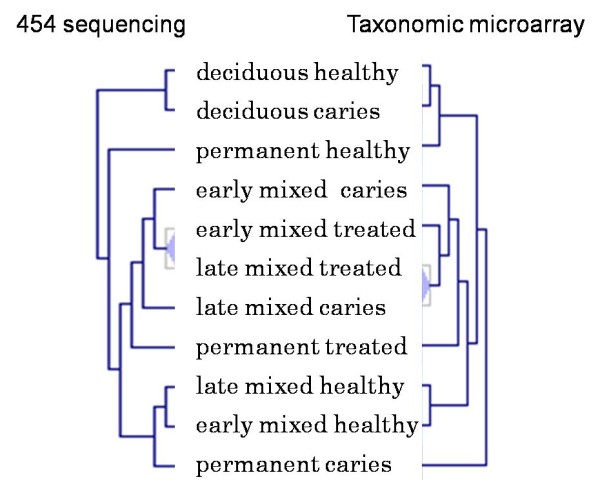
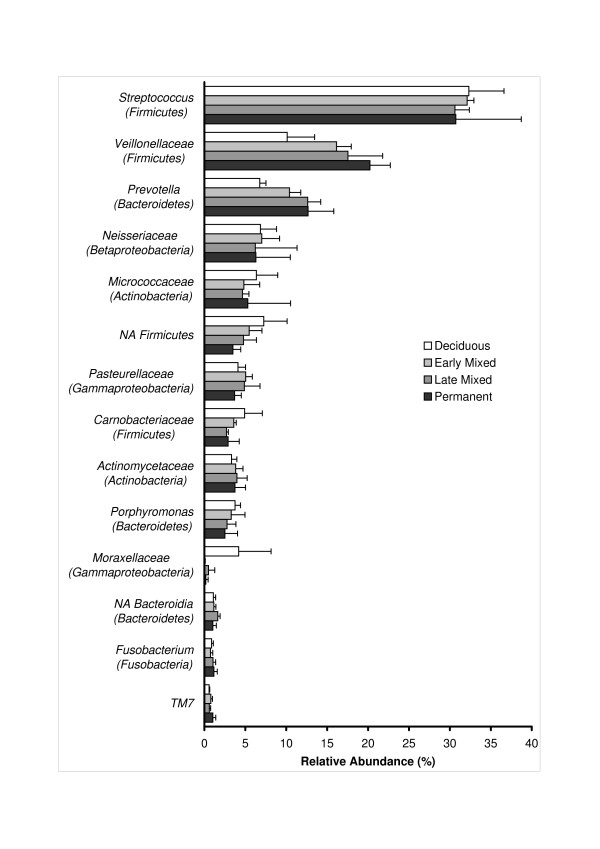
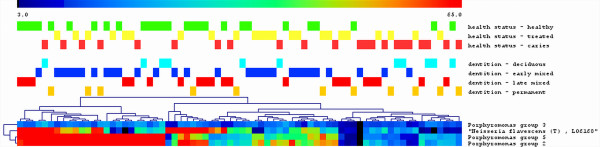
Pyrosequencing reads (126174 reads, 1045 unique sequences) represented 8 phyla and 113 higher taxa in saliva samples. Four phyla--Firmicutes, Bacteriodetes, Proteobacteria and Actinobacteria--predominated in all groups. The deciduous dentition harboured a higher proportion of Proteobacteria (Gammaproteobacteria, Moraxellaceae) than Bacteroidetes, while in all other groups Bacteroidetes were at least as abundant as Proteobacteria. Bacteroidetes (mainly genus Prevotella), Veillonellaceae family, Spirochaetes and candidate division TM7 increased with increasing age, reflecting maturation of the microbiome driven by biological changes with age. Microarray analysis enabled further analysis of the individual salivary microbiota. Of 350 microarray probes, 156 gave a positive signal with, on average, 77 (range 48-93) probes per individual sample. A caries-free oral status significantly associated with the higher signal of the probes targeting Porphyromonas catoniae and Neisseria flavescens.
The potential role of P. catoniae and N. flavescens as oral health markers should be assessed in large-scale clinical studies. The combination of both open-ended and targeted molecular approaches provides us with information that will increase our understanding of the interplay between the human host and its microbiome.
了解共生微生物群与健康的关系对于预防疾病至关重要。在这里,我们研究了儿童(N=74,年龄 3-18 岁)从乳牙到恒牙自然过渡过程中的口腔微生物组成,并将微生物谱与口腔健康状况相关联。通过对 16S rRNA 的 V5-V6 高变区进行条码焦磷酸测序以及使用系统发生微阵列,评估了唾液中的微生物组成。
焦磷酸测序读取(126174 个读取,1045 个独特序列)代表了唾液样本中 8 个门和 113 个高级分类群。四个门 - 厚壁菌门、拟杆菌门、变形菌门和放线菌门 - 在所有组中均占主导地位。乳牙组中变形菌门(γ-变形菌纲、莫拉氏菌科)的比例高于拟杆菌门,而在所有其他组中,拟杆菌门与变形菌门的丰度至少相同。拟杆菌门(主要属普雷沃氏菌属)、韦荣球菌科、螺旋体和候选门 TM7 随着年龄的增长而增加,反映了由年龄相关的生物学变化驱动的微生物组成熟。微阵列分析使我们能够进一步分析个体唾液微生物群。在 350 个微阵列探针中,有 156 个探针给出了阳性信号,每个个体样本的平均信号有 77 个(范围为 48-93 个)探针。无龋口腔状态与针对 Porphyromonas catoniae 和 Neisseria flavescens 的探针的更高信号显著相关。
P. catoniae 和 N. flavescens 作为口腔健康标志物的潜在作用应在大规模临床研究中进行评估。开放式和靶向分子方法的结合为我们提供了信息,将增加我们对人类宿主与其微生物组相互作用的理解。