Department of Psychology, Max Planck Institute for Human Cognitive and Brain Sciences, Leipzig, Germany.
Exp Brain Res. 2011 Jun;211(3-4):371-85. doi: 10.1007/s00221-011-2709-9. Epub 2011 May 15.
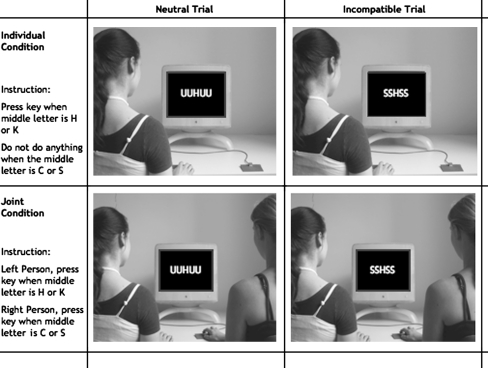
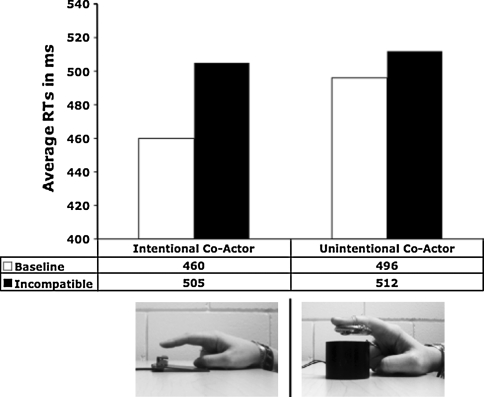
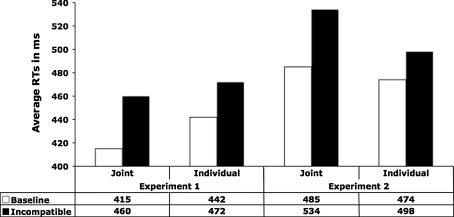
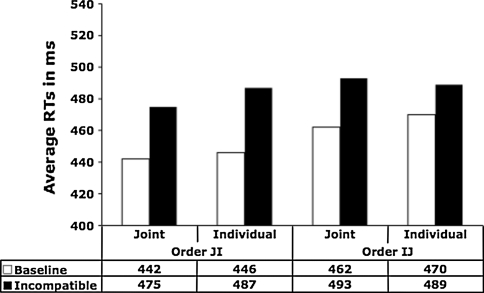
The Eriksen flanker task (Eriksen and Eriksen in Percept Psychophys 16:143-149, 1974) was distributed among pairs of participants to investigate whether individuals take into account a co-actor's S-R mapping even when coordination is not required. Participants responded to target letters (Experiment 1) or colors (Experiment 2) surrounded by distractors. When performing their part of the task next to another person performing the complementary part of the task, participants responded more slowly to stimuli containing flankers that were potential targets for their co-actor (incompatible trials), compared to stimuli containing identical, compatible, or neutral flankers. This joint Flanker effect also occurred when participants merely believed to be performing the task with a co-actor (Experiment 3). Furthermore, Experiment 4 demonstrated that people form shared task representations only when they perceive their co-actor as intentionally controlling her actions. These findings substantiate and generalize earlier results on shared task representations and advance our understanding of the basic mechanisms subserving joint action.
埃里克森侧翼任务(Eriksen 和 Eriksen 在 Percept Psychophys 16:143-149, 1974)在参与者对之间分配,以调查即使不需要协调,个体是否会考虑到共同行动者的 S-R 映射。参与者对目标字母(实验 1)或颜色(实验 2)做出反应,周围环绕着干扰项。当与执行任务的互补部分的另一个人一起执行任务时,与包含可能是共同行动者的目标的侧翼(不兼容试验)的刺激相比,参与者对包含相同、兼容或中性侧翼的刺激的反应速度较慢。当参与者仅认为自己与共同行动者一起执行任务时(实验 3),也会出现这种联合的 Flanker 效应。此外,实验 4 表明,只有当人们认为他们的共同行动者有意控制她的行动时,他们才会形成共同的任务表示。这些发现证实和推广了关于共同任务表示的早期结果,并推进了我们对联合行动基本机制的理解。