Roffman E, Albert J P, Goff J P, Frenkel N
Laboratory of Viral Diseases, National Institute of Allergy and Infectious Diseases/Twinbrook, Rockville, Maryland.
J Virol. 1990 Dec;64(12):6308-13. doi: 10.1128/JVI.64.12.6308-6313.1990.
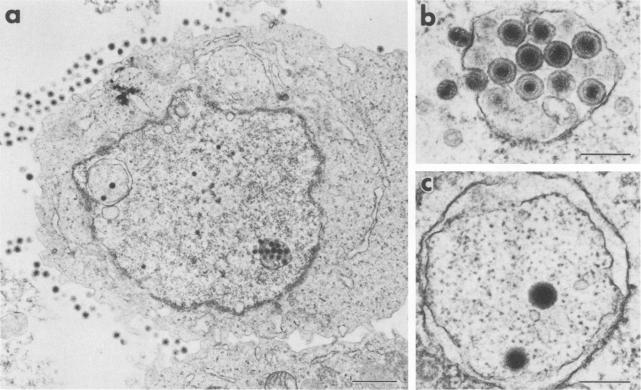
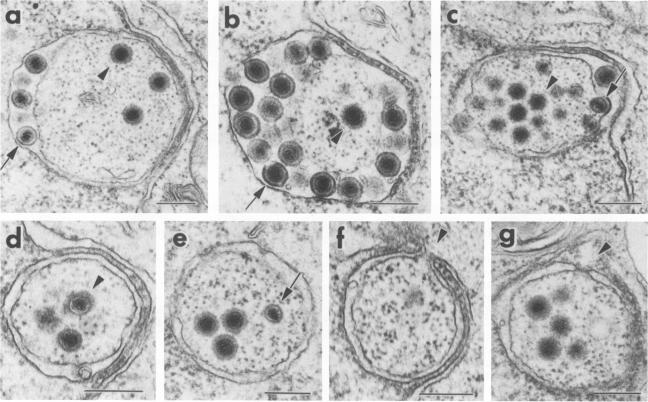
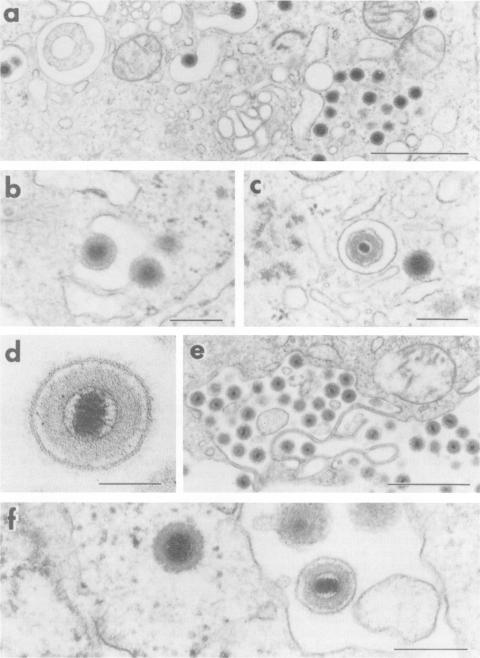
The virion of human herpesvirus 6 (HHV-6) contains a very distinct tegument layer, occupying the space between the nucleocapsid and the virion envelope. Ultrastructural analyses of thymocytes infected with HHV-6 revealed the presence of intranuclear spherical compartments, approximately 1.5 microns in diameter, in which tegumentation seems to take place. These compartments, termed tegusomes, were bounded by two membranes and contained ribosomes, consistent with their derivation by cytoplasmic invagination into the nucleus. Capsids located within the nucleus outside the tegusomes were all naked, while those located in the cytoplasm were uniformly tegumented. In contrast, capsids present inside the tegusomes contains teguments of variable thicknesses. In addition, nucleocapsids were documented in the process of budding into the tegusomes. We thus suggest that the tegusomes represent a cellular site in which HHV-6 virions acquire their tegument.
人类疱疹病毒6型(HHV-6)的病毒粒子含有一层非常独特的内膜层,占据核衣壳和病毒粒子包膜之间的空间。对感染HHV-6的胸腺细胞进行的超微结构分析显示,存在直径约1.5微米的核内球形区室,内膜化似乎在此发生。这些区室称为内膜体,由两层膜界定并含有核糖体,这与其通过细胞质内陷进入细胞核的起源一致。位于内膜体外细胞核内的衣壳都是裸露的,而位于细胞质中的衣壳则均匀地带有内膜。相比之下,内膜体内的衣壳含有厚度不一的内膜。此外,有记录显示核衣壳正在出芽进入内膜体。因此,我们认为内膜体代表了HHV-6病毒粒子获取其内膜的细胞位点。