Department of Immunology and Infectious Diseases, Harvard School of Public Health Boston, MA, USA.
Front Microbiol. 2011 May 26;2:111. doi: 10.3389/fmicb.2011.00111. eCollection 2011.
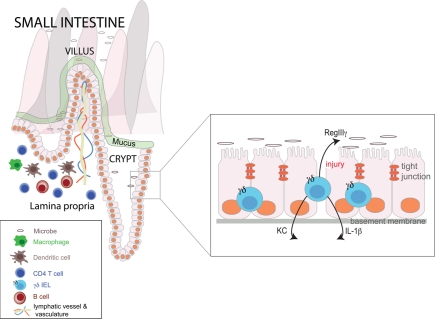
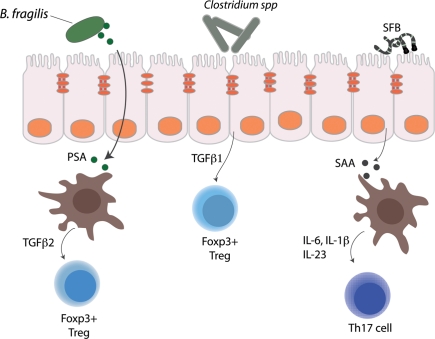
It is intuitive that immune cells in the gut may require microbiota-derived cues for their differentiation. The proximity between host and microbe in the intestine would seemingly necessitate co-adaptation. However, it has been challenging to determine the members and features of the gut microbiota that influence immune system development and function. The recent identification of immunomodulatory members of the commensal microbiota is providing insight into the dependence of select, intestinal immune cell subsets on specific microbial species. In this review, we focus on the gut microbiota's influence on the development and function of mucosal T cells subsets, specifically intraepithelial lymphocytes and lamina propria CD4 T cells.
很显然,肠道中的免疫细胞可能需要微生物群衍生的信号来进行分化。宿主和肠道微生物之间的接近程度似乎需要共同适应。然而,确定影响免疫系统发育和功能的肠道微生物群的成员和特征一直具有挑战性。最近,共生微生物群落中免疫调节成员的鉴定为了解特定肠道免疫细胞亚群对特定微生物物种的依赖性提供了线索。在这篇综述中,我们重点讨论了肠道微生物群对黏膜 T 细胞亚群(特别是上皮内淋巴细胞和固有层 CD4 T 细胞)的发育和功能的影响。