De Luca Alessio, Stefani Laura, Pedrizzetti Gianni, Pedri Stefano, Galanti Giorgio
Sport Medicine Centre, University of Florence, V. delle Oblate, 4, 50134 Florence, Italy.
Cardiovasc Ultrasound. 2011 Oct 12;9:27. doi: 10.1186/1476-7120-9-27.
Regular training, in particular endurance exercise, induces structural myocardial adaptation, so-called "athlete's heart". In addition to the 2D standard echo parameters, assessment of myocardial function is currently possible by deformation parameters (strain, rotation and twist). Aim of study is to assess the role of rotation and twist parameters for better characterize the heart performance in trained elite young athletes from different kind of sports. Eventually, verify early on any possible impact due to the regular sport activity not revealed by the standard parameters.
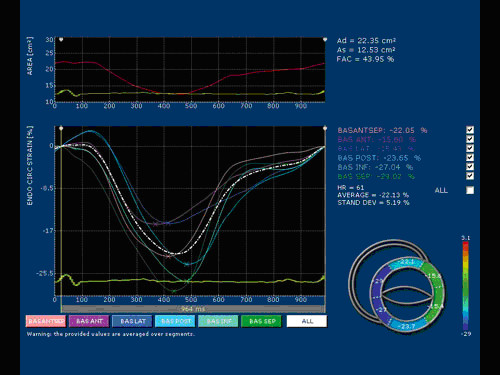
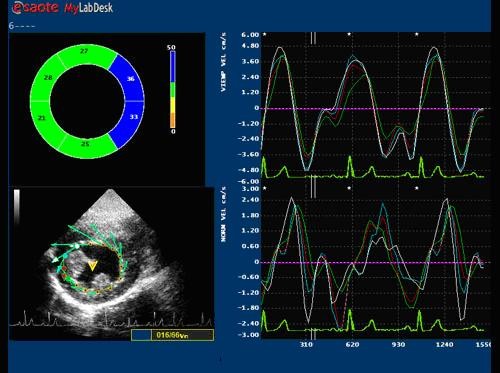
50 young athletes (16 cyclists, 17 soccer players, 17 basket players) regularly trained at least three times a week for at least 9 months a year and 10 young controls (mean age 18.5 ± 0.5 years) were evaluated either by to 2D echocardiography or by a Speckle Tracking (ST) multi-layer approach to calculate Left Ventricle (LV) endocardial and epicardial rotation, twist, circumferential strain (CS) and longitudinal strain (LS). Data were compared by ANOVA test.
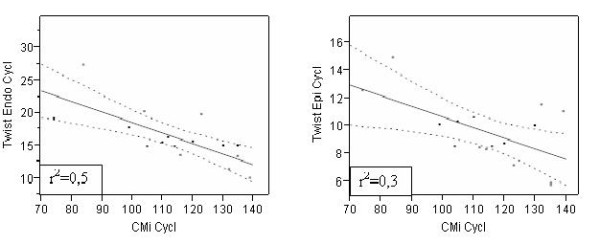
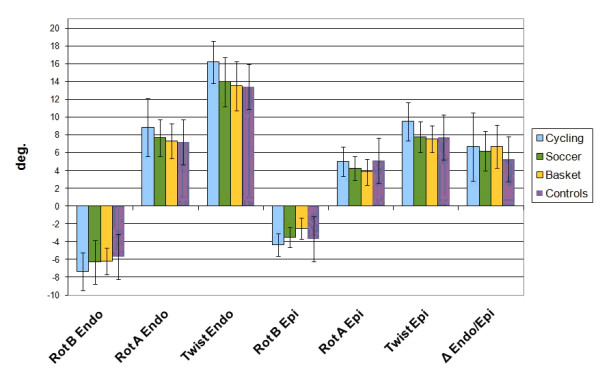
All the found values were within the normal range. Left Ventricle Diastolic Diameter (LVDD 51.7 ± 2.6 mm), Cardiac Mass index (CMi 114.5 ± 18.5 g/m²), epi-CS, epi-LS, epicardial apex rotation and the Endo/Epi twist were significantly higher only in cyclists. In all the groups, a physiological difference of the Endo/Epi basal circumferential strain and twist values have been found. A weak but not significant relationship between the Endo and twist values and LVDD (r² = 0.44, p = .005) and CMi was also reported in cyclists.
Progressive increase of apical LV twist may represent an important component of myocardial remodelling. This aspect is particularly evident in the young cyclists group where the CMi and the LVDD are higher. ST multilayer approach completes the LV performance evaluation in young trained athletes showing values similar to adults.
规律训练,尤其是耐力运动,会引起心肌结构适应性改变,即所谓的“运动员心脏”。除了二维标准超声心动图参数外,目前还可以通过形变参数(应变、旋转和扭转)评估心肌功能。本研究的目的是评估旋转和扭转参数在更好地描述来自不同运动项目的训练有素的年轻精英运动员心脏功能方面的作用。最终,尽早验证常规运动活动可能产生的任何未被标准参数揭示的影响。
对50名年轻运动员(16名自行车运动员、17名足球运动员、17名篮球运动员)进行评估,他们每年至少每周规律训练三次,每次至少9个月,另外对10名年轻对照组(平均年龄18.5±0.5岁)进行二维超声心动图或斑点追踪(ST)多层方法评估,以计算左心室(LV)心内膜和心外膜的旋转、扭转、圆周应变(CS)和纵向应变(LS)。通过方差分析检验比较数据。
所有测得值均在正常范围内。仅自行车运动员的左心室舒张直径(LVDD 51.7±2.6 mm)、心脏质量指数(CMi 114.5±18.5 g/m²)、心外膜CS、心外膜LS、心外膜心尖旋转以及心内膜/心外膜扭转显著更高。在所有组中,均发现心内膜/心外膜基底圆周应变和扭转值存在生理差异。在自行车运动员中,还报告了心内膜与扭转值和LVDD(r² = 0.44,p = 0.005)以及CMi之间存在微弱但不显著的关系。
左心室心尖扭转的逐渐增加可能是心肌重塑的一个重要组成部分。这一现象在CMi和LVDD较高的年轻自行车运动员组中尤为明显。ST多层方法完善了对年轻训练有素运动员左心室功能的评估,其显示的值与成年人相似。