Wellman Center for Photomedicine, Massachusetts General Hospital, Boston, Massachusetts, United States of America.
PLoS One. 2011;6(10):e26212. doi: 10.1371/journal.pone.0026212. Epub 2011 Oct 18.
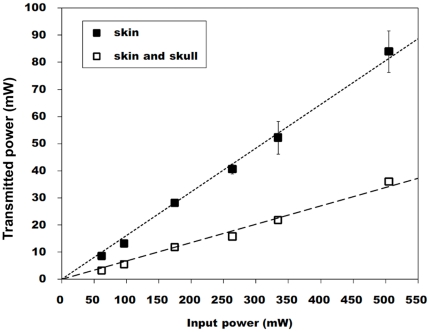
Transcranial low-level laser therapy (LLLT) using near-infrared light can efficiently penetrate through the scalp and skull and could allow non-invasive treatment for traumatic brain injury (TBI). In the present study, we compared the therapeutic effect using 810-nm wavelength laser light in continuous and pulsed wave modes in a mouse model of TBI.
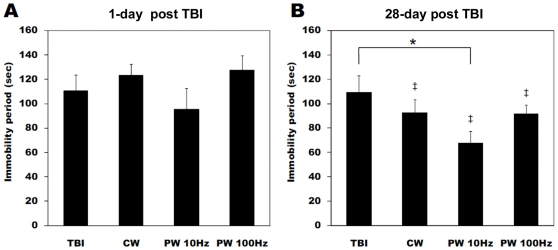
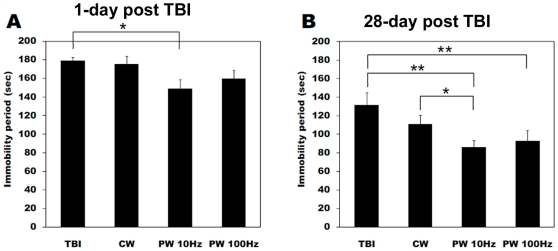
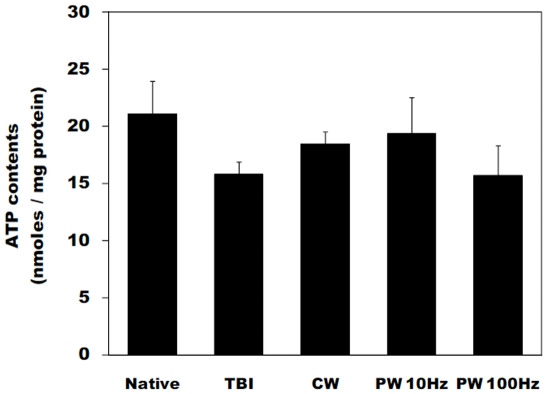
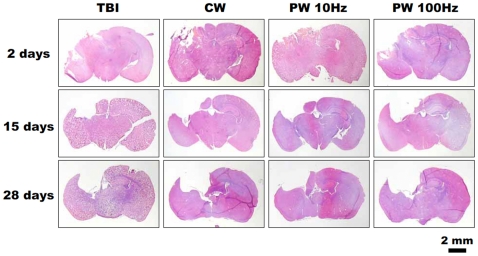
STUDY DESIGN/MATERIALS AND METHODS: TBI was induced by a controlled cortical-impact device and 4-hours post-TBI 1-group received a sham treatment and 3-groups received a single exposure to transcranial LLLT, either continuous wave or pulsed at 10-Hz or 100-Hz with a 50% duty cycle. An 810-nm Ga-Al-As diode laser delivered a spot with diameter of 1-cm onto the injured head with a power density of 50-mW/cm(2) for 12-minutes giving a fluence of 36-J/cm(2). Neurological severity score (NSS) and body weight were measured up to 4 weeks. Mice were sacrificed at 2, 15 and 28 days post-TBI and the lesion size was histologically analyzed. The quantity of ATP production in the brain tissue was determined immediately after laser irradiation. We examined the role of LLLT on the psychological state of the mice at 1 day and 4 weeks after TBI using tail suspension test and forced swim test.
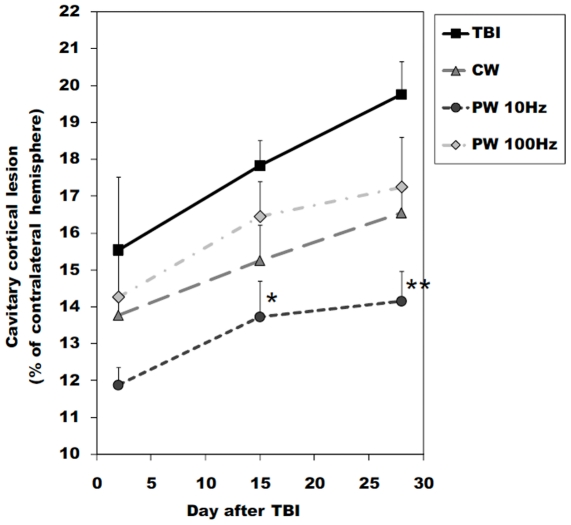
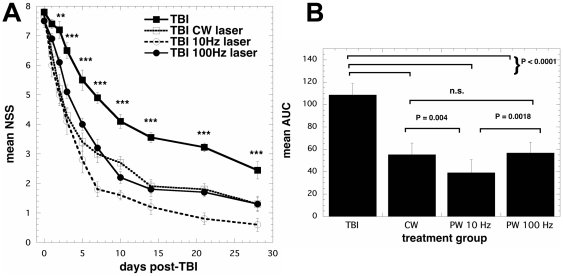
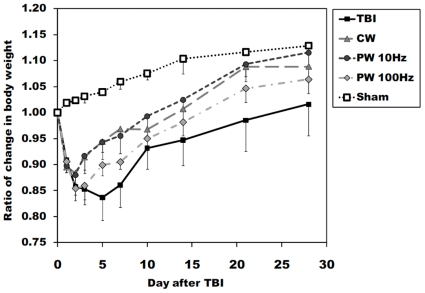
The 810-nm laser pulsed at 10-Hz was the most effective judged by improvement in NSS and body weight although the other laser regimens were also effective. The brain lesion volume of mice treated with 10-Hz pulsed-laser irradiation was significantly lower than control group at 15-days and 4-weeks post-TBI. Moreover, we found an antidepressant effect of LLLT at 4-weeks as shown by forced swim and tail suspension tests.
The therapeutic effect of LLLT for TBI with an 810-nm laser was more effective at 10-Hz pulse frequency than at CW and 100-Hz. This finding may provide a new insight into biological mechanisms of LLLT.
使用近红外光的经颅低水平激光疗法(LLLT)可以有效地穿透头皮和颅骨,从而实现对创伤性脑损伤(TBI)的非侵入性治疗。在本研究中,我们比较了在 TBI 小鼠模型中使用 810nm 波长激光的连续波和脉冲波模式的治疗效果。
研究设计/材料和方法:使用皮质撞击装置诱导 TBI,在 TBI 后 4 小时,1 组接受假治疗,3 组接受单次经颅 LLLT 照射,分别为连续波或 10Hz 或 100Hz 的脉冲波,占空比为 50%。一个 810nmGa-Al-As 二极管激光将直径为 1cm 的光斑照射到受伤的头部,功率密度为 50mW/cm²,照射 12 分钟,累积剂量为 36J/cm²。在 4 周内测量神经严重程度评分(NSS)和体重。在 TBI 后 2、15 和 28 天处死小鼠,并对病变大小进行组织学分析。激光照射后立即测定脑组织中 ATP 的产生量。我们在 TBI 后 1 天和 4 周使用悬尾试验和强迫游泳试验检查 LLLT 对小鼠心理状态的影响。
以 NSS 和体重的改善为判断标准,10Hz 脉冲激光最为有效,尽管其他激光方案也有效。在 TBI 后 15 天和 4 周,接受 10Hz 脉冲激光照射的小鼠的脑损伤体积明显小于对照组。此外,我们发现 LLLT 在 4 周时具有抗抑郁作用,表现为强迫游泳和悬尾试验。
810nm 激光治疗 TBI 的疗效以 10Hz 脉冲频率优于连续波和 100Hz。这一发现可能为 LLLT 的生物学机制提供新的见解。