Division of Environmental Medicine, Norwegian Institute of Public Health, Oslo, Norway.
Environ Health Perspect. 2013 Mar;121(3):374-9. doi: 10.1289/ehp.1205396. Epub 2012 Nov 29.
Acrylamide has shown developmental and reproductive toxicity in animals, as well as neurotoxic effects in humans with occupational exposures. Because it is widespread in food and can pass through the human placenta, concerns have been raised about potential developmental effects of dietary exposures in humans.
We assessed associations of prenatal exposure to dietary acrylamide with small for gestational age (SGA) and birth weight.
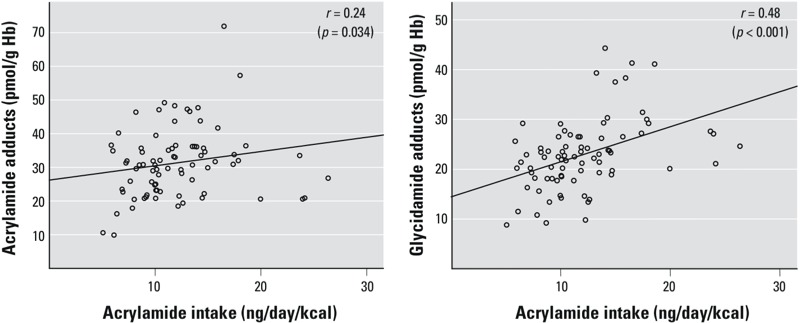
This study included 50,651 women in the Norwegian Mother and Child Cohort Study (MoBa). Acrylamide exposure assessment was based on intake estimates obtained from a food frequency questionnaire (FFQ), which were compared with hemoglobin (Hb) adduct measurements reflecting acrylamide exposure in a subset of samples (n = 79). Data on infant birth weight and gestational age were obtained from the Medical Birth Registry of Norway. Multivariable regression was used to estimate associations between prenatal acrylamide and birth outcomes.
Acrylamide intake during pregnancy was negatively associated with fetal growth. When women in the highest quartile of acrylamide intake were compared with women in the lowest quartile, the multivariable-adjusted odds ratio (OR) for SGA was 1.11 (95% CI: 1.02, 1.21) and the coefficient for birth weight was -25.7 g (95% CI: -35.9, -15.4). Results were similar after excluding mothers who smoked during pregnancy. Maternal acrylamide- and glycidamide-Hb adduct levels were correlated with estimated dietary acrylamide intakes (Spearman correlations = 0.24; 95% CI: 0.02, 0.44; and 0.48; 95% CI: 0.29, 0.63, respectively).
Lowering dietary acrylamide intake during pregnancy may improve fetal growth.
丙烯酰胺已在动物中显示出发育毒性和生殖毒性,并且职业暴露的人类也具有神经毒性。由于它在食物中广泛存在并且可以穿过胎盘,因此人们担心人类饮食暴露可能会对发育产生影响。
我们评估了产前暴露于饮食中的丙烯酰胺与小于胎龄儿(SGA)和出生体重的关系。
这项研究包括挪威母亲和儿童队列研究(MoBa)中的 50651 名妇女。丙烯酰胺暴露评估是基于从食物频率问卷(FFQ)中获得的摄入量估算值得出的,该值与反映样本中丙烯酰胺暴露的血红蛋白(Hb)加合物测量值进行了比较(n = 79)。婴儿出生体重和胎龄的数据来自挪威医学出生登记处。多变量回归用于估计产前丙烯酰胺与出生结局之间的关系。
怀孕期间丙烯酰胺的摄入量与胎儿生长呈负相关。当将摄入丙烯酰胺最多的四分位数的妇女与摄入丙烯酰胺最少的四分位数的妇女进行比较时,SGA 的多变量调整比值比(OR)为 1.11(95%CI:1.02,1.21),出生体重的系数为-25.7g(95%CI:-35.9,-15.4)。排除怀孕期间吸烟的母亲后,结果相似。母体丙烯酰胺和丙烯醛-Hb 加合物水平与估计的饮食丙烯酰胺摄入量相关(Spearman 相关系数分别为 0.24(95%CI:0.02,0.44)和 0.48(95%CI:0.29,0.63))。
怀孕期间降低饮食中的丙烯酰胺摄入量可能会改善胎儿生长。