Department of Virology, Institute of Tropical Medicine, Global COE Program, Leading Graduate School Program, Nagasaki University, Nagasaki, Japan.
Virol J. 2013 Mar 4;10:68. doi: 10.1186/1743-422X-10-68.
Tick-borne encephalitis virus (TBEV) is a causative agent of acute central nervous system disease in humans. It has three subtypes, far eastern (FE), Siberian (Sib) and European (Eu) subtypes, which are distributed over a wide area of Europe and Asia. The objective of this study was to develop a simple and rapid assay for the detection of TBEV RNA by using reverse-transcriptase loop-mediated isothermal amplification (RT-LAMP) method that can differentiate the three subtypes of TBEV and can be used for clinical diagnosis and epidemiological study.
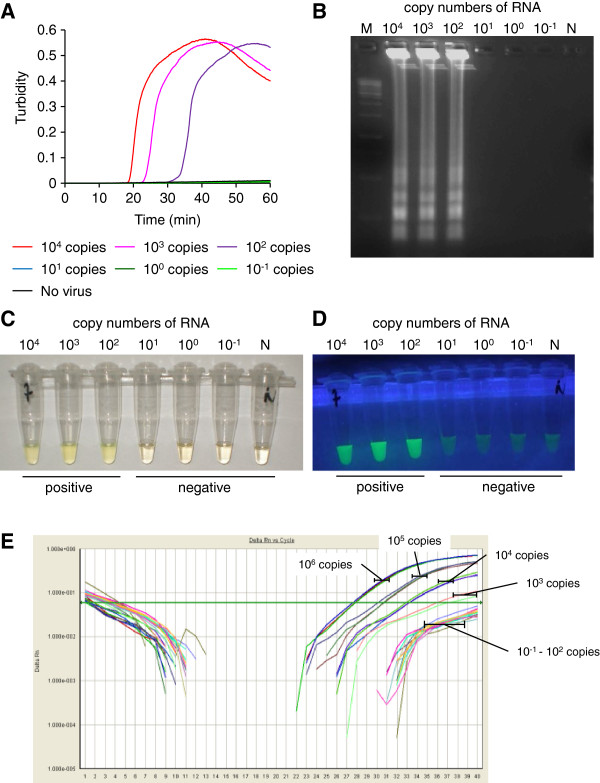
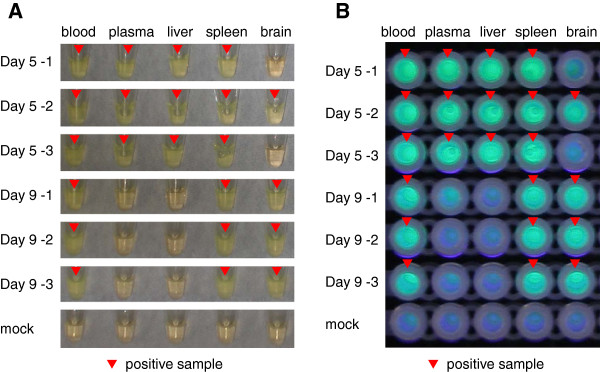
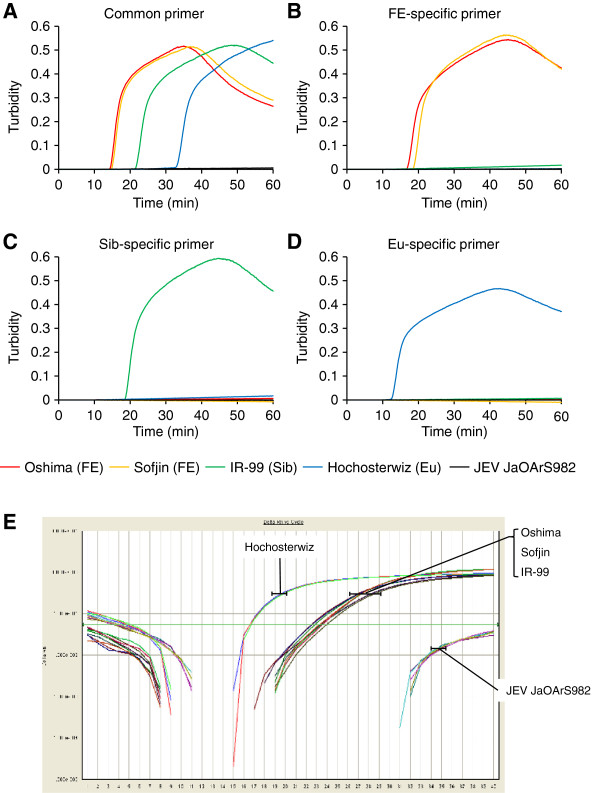
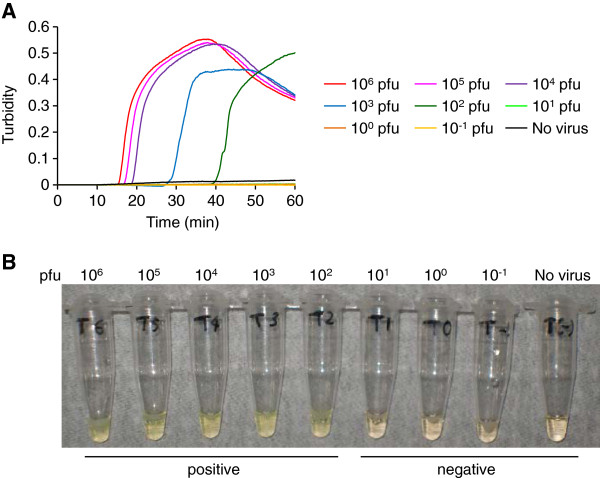
Primers for TBEV-specific and subtype-specific RT-LAMP assay were designed to target the consensus sequence in NS1 of all subtypes and the consensus sequence in the E gene of each subtype, respectiveluy. In vitro transcribed RNA of Oshima strain that belongs to FE subtype was serially diluted and used to examine the sensitivity of the assay. Cross-reactivity of subtype-specific RT-LAMP assay was tested by using the RNA of Oshima and Sofjin (FE), IR-99 (Sib) and Hochosterwitz (Eu) strains. RNA extracted from the mixtures of TBEV and ticks, and of TBEV and human blood, and the mouse tissues infected with TBEV, were evaluated in the assay. Positive amplification was observed by real-time monitoring of turbidity and by visual detection of color change.
The sensitivity of TBEV-specific RT-LAMP assay was 102 copies of target RNA per reaction volume. FE-specific RT-LAMP assay amplified viral genes of Oshima and Sofjin strains but not of IR-99 and Hochosterwitz strains, and of Japanese encephalitis virus. RT-LAMP assay for Sib and for Eu specifically amplified viral genes of IR-99 and Hochosterwitz strains, respectively. We also showed that tick or human blood extract did not inhibit the amplification of viral gene during the assay. Furthermore, we confirmed that the TBEV RT-LAMP could detect virus RNA from peripheral and central nervous system tissues of laboratory mice infected with TBEV.
TBEV RT-LAMP assay offers a sensitive, specific, rapid and easy-to-handle method for the detection of TBEV RNA in tick samples and this may be applied in the clinical samples collected from TBE-suspected patients.
蜱传脑炎病毒(TBEV)是人类急性中枢神经系统疾病的病原体。它有三个亚型,远东(FE)、西伯利亚(Sib)和欧洲(Eu)亚型,分布在欧洲和亚洲的广大地区。本研究的目的是开发一种简单快速的检测方法,通过逆转录环介导等温扩增(RT-LAMP)方法检测 TBEV RNA,该方法可以区分 TBEV 的三个亚型,并可用于临床诊断和流行病学研究。
设计了针对所有亚型 NS1 中的保守序列和每个亚型 E 基因中的保守序列的 TBEV 特异性和亚型特异性 RT-LAMP 检测引物。使用属于 FE 亚型的 Oshima 株的体外转录 RNA 进行连续稀释,并用于检测该检测方法的灵敏度。使用 Oshima 和 Sofjin(FE)、IR-99(Sib)和 Hochosterwitz(Eu)株的 RNA 测试亚型特异性 RT-LAMP 检测的交叉反应性。从 TBEV 和蜱、TBEV 和人血的混合物以及感染 TBEV 的小鼠组织中提取的 RNA 在该检测中进行了评估。通过实时监测浊度和观察颜色变化来观察阳性扩增。
TBEV 特异性 RT-LAMP 检测的灵敏度为每个反应体积 102 个靶 RNA 拷贝。FE 特异性 RT-LAMP 检测扩增了 Oshima 和 Sofjin 株的病毒基因,但未扩增 IR-99 和 Hochosterwitz 株以及日本脑炎病毒的基因。Sib 和 Eu 的 RT-LAMP 检测分别特异性扩增了 IR-99 和 Hochosterwitz 株的病毒基因。我们还表明,在检测过程中,蜱或人血提取物不会抑制病毒基因的扩增。此外,我们证实 TBEV RT-LAMP 可以检测感染 TBEV 的实验小鼠外周和中枢神经系统组织中的病毒 RNA。
TBEV RT-LAMP 检测方法为蜱样本中 TBEV RNA 的检测提供了一种敏感、特异、快速且易于操作的方法,可应用于疑似 TBE 患者的临床样本。