Department of Radiology, Oslo University Hospital, University of Oslo, Oslo, Norway.
Eur Radiol. 2013 Aug;23(8):2061-71. doi: 10.1007/s00330-013-2820-3. Epub 2013 Apr 4.
To compare double readings when interpreting full field digital mammography (2D) and tomosynthesis (3D) during mammographic screening.
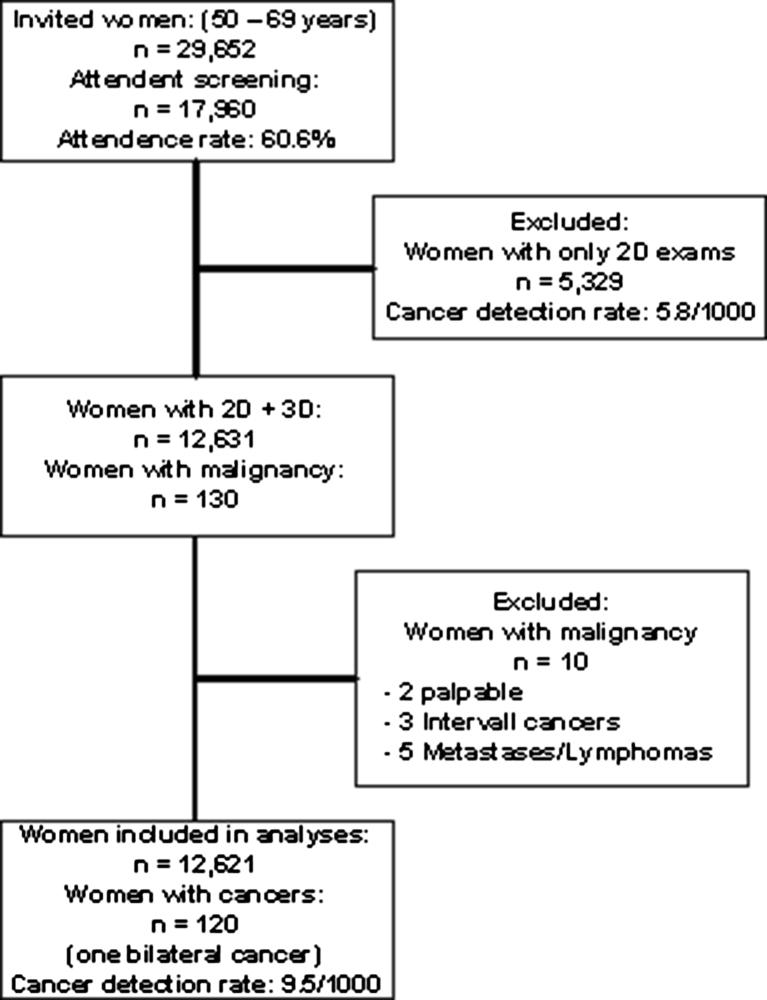
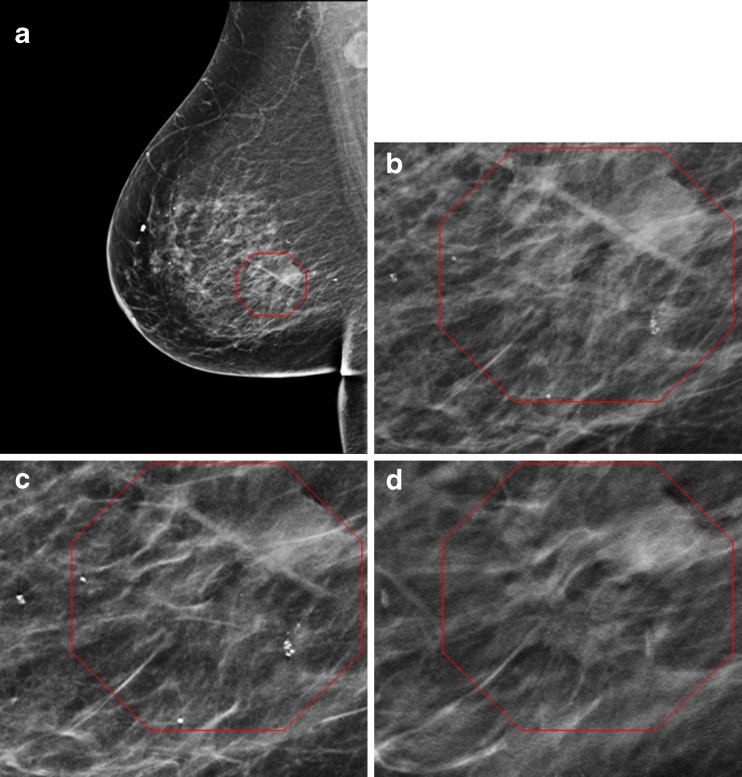
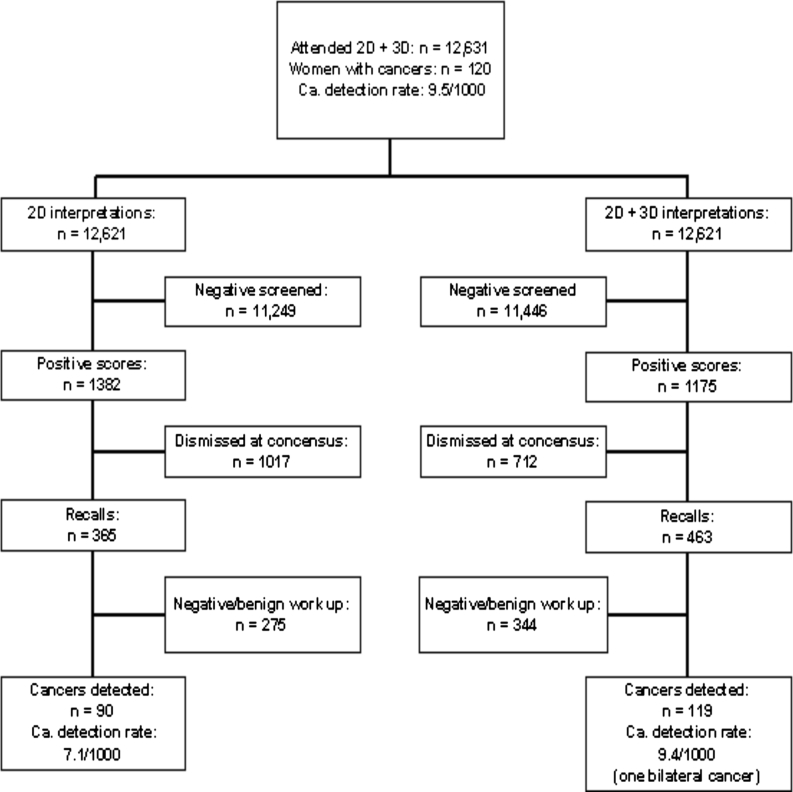
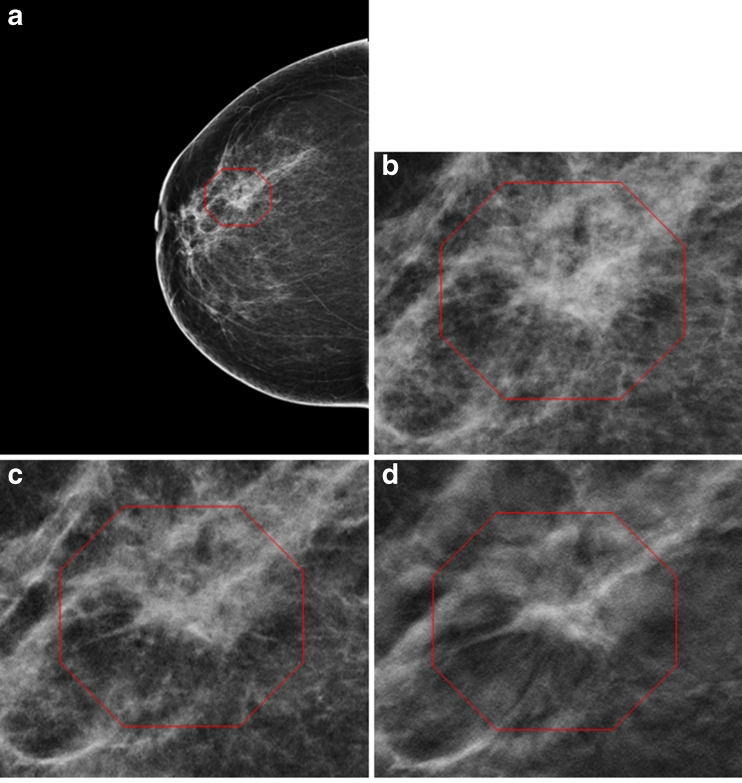
A prospective, Ethical Committee approved screening study is underway. During the first year 12,621 consenting women underwent both 2D and 3D imaging. Each examination was independently interpreted by four radiologists under four reading modes: Arm A-2D; Arm B-2D + CAD; Arm C-2D + 3D; Arm D-synthesised 2D + 3D. Examinations with a positive score by at least one reader were discussed at an arbitration meeting before a final management decision. Paired double reading of 2D (Arm A + B) and 2D + 3D (Arm C + D) were analysed. Performance measures were compared using generalised linear mixed models, accounting for inter-reader performance heterogeneity (P < 0.05).
Pre-arbitration false-positive scores were 10.3 % (1,286/12,501) and 8.5 % (1,057/12,501) for 2D and 2D + 3D, respectively (P < 0.001). Recall rates were 2.9 % (365/12,621) and 3.7 % (463/12,621), respectively (P = 0.005). Cancer detection was 7.1 (90/12,621) and 9.4 (119/12,621) per 1,000 examinations, respectively (30 % increase, P < 0.001); positive predictive values (detected cancer patients per 100 recalls) were 24.7 % and 25.5 %, respectively (P = 0.97). Using 2D + 3D, double-reading radiologists detected 27 additional invasive cancers (P < 0.001).
Double reading of 2D + 3D significantly improves the cancer detection rate in mammography screening.
• Tomosynthesis-based screening was successfully implemented in a large prospective screening trial. • Double reading of tomosynthesis-based examinations significantly reduced false-positive interpretations. • Double reading of tomosynthesis significantly increased the detection of invasive cancers.
比较全视野数字乳腺摄影(2D)和断层合成(3D)在乳腺筛查中进行双读片时的效果。
正在进行一项前瞻性、伦理委员会批准的筛查研究。在第一年中,有 12621 名同意的女性接受了 2D 和 3D 成像检查。每次检查均由 4 名放射科医生在 4 种阅读模式下独立解读:臂 A-2D;臂 B-2D+CAD;臂 C-2D+3D;臂 D-合成 2D+3D。至少有一位读者评分阳性的检查将在仲裁会议上进行讨论,然后再做出最终管理决定。分析了 2D(臂 A+B)和 2D+3D(臂 C+D)的双读片。使用广义线性混合模型比较了性能指标,并考虑了读者间的性能异质性(P<0.05)。
2D 的预仲裁假阳性评分分别为 10.3%(12501 例中有 1286 例)和 8.5%(12501 例中有 1057 例)(P<0.001)。召回率分别为 2.9%(12621 例中有 365 例)和 3.7%(12621 例中有 463 例)(P=0.005)。癌症检出率分别为 7.1(每 1000 例中有 90 例)和 9.4(每 1000 例中有 119 例),分别增加了 30%(P<0.001);阳性预测值(每 100 次召回检出的癌症患者数)分别为 24.7%和 25.5%(P=0.97)。使用 2D+3D,双读片放射科医生检出了 27 例额外的浸润性癌症(P<0.001)。
2D+3D 的双读片显著提高了乳腺筛查中的癌症检出率。
• 断层合成筛查在一项大型前瞻性筛查试验中成功实施。• 断层合成检查的双读片显著减少了假阳性解读。• 断层合成的双读片显著增加了浸润性癌症的检出率。