Institute of Sciences of Food Production ISPA, National Research Council CNR, Bari, Italy.
Toxins (Basel). 2013 Apr 19;5(4):717-42. doi: 10.3390/toxins5040717.
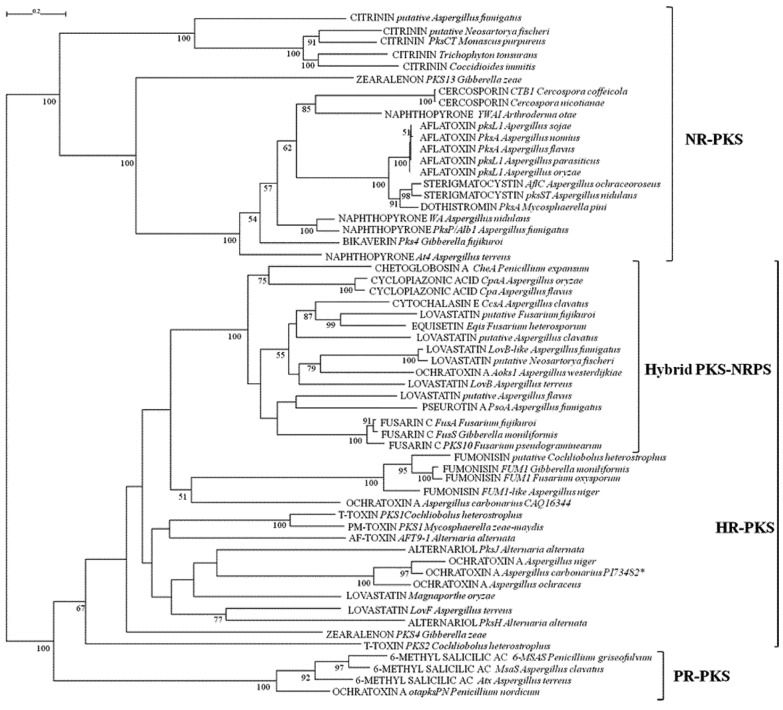
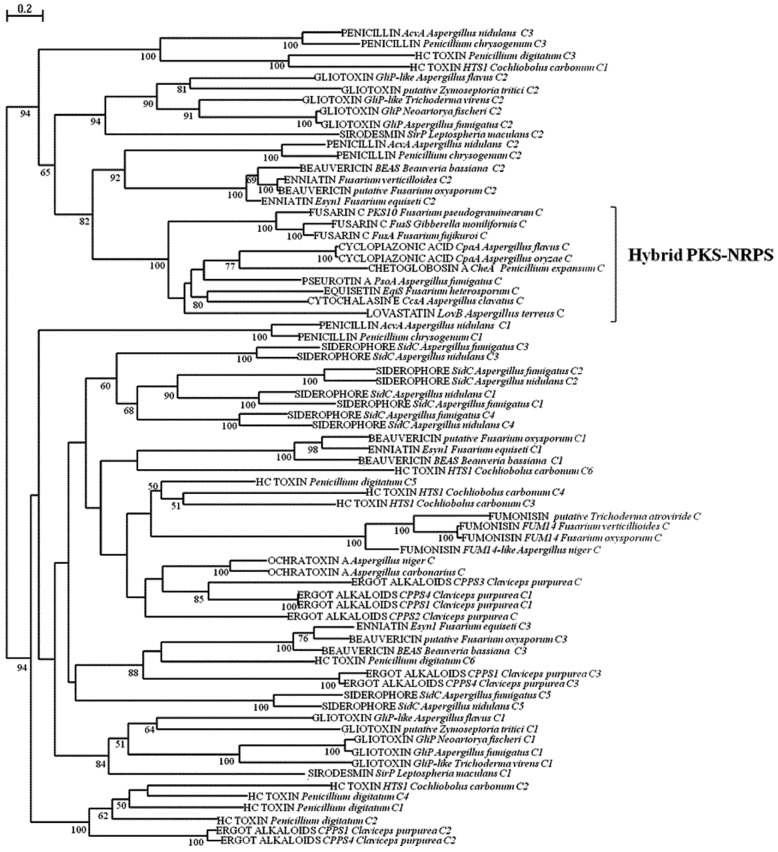
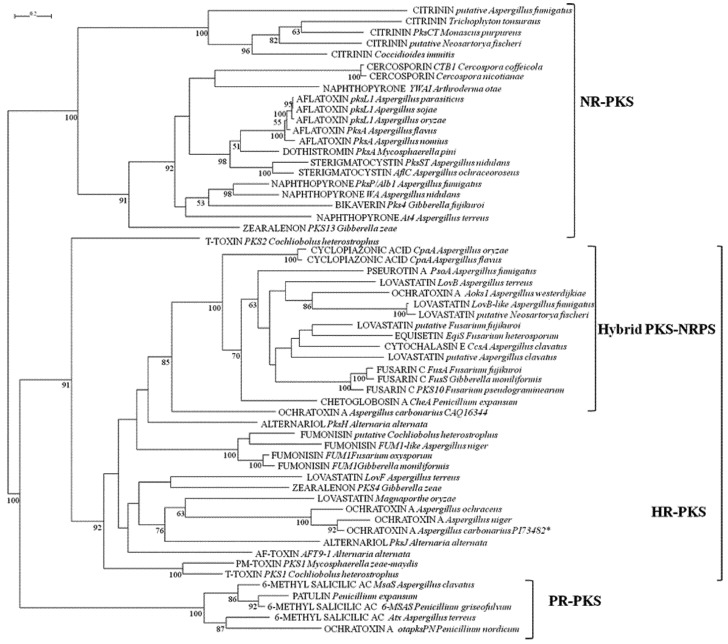
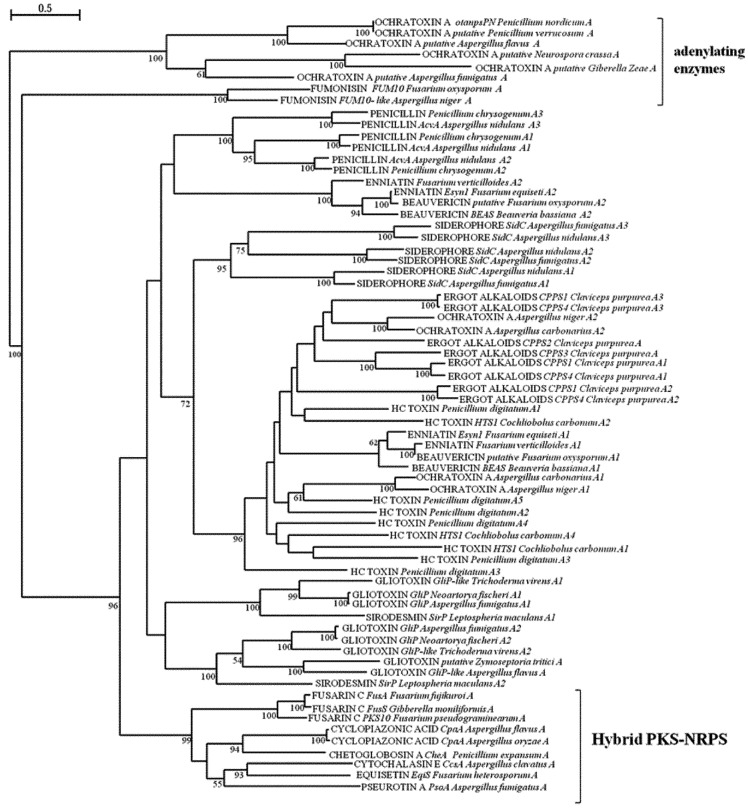
Polyketide synthase (PKSs) and nonribosomal peptide synthetase (NRPSs) are large multimodular enzymes involved in biosynthesis of polyketide and peptide toxins produced by fungi. Furthermore, hybrid enzymes, in which a reducing PKS region is fused to a single NRPS module, are also responsible of the synthesis of peptide-polyketide metabolites in fungi. The genes encoding for PKSs and NRPSs have been exposed to complex evolutionary mechanisms, which have determined the great number and diversity of metabolites. In this study, we considered the most important polyketide and peptide mycotoxins and, for the first time, a phylogenetic analysis of both PKSs and NRPSs involved in their biosynthesis was assessed using two domains for each enzyme: β-ketosynthase (KS) and acyl-transferase (AT) for PKSs; adenylation (A) and condensation (C) for NRPSs. The analysis of both KS and AT domains confirmed the differentiation of the three classes of highly, partially and non-reducing PKSs. Hybrid PKS-NRPSs involved in mycotoxins biosynthesis grouped together in the phylogenetic trees of all the domains analyzed. For most mycotoxins, the corresponding biosynthetic enzymes from distinct fungal species grouped together, except for PKS and NRPS involved in ochratoxin A biosynthesis, for which an unlike process of evolution could be hypothesized in different species.
聚酮合酶(PKSs)和非核糖体肽合酶(NRPSs)是参与真菌产生的聚酮和肽毒素生物合成的大型多模块酶。此外,其中还原 PKS 区域融合到单个 NRPS 模块的杂交酶也负责真菌中肽-聚酮代谢物的合成。编码 PKSs 和 NRPSs 的基因经历了复杂的进化机制,这决定了代谢物的大量多样性。在这项研究中,我们考虑了最重要的聚酮和肽类真菌毒素,并且首次使用每个酶的两个结构域(β-酮基合酶(KS)和酰基转移酶(AT)用于 PKS;腺嘌呤化(A)和缩合(C)用于 NRPS)评估了它们生物合成中涉及的 PKSs 和 NRPSs 的系统发育分析。KS 和 AT 结构域的分析证实了三类高度、部分和非还原 PKSs 的分化。参与真菌毒素生物合成的杂交 PKS-NRPSs 在所有分析的结构域的系统发育树中聚在一起。对于大多数真菌毒素,来自不同真菌物种的相应生物合成酶聚集在一起,但产赭曲霉毒素 A 的 PKS 和 NRPS 除外,不同物种可能存在不同的进化过程。