Saw Swee Hock School of Public Health, National University of Singapore, Singapore, Republic of Singapore.
Int J Behav Nutr Phys Act. 2013 May 30;10:70. doi: 10.1186/1479-5868-10-70.
Recent evidence shows that sedentary behaviour may be an independent risk factor for cardiovascular diseases, diabetes, cancers and all-cause mortality. However, results are not consistent and different types of sedentary behaviour might have different effects on health. Thus the aim of this study was to evaluate the association between television screen time, computer/reading time and cardio-metabolic biomarkers in a multiethnic urban Asian population. We also sought to understand the potential mediators of this association.
The Singapore Prospective Study Program (2004-2007), was a cross-sectional population-based study in a multiethnic population in Singapore. We studied 3305 Singaporean adults of Chinese, Malay and Indian ethnicity who did not have pre-existing diseases and conditions that could affect their physical activity. Multiple linear regression analysis was used to assess the association of television screen time and computer/reading time with cardio-metabolic biomarkers [blood pressure, lipids, glucose, adiponectin, C reactive protein and homeostasis model assessment of insulin resistance (HOMA-IR)]. Path analysis was used to examine the role of mediators of the observed association.
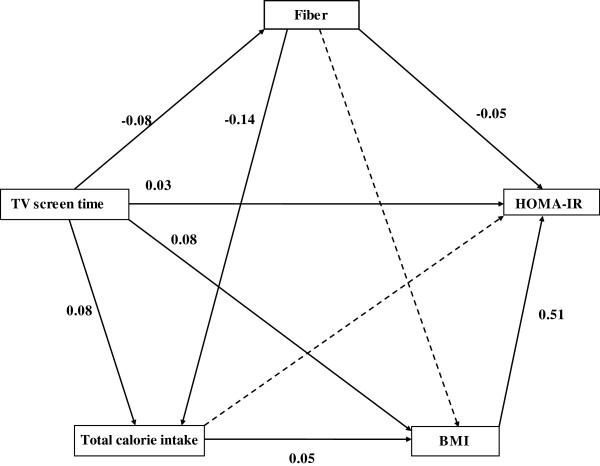
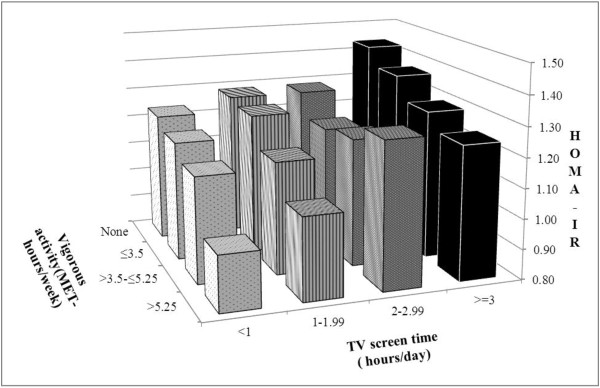
Longer television screen time was significantly associated with higher systolic blood pressure, total cholesterol, triglycerides, C reactive protein, HOMA-IR, and lower adiponectin after adjustment for potential socio-demographic and lifestyle confounders. Dietary factors and body mass index, but not physical activity, were potential mediators that explained most of these associations between television screen time and cardio-metabolic biomarkers. The associations of television screen time with triglycerides and HOMA-IR were only partly explained by dietary factors and body mass index. No association was observed between computer/ reading time and worse levels of cardio-metabolic biomarkers.
In this urban Asian population, television screen time was associated with worse levels of various cardio-metabolic risk factors. This may reflect detrimental effects of television screen time on dietary habits rather than replacement of physical activity.
最近的证据表明,久坐行为可能是心血管疾病、糖尿病、癌症和全因死亡率的独立危险因素。然而,结果并不一致,不同类型的久坐行为可能对健康有不同的影响。因此,本研究旨在评估多民族城市亚洲人群中看电视时间、电脑/阅读时间与心血管代谢生物标志物之间的关系。我们还试图了解这种关联的潜在中介因素。
新加坡前瞻性研究计划(2004-2007 年)是在新加坡多民族人群中进行的一项横断面人群基础研究。我们研究了 3305 名没有影响其身体活动的既往疾病和状况的新加坡成年人,他们分别属于华族、马来族和印族。多元线性回归分析用于评估看电视时间和电脑/阅读时间与心血管代谢生物标志物[血压、血脂、血糖、脂联素、C 反应蛋白和稳态模型评估的胰岛素抵抗(HOMA-IR)]之间的关系。路径分析用于检验观察到的关联中介因素的作用。
在调整潜在的社会人口统计学和生活方式混杂因素后,看电视时间较长与收缩压、总胆固醇、甘油三酯、C 反应蛋白、HOMA-IR 升高和脂联素降低显著相关。饮食因素和体重指数,而不是身体活动,是解释看电视时间与心血管代谢生物标志物之间大多数关联的潜在中介因素。看电视时间与甘油三酯和 HOMA-IR 的关联部分由饮食因素和体重指数解释。电脑/阅读时间与心血管代谢生物标志物水平恶化之间没有关联。
在这个城市亚洲人群中,看电视时间与各种心血管代谢风险因素的水平较差有关。这可能反映了看电视时间对饮食习惯的有害影响,而不是身体活动的替代。