Patil Shrikant L, Somashekarappa Hm, Rajashekhar Kp
Department of Physiology, K. S. Hegde Medical Academy, Nitte University, Mangalore, Karnataka, India.
Indian J Nucl Med. 2012 Oct;27(4):237-42. doi: 10.4103/0972-3919.115394.
Radiation therapy is the prime treatment modality against various cancers. However, its use is limited due to the effects of radiation on normal tissues.
In view of this, present study was carried out to evaluate the radioprotective potential of Rutin (RUT) and Quercetin (QRT) in Swiss Albino mice exposed to the whole body gamma radiation. To gain insight into the mechanism of action, RUT and QRT were tested for its antioxidant levels in mice.
Optimum protective dose of RUT and QRT against radiation induced animal mortality was selected by administration of various doses of the RUT and QRT before 10 Gy gamma irradiation.
Swiss Albino mice were used for the assessment of radiation induced sickness along with the survival analysis and anti-oxidative properties of RUT and QRT.
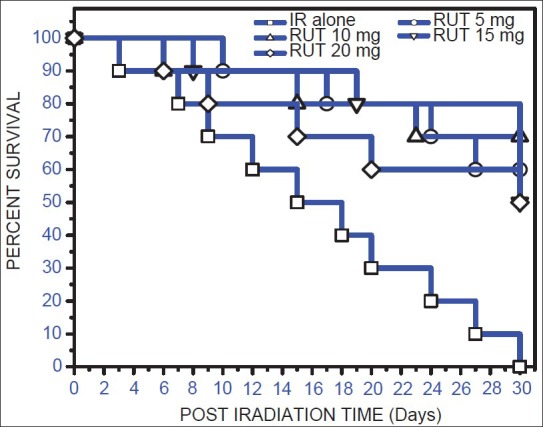
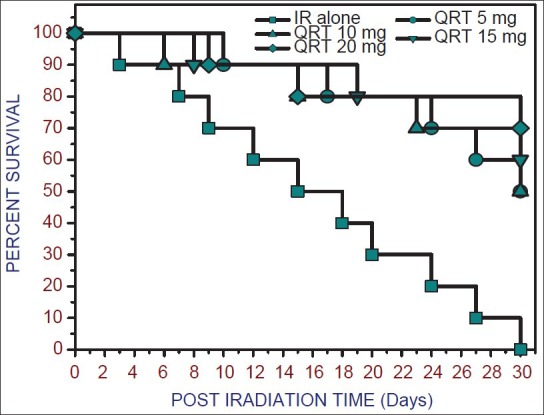
Survival studies were determined using the Kaplan-Meier survival curves.
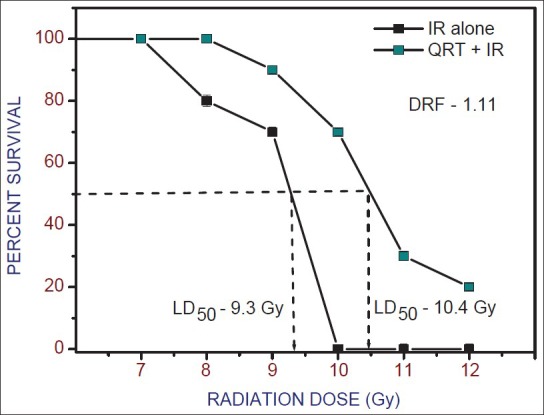
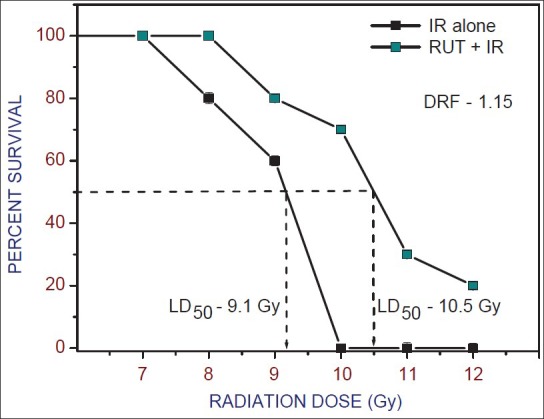
The maximum survival was observed with 10 mg/kg. b. wt. and 20 mg/kg. b. wt. of RUT and QRT respectively, this dose was considered as an optimal dose for radioprotection. Treatment of mice with RUT and QRT before irradiation delayed the onset of mortality as compared with the untreated irradiated controls. The oral administration of RUT and QRT resulted in an increase in the radiation tolerance and the dose reduction factor was found to be 1.15 and 1.11 respectively. RUT and QRT pre-treatment significantly (P < 0.01) elevated levels of reduced glutathione, glutathione-S-transferase, catalase, Superoxide dismutase, and a decreased lipid peroxidation in mouse liver homogenate at 24 h after exposure to 4.5 Gy.
Present findings demonstrate the potential of RUT and QRT in mitigating radiation-induced mortality, which may be attributed to the elevation in the antioxidant status, anti-lipid peroxidative potential.
放射治疗是针对各种癌症的主要治疗方式。然而,由于辐射对正常组织的影响,其应用受到限制。
有鉴于此,本研究旨在评估芦丁(RUT)和槲皮素(QRT)对接受全身γ射线辐射的瑞士白化小鼠的辐射防护潜力。为深入了解其作用机制,对小鼠体内的RUT和QRT的抗氧化水平进行了检测。
在10 Gyγ射线照射前,通过给予不同剂量的RUT和QRT,选择出对辐射诱导动物死亡具有最佳保护作用的剂量。
使用瑞士白化小鼠评估辐射诱导的疾病情况,同时分析RUT和QRT的生存情况及抗氧化特性。
采用Kaplan-Meier生存曲线进行生存研究。
分别给予10 mg/kg体重和20 mg/kg体重的RUT和QRT时观察到最大存活率,该剂量被视为辐射防护的最佳剂量。与未治疗的辐射对照组相比,照射前用RUT和QRT治疗小鼠可延迟死亡的发生。口服RUT和QRT可提高辐射耐受性,剂量降低因子分别为1.15和1.11。在暴露于4.5 Gy后24小时,RUT和QRT预处理显著(P<0.01)提高了小鼠肝脏匀浆中还原型谷胱甘肽、谷胱甘肽-S-转移酶、过氧化氢酶、超氧化物歧化酶的水平,并降低了脂质过氧化水平。
目前的研究结果表明RUT和QRT具有减轻辐射诱导死亡的潜力,这可能归因于抗氧化状态的提高和抗脂质过氧化潜力。