Non-Clinical-Safety, F, Hoffmann - La Roche AG, Grenzacherstrasse 124, 4070, Basel, Switzerland.
BMC Bioinformatics. 2013 Dec 13;14:361. doi: 10.1186/1471-2105-14-361.
Boolean models are increasingly used to study biological signaling networks. In a Boolean network, nodes represent biological entities such as genes, proteins or protein complexes, and edges indicate activating or inhibiting influences of one node towards another. Depending on the input of activators or inhibitors, Boolean networks categorize nodes as either active or inactive. The formalism is appealing because for many biological relationships, we lack quantitative information about binding constants or kinetic parameters and can only rely on a qualitative description of the type "A activates (or inhibits) B". A central aim of Boolean network analysis is the determination of attractors (steady states and/or cycles). This problem is known to be computationally complex, its most important parameter being the number of network nodes. Various algorithms tackle it with considerable success. In this paper we present an algorithm, which extends the size of analyzable networks thanks to simple and intuitive arguments.
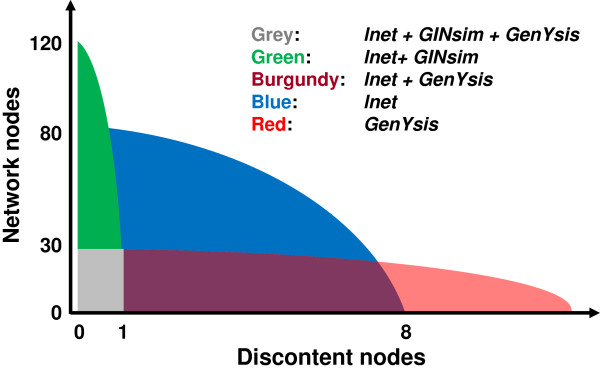
We present lnet, a software package which, in fully asynchronous updating mode and without any network reduction, detects the fixed states of Boolean networks with up to 150 nodes and a good part of any present cycles for networks with up to half the above number of nodes. The algorithm goes through a complete enumeration of the states of appropriately selected subspaces of the entire network state space. The size of these relevant subspaces is small compared to the full network state space, allowing the analysis of large networks. The subspaces scanned for the analyses of cycles are larger, reducing the size of accessible networks. Importantly, inherent in cycle detection is a classification scheme based on the number of non-frozen nodes of the cycle member states, with cycles characterized by fewer non-frozen nodes being easier to detect. It is further argued that these detectable cycles are also the biologically more important ones. Furthermore, lnet also provides standard Boolean analysis features such as node loop detection.
lnet is a software package that facilitates the analysis of large Boolean networks. Its intuitive approach helps to better understand the network in question.
布尔网络越来越多地被用于研究生物信号网络。在布尔网络中,节点代表生物实体,如基因、蛋白质或蛋白质复合物,边表示一个节点对另一个节点的激活或抑制影响。根据激活剂或抑制剂的输入,布尔网络将节点分类为活跃或不活跃。这种形式主义很有吸引力,因为对于许多生物学关系,我们缺乏关于结合常数或动力学参数的定量信息,只能依靠对“A 激活(或抑制)B”类型的定性描述。布尔网络分析的一个中心目标是确定吸引子(稳定状态和/或循环)。这个问题在计算上很复杂,其最重要的参数是网络节点的数量。各种算法都取得了相当大的成功。在本文中,我们提出了一种算法,该算法通过简单直观的论证扩展了可分析网络的规模。
我们提出了 lnet,这是一个软件包,在完全异步更新模式下,无需任何网络简化,即可检测具有多达 150 个节点的布尔网络的固定状态,并为具有上述节点数一半以下的网络检测大部分现有循环。该算法通过对整个网络状态空间的适当选择子空间的状态进行完全枚举。与整个网络状态空间相比,这些相关子空间的大小较小,允许对大型网络进行分析。用于循环分析的子空间更大,减少了可访问网络的大小。重要的是,循环检测中固有一个基于循环成员状态中非冻结节点数量的分类方案,具有较少非冻结节点的循环更容易检测。进一步认为,这些可检测的循环也是生物学上更重要的循环。此外,lnet 还提供了标准的布尔分析功能,如节点环路检测。
lnet 是一个方便分析大型布尔网络的软件包。其直观的方法有助于更好地理解所研究的网络。