Deep Kamal, Poddar Abhijit, Das Subrata K
Institute of Life Sciences, Department of Biotechnology, Bhubaneswar, India.
PLoS One. 2013 Dec 20;8(12):e85493. doi: 10.1371/journal.pone.0085493. eCollection 2013.
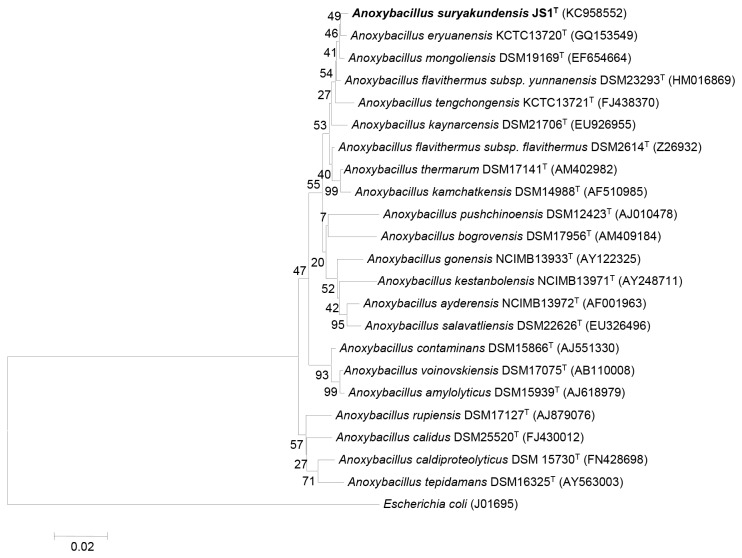
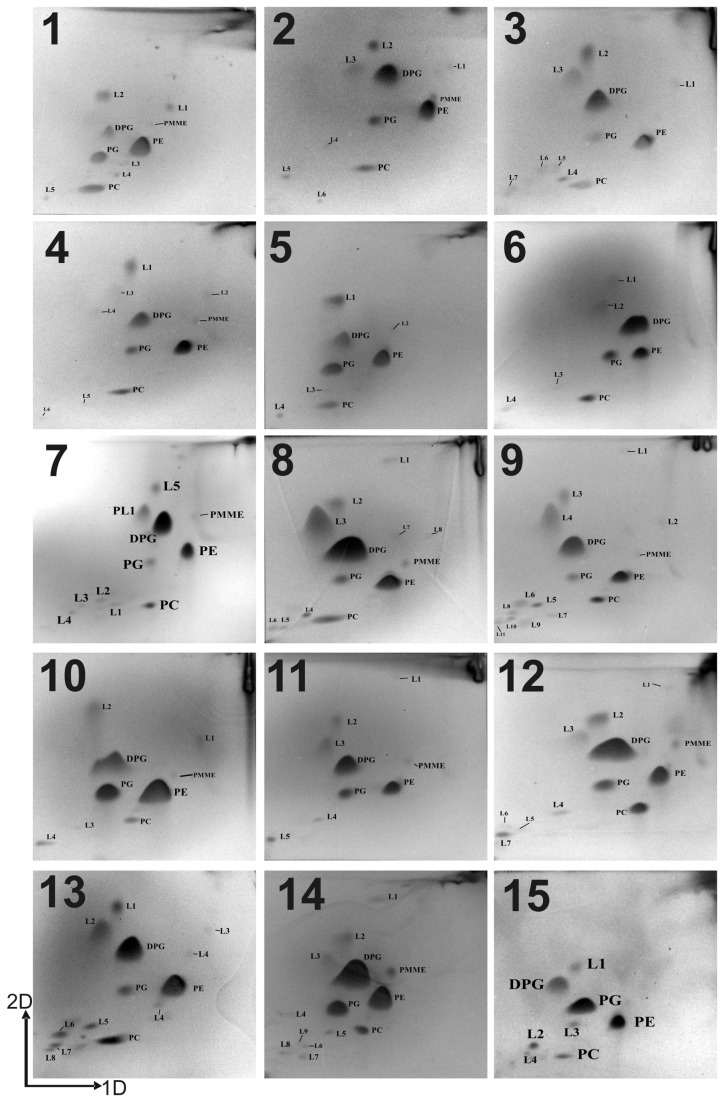
Four closely related facultative anaerobe, moderately thermophilic, Gram positive rods (JS1(T), JS5, JS11, and JS15) were isolated from sediment samples from a hot spring at Suryakund, Jharkhand, India. Colonies were pale yellow, rough surface with uneven edges on TSA after 72 h incubation. Heterotrophic growth was observed at 40-60°C and pH 5.5-11.5; optimum growth occurred at 55°C and pH 7.5. 16S rRNA gene sequence analysis revealed the strains belong to genus Anoxybacillus. DNA-DNA homology values among strains were above 70% and showed distinct ERIC and REP PCR profile. On the basis of morphology and biochemical characteristics, strain JS1(T) was studied further. Strain JS1(T) showed 99.30% sequence similarity with A. flavithermus subsp. yunnanensis, 99.23% with A. mongoliensis, 99.16% with A. eryuanensis, 98.74% with A. flavithermus subsp. flavithermus, 98.54% with A. tengchongensis, 98.51% with A. pushchinoensis, 97.91% with A. thermarum, 97.82% with A. kaynarcensis, 97.77% with A. ayderensis and A. kamchatkensis, 97.63% with A. salavatliensis, 97.55% with A. kestanbolensis, 97.48% with A. contaminans, 97.27% with A. gonensis and 97.17% with A. voinovskiensis. In 16S rRNA secondary structure based phylogenetic comparison, strain JS1(T) was clustered with Anoxybacillus eryuanensis, A. mongoliensis, and A. flavithermus subsp. yunnanensis and showed 15 species specific base substitutions with maximum variability in helix 6. Moreover, DNA-DNA relatedness between JS1(T) and the closely related type strains were well below 70%. The DNA G+C content was 42.1 mol%. The major fatty acids were C(15:0 iso), C(16:0 iso) and C(17:0iso). The polar lipids were a phosphatidylgylycerol, a diphosphatidylglycerol, a phosphatidylethnolamine, a phosphatidylcholine, a phosphatidyl monomethylethanolamine and four unknown lipids. Based on polyphasic approach, strain JS1(T) represent a novel species of the genus Anoxybacillus for which Anoxybacillus suryakundensis sp. nov. is proposed. The type strain is JS1(T) (= DSM 27374(T) = LMG 27616(T) =JCM19211(T)).
从印度恰尔肯德邦苏里亚昆德温泉的沉积物样本中分离出了4株亲缘关系密切的兼性厌氧、嗜热适度、革兰氏阳性杆菌(JS1(T)、JS5、JS11和JS15)。在TSA培养基上培养72小时后,菌落呈浅黄色,表面粗糙,边缘不整齐。在40-60°C和pH 5.5-11.5条件下观察到异养生长;最适生长温度为55°C,最适pH为7.5。16S rRNA基因序列分析表明这些菌株属于嗜热栖热菌属。菌株间的DNA-DNA同源性值高于70%,并显示出独特的ERIC和REP PCR图谱。基于形态学和生化特征,对菌株JS1(T)进行了进一步研究。菌株JS1(T)与云南嗜热栖热菌亚种的序列相似性为99.30%,与蒙古嗜热栖热菌的相似性为99.23%,与洱源嗜热栖热菌的相似性为99.16%,与嗜热栖热菌亚种嗜热栖热菌的相似性为98.74%,与腾冲嗜热栖热菌的相似性为98.54%,与普希诺嗜热栖热菌的相似性为98.51%,与嗜热栖热菌的相似性为97.91%,与卡因纳尔嗜热栖热菌的相似性为97.82%,与艾德尔嗜热栖热菌和堪察加嗜热栖热菌的相似性为97.77%,与萨拉瓦特利嗜热栖热菌的相似性为97.63%,与凯斯唐博尔嗜热栖热菌的相似性为97.55%,与污染嗜热栖热菌的相似性为97.48%,与戈内嗜热栖热菌的相似性为97.27%,与沃伊诺夫斯基嗜热栖热菌的相似性为97.17%。在基于16S rRNA二级结构的系统发育比较中, 菌株JS1(T)与洱源嗜热栖热菌、蒙古嗜热栖热菌和云南嗜热栖热菌亚种聚类在一起,并在螺旋6中显示出15个物种特异性碱基替换,具有最大变异性。此外,JS1(T)与密切相关的模式菌株之间的DNA-DNA相关性远低于70%。DNA G+C含量为42.1 mol%。主要脂肪酸为C(15:0 iso)、C(16:0 iso)和C(17:0iso)。极性脂质为磷脂酰甘油、二磷脂酰甘油、磷脂酰乙醇胺、磷脂酰胆碱、磷脂酰单甲基乙醇胺和四种未知脂质。基于多相分类方法,菌株JS1(T)代表嗜热栖热菌属的一个新物种,为此提出了苏里亚昆德嗜热栖热菌新种。模式菌株为JS1(T) (= DSM 27374(T) = LMG 27616(T) =JCM19211(T))。