Pathology and Laboratory Medicine, UCLA, 10833 Le Conte Ave 13-188 CHS, Los Angeles, CA 90095, USA.
Microbiome. 2013 Oct 12;1(1):26. doi: 10.1186/2049-2618-1-26.
Regardless of infection route, the intestine is the primary site for HIV-1 infection establishment and results in significant mucosal CD4+ T lymphocyte depletion, induces an inflammatory state that propagates viral dissemination, facilitates microbial translocation, and fosters establishment of one of the largest HIV reservoirs. Here we test the prediction that HIV infection modifies the composition and function of the mucosal commensal microbiota.
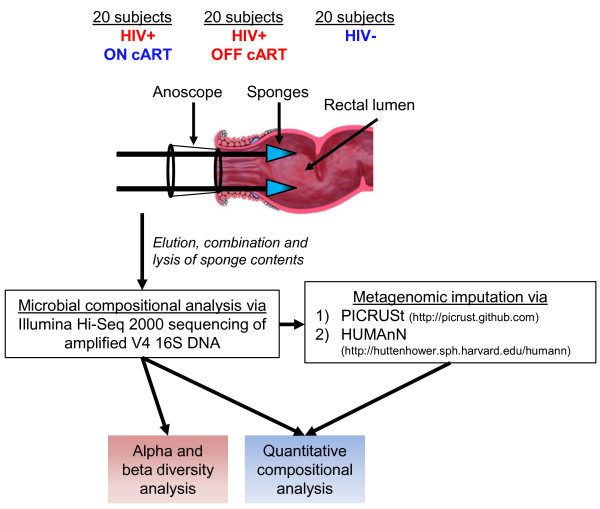
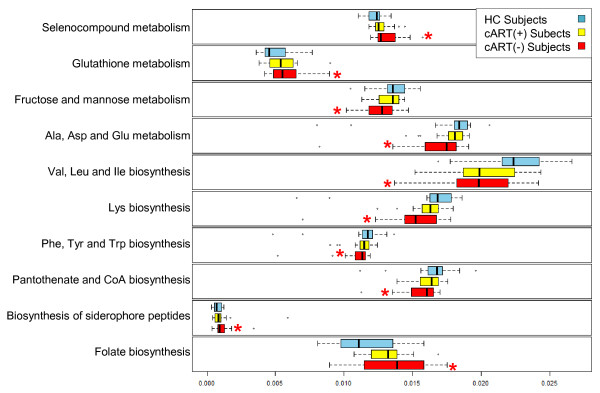
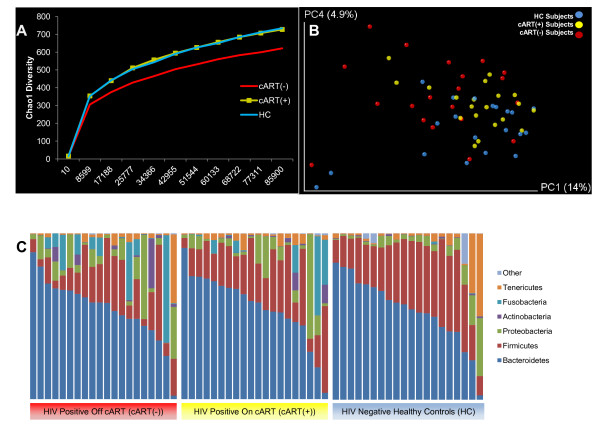
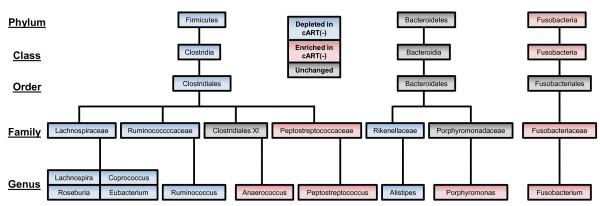
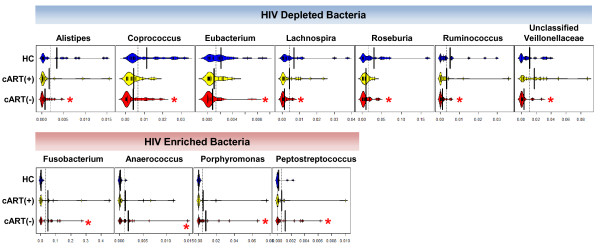
Rectal mucosal microbiota were collected from human subjects using a sponge-based sampling methodology. Samples were collected from 20 HIV-positive men not receiving combination anti-retroviral therapy (cART), 20 HIV-positive men on cART and 20 healthy, HIV-negative men. Microbial composition of samples was analyzed using barcoded 16S Illumina deep sequencing (85,900 reads per sample after processing). Microbial metagenomic information for the samples was imputed using the bioinformatic tools PICRUST and HUMAnN. Microbial composition and imputed function in HIV-positive individuals not receiving cART was significantly different from HIV-negative individuals. Genera including Roseburia, Coprococcus, Ruminococcus, Eubacterium, Alistipes and Lachnospira were depleted in HIV-infected subjects not receiving cART, while Fusobacteria, Anaerococcus, Peptostreptococcus and Porphyromonas were significantly enriched. HIV-positive subjects receiving cART exhibited similar depletion and enrichment for these genera, but were of intermediate magnitude and did not achieve statistical significance. Imputed metagenomic functions, including amino acid metabolism, vitamin biosynthesis, and siderophore biosynthesis differed significantly between healthy controls and HIV-infected subjects not receiving cART.
HIV infection was associated with rectal mucosal changes in microbiota composition and imputed function that cART failed to completely reverse. HIV infection was associated with depletion of some commensal species and enrichment of a few opportunistic pathogens. Many imputed metagenomic functions differed between samples from HIV-negative and HIV-positive subjects not receiving cART, possibly reflecting mucosal metabolic changes associated with HIV infection. Such functional pathways may represent novel interventional targets for HIV therapy if normalizing the microbial composition or functional activity of the microbiota proves therapeutically useful.
无论感染途径如何,肠道都是 HIV-1 感染建立的主要部位,会导致显著的黏膜 CD4+T 淋巴细胞耗竭,引发炎症状态,促进病毒传播,促进微生物易位,并促进最大的 HIV 储库之一的建立。在这里,我们检验了 HIV 感染改变黏膜共生菌群组成和功能的预测。
使用基于海绵的采样方法从人类受试者的直肠黏膜中采集样本。共采集了 20 名未接受联合抗逆转录病毒治疗(cART)的 HIV 阳性男性、20 名接受 cART 的 HIV 阳性男性和 20 名健康、HIV 阴性男性的样本。使用带有条形码的 16S Illumina 深度测序(处理后每个样本 85900 个读数)分析样本的微生物组成。使用生物信息学工具 PICRUST 和 HUMAnN 对样本的微生物宏基因组信息进行推断。未接受 cART 的 HIV 阳性个体的微生物组成和推断功能与 HIV 阴性个体明显不同。在未接受 cART 的 HIV 感染患者中,Roseburia、Coprococcus、Ruminococcus、Eubacterium、Alistipes 和 Lachnospira 等属减少,而 Fusobacteria、Anaerococcus、Peptostreptococcus 和 Porphyromonas 则明显富集。接受 cART 的 HIV 阳性患者对这些属表现出类似的减少和富集,但程度中等,未达到统计学意义。推断的宏基因组功能,包括氨基酸代谢、维生素生物合成和铁载体生物合成,在健康对照组和未接受 cART 的 HIV 感染患者之间有显著差异。
HIV 感染与 cART 未能完全逆转的直肠黏膜微生物组成和推断功能的变化有关。HIV 感染与一些共生种的减少和少数机会性病原体的富集有关。来自 HIV 阴性和未接受 cART 的 HIV 阳性患者的样本之间的许多推断的宏基因组功能不同,这可能反映了与 HIV 感染相关的黏膜代谢变化。如果使微生物组成或功能活性正常化对 HIV 治疗具有治疗意义,那么这些功能途径可能成为 HIV 治疗的新的干预靶点。