Institute of Medical Virology, Hospital of the Johann Wolfgang Goethe University of Frankfurt, Frankfurt, Germany.
MikroLab GmbH, Bremen, Germany.
PLoS One. 2014 Jan 27;9(1):e86128. doi: 10.1371/journal.pone.0086128. eCollection 2014.
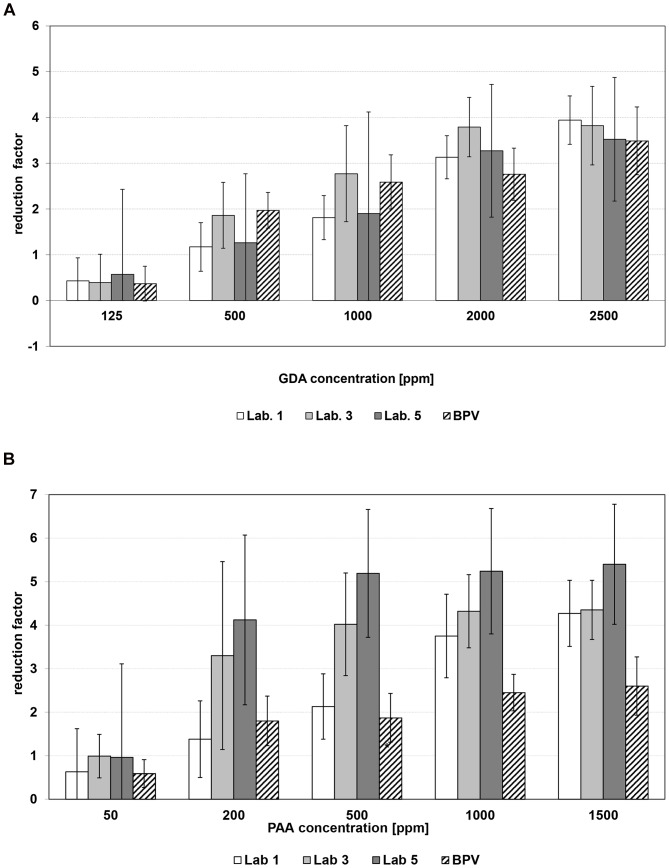
Surface disinfectants are part of broader preventive strategies preventing the transmission of bacteria, fungi and viruses in medical institutions. To evaluate their virucidal efficacy, these products must be tested with appropriate model viruses with different physico-chemical properties under conditions representing practical application in hospitals. The aim of this study was to evaluate a quantitative carrier assay. Furthermore, different putative model viruses like adenovirus type 5 (AdV-5) and different animal parvoviruses were evaluated with respect to their tenacity and practicability in laboratory handling. To evaluate the robustness of the method, some of the viruses were tested in parallel in different laboratories in a multi-center study. Different biocides, which are common active ingredients of surface disinfectants, were used in the test. After drying on stainless steel discs as the carrier, model viruses were exposed to different concentrations of three alcohols, peracetic acid (PAA) or glutaraldehyde (GDA), with a fixed exposure time of 5 minutes. Residual virus was determined after treatment by endpoint titration. All parvoviruses exhibited a similar stability with respect to GDA, while AdV-5 was more susceptible. For PAA, the porcine parvovirus was more sensitive than the other parvoviruses, and again, AdV-5 presented a higher susceptibility than the parvoviruses. All parvoviruses were resistant to alcohols, while AdV-5 was only stable when treated with 2-propanol. The analysis of the results of the multi-center study showed a high reproducibility of this test system. In conclusion, two viruses with different physico-chemical properties can be recommended as appropriate model viruses for the evaluation of the virucidal efficacy of surface disinfectants: AdV-5, which has a high clinical impact, and murine parvovirus (MVM) with the highest practicability among the parvoviruses tested.
表面消毒剂是预防医疗机构中细菌、真菌和病毒传播的更广泛预防策略的一部分。为了评估其杀病毒效果,必须在代表医院实际应用条件下,使用具有不同理化特性的适当模型病毒对这些产品进行测试。本研究旨在评估一种定量载体测定法。此外,还评估了不同的假定模型病毒,如腺病毒 5 型(AdV-5)和不同的动物细小病毒,以评估它们在实验室处理中的持久性和实用性。为了评估该方法的稳健性,在多中心研究中,一些病毒在不同实验室中平行进行了测试。测试中使用了一些常见的表面消毒剂活性成分的消毒剂。在作为载体的不锈钢盘上干燥后,将模型病毒暴露于不同浓度的三种醇、过氧乙酸(PAA)或戊二醛(GDA)中,固定暴露时间为 5 分钟。处理后通过终点滴定法测定残留病毒。所有细小病毒对 GDA 的稳定性相似,而 AdV-5 则更敏感。对于 PAA,猪细小病毒比其他细小病毒更敏感,而且 AdV-5 的敏感性再次高于细小病毒。所有细小病毒均对醇具有抗性,而 AdV-5 仅在 2-丙醇处理时稳定。多中心研究结果分析表明,该测试系统具有高度的可重复性。总之,两种具有不同理化特性的病毒可被推荐作为评估表面消毒剂杀病毒效果的合适模型病毒:具有高临床影响的 AdV-5 和在测试的细小病毒中实用性最高的鼠细小病毒(MVM)。