Vuković Rosemary, Blažetić Senka, Oršolić Ivana, Heffer Marija, Vari Sandor G, Gajdoš Martin, Krivošíková Zora, Kramárová Patrícia, Kebis Anton, Has-Schön Elizabeta
Elizabeta Has-Schön, Department of Biology, Cara Hadrijana 8/A, 31000 Osijek, Croatia,
Croat Med J. 2014 Jun 1;55(3):218-27. doi: 10.3325/cmj.2014.55.218.
To estimate the impact of high fat diet and estrogen deficiency on the oxidative and antioxidative status in the liver of the ovariectomized rats, as well as the ameliorating effect of physical activity or consumption of functional food containing bioactive compounds with antioxidative properties on oxidative damage in the rat liver.
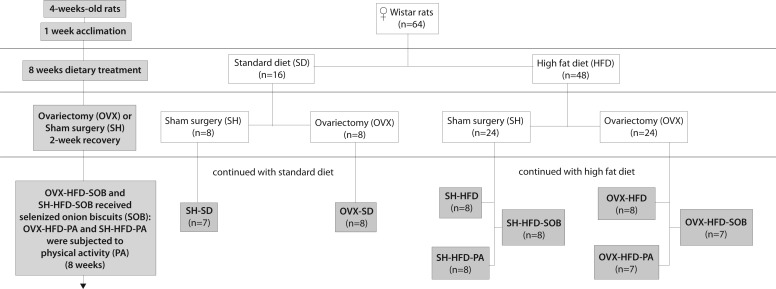
The study was conducted from November 2012 to April 2013. Liver oxidative damage was determined by lipid peroxidation levels expressed in terms of thiobarbituric acid reactive substances (TBARS), while liver antioxidative status was determined by catalase (CAT), glutathione peroxidase (GPx), glutathione S-transferase (GST), glutathione reductase (GR) activities, and glutathione (GSH) content. Sixty-four female Wistar rats were divided into eight groups: sham operated and ovariectomized rats that received either standard diet, high fat diet, or high fat diet supplemented with cereal selenized onion biscuits or high fat diet together with introduction of physical exercise of animals.
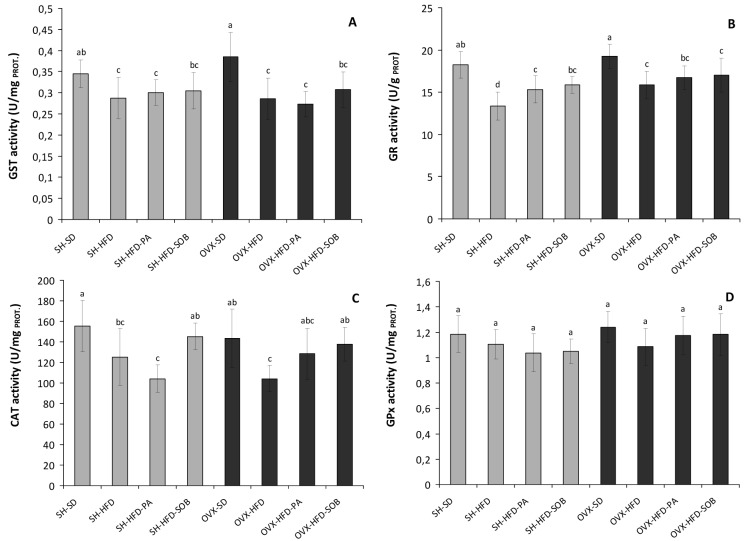
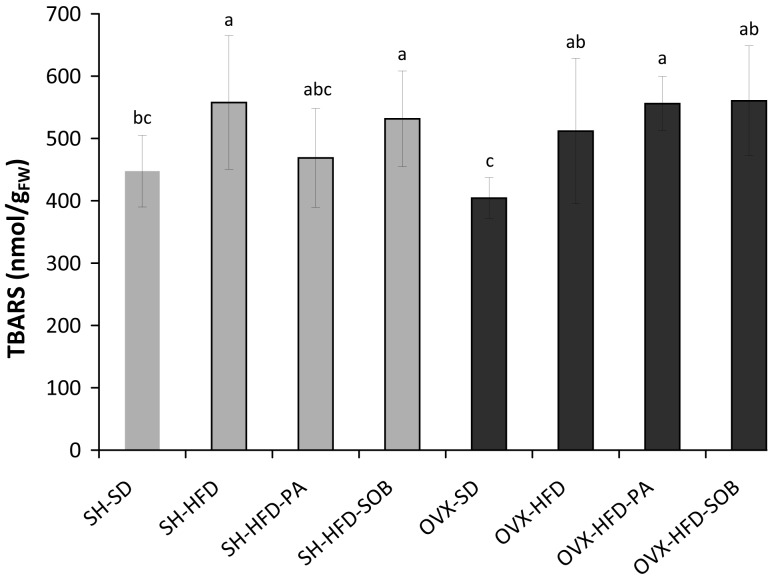
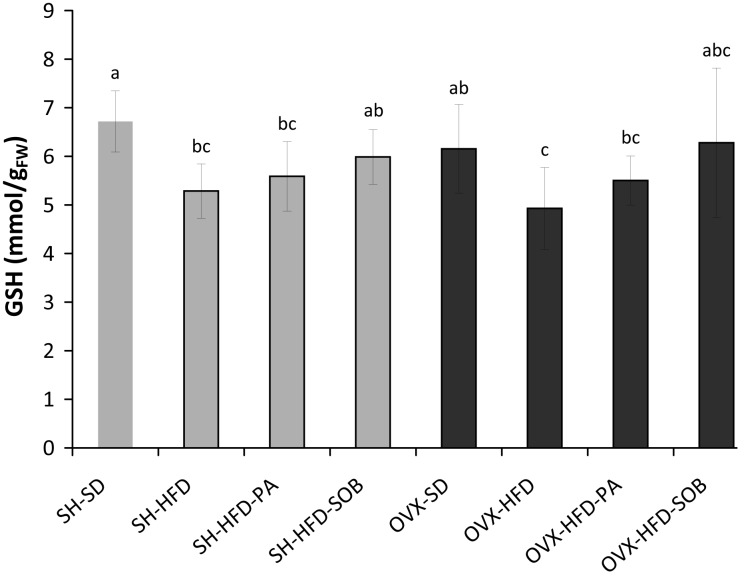
High fat diet significantly increased TBARS content in the liver compared to standard diet (P=0.032, P=0.030). Furthermore, high fat diet decreased the activities of CAT, GR, and GST, as well as the content of GSH (P<0.050). GPx activity remained unchanged in all groups. Physical activity and consumption of cereal selenized onion biscuits showed protective effect through increased GR activity in sham operated rats (P=0.026, P=0.009), while in ovariectomized group CAT activity was increased (P=0.018) in rats that received cereal selenized onion biscuits.
Feeding rats with high fat diet was accompanied by decreased antioxidative enzyme activities and increased lipid peroxidation. Bioactive compounds of cereal selenized onion biscuits showed potential to attenuate the adverse impact of high fat diet on antioxidative status.
评估高脂饮食和雌激素缺乏对去卵巢大鼠肝脏氧化及抗氧化状态的影响,以及体育活动或食用含有具有抗氧化特性生物活性化合物的功能性食品对大鼠肝脏氧化损伤的改善作用。
该研究于2012年11月至2013年4月进行。肝脏氧化损伤通过以硫代巴比妥酸反应性物质(TBARS)表示的脂质过氧化水平来确定,而肝脏抗氧化状态则通过过氧化氢酶(CAT)、谷胱甘肽过氧化物酶(GPx)、谷胱甘肽S-转移酶(GST)、谷胱甘肽还原酶(GR)活性以及谷胱甘肽(GSH)含量来确定。64只雌性Wistar大鼠被分为八组:假手术组和去卵巢大鼠,分别给予标准饮食、高脂饮食、补充谷物硒化洋葱饼干的高脂饮食或高脂饮食并同时对动物进行体育锻炼。
与标准饮食相比,高脂饮食显著增加了肝脏中TBARS的含量(P=0.032,P=0.030)。此外,高脂饮食降低了CAT、GR和GST的活性以及GSH的含量(P<0.050)。所有组中GPx活性保持不变。体育活动和食用谷物硒化洋葱饼干通过增加假手术组大鼠的GR活性显示出保护作用(P=0.026,P=0.009),而在去卵巢组中,食用谷物硒化洋葱饼干的大鼠CAT活性增加(P=0.018)。
给大鼠喂食高脂饮食会伴随着抗氧化酶活性降低和脂质过氧化增加。谷物硒化洋葱饼干中的生物活性化合物显示出减轻高脂饮食对抗氧化状态不利影响的潜力。