Biswas Sumalika, Vadrevu Krishna Prasad, Lwin Zin Mar, Lasko Kristofer, Justice Christopher O
Department of Geographical Sciences, University of Maryland, College Park, Maryland, United States of America.
Mandalay Technological University, Patheingyi, Mandalay, Myanmar.
PLoS One. 2015 Apr 24;10(4):e0124346. doi: 10.1371/journal.pone.0124346. eCollection 2015.
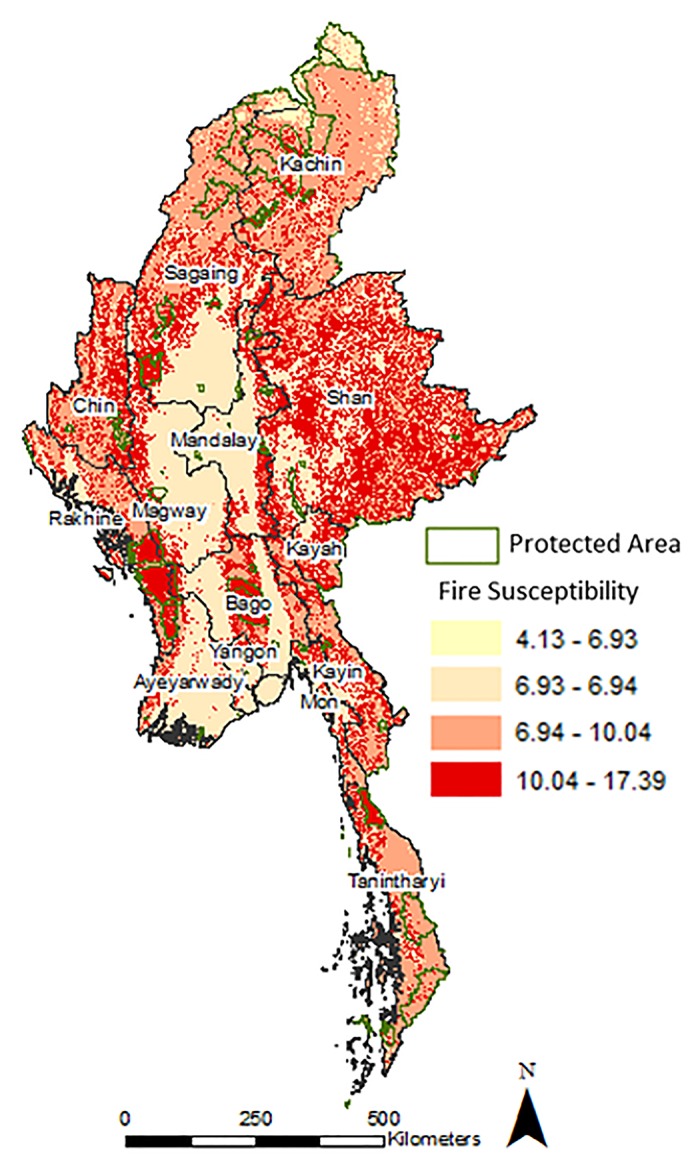
Fire is an important disturbance agent in Myanmar impacting several ecosystems. In this study, we quantify the factors impacting vegetation fires in protected and non-protected areas of Myanmar. Satellite datasets in conjunction with biophysical and anthropogenic factors were used in a spatial framework to map the causative factors of fires. Specifically, we used the frequency ratio method to assess the contribution of each causative factor to overall fire susceptibility at a 1km scale. Results suggested the mean fire density in non-protected areas was two times higher than the protected areas. Fire-land cover partition analysis suggested dominant fire occurrences in the savannas (protected areas) and woody savannas (non-protected areas). The five major fire causative factors in protected areas in descending order include population density, land cover, tree cover percent, travel time from nearest city and temperature. In contrast, the causative factors in non-protected areas were population density, tree cover percent, travel time from nearest city, temperature and elevation. The fire susceptibility analysis showed distinct spatial patterns with central Myanmar as a hot spot of vegetation fires. Results from propensity score matching suggested that forests within protected areas have 11% less fires than non-protected areas. Overall, our results identify important causative factors of fire useful to address broad scale fire risk concerns at a landscape scale in Myanmar.
火灾是缅甸一种重要的干扰因素,影响着多个生态系统。在本研究中,我们对影响缅甸保护区和非保护区植被火灾的因素进行了量化。结合生物物理和人为因素的卫星数据集被用于一个空间框架中,以绘制火灾的成因。具体而言,我们使用频率比方法来评估每个成因在1公里尺度上对整体火灾易发性的贡献。结果表明,非保护区的平均火灾密度是保护区的两倍。火灾-土地覆盖分区分析表明,火灾主要发生在稀树草原(保护区)和木本稀树草原(非保护区)。保护区的五大火灾成因按降序排列包括人口密度、土地覆盖、树木覆盖率、距最近城市的出行时间和温度。相比之下,非保护区的成因是人口密度、树木覆盖率、距最近城市的出行时间、温度和海拔。火灾易发性分析显示出明显的空间格局,缅甸中部是植被火灾的热点地区。倾向得分匹配结果表明,保护区内的森林火灾比非保护区少11%。总体而言,我们的结果确定了火灾的重要成因,有助于解决缅甸景观尺度上广泛的火灾风险问题。