Bitterman-Deutsch Ora, Kogan Leonid, Nasser Faris
Faculty of Medicine in the Galilee, Bar Ilan University , Safed ; Dermatology Clinic, Galilee Medical Center , Nahariya, Israel.
Faculty of Medicine in the Galilee, Bar Ilan University , Safed ; Department of Plastic Surgery, Galilee Medical Center , Nahariya, Israel.
Dermatol Reports. 2015 Mar 30;7(1):5851. doi: 10.4081/dr.2015.5851. eCollection 2015 Mar 16.
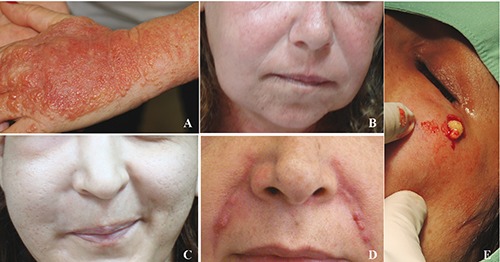
Hyaluronic acid (HA) fillers in cosmetic medicine have been considered relatively safe, though fillers used in European countries and throughout the world are not necessarily approved by the Food and Drug Administration. As their use continues to expand worldwide, physicians in a wide range of medical specialties are authorized to perform HA injections, including general medicine practitioners and even dentists. An increasing number of reports have appeared regarding side effects to these products. It is now known that reactions to Hyaluronic acid are related not only to technical faults of the injections, but also to immune responses, including delayed hypersensitivity and granulomatous reactions. Herein, we describe five cases treated by a variety of treatment modalities, all with delayed reactions to different brands of hyaluronic acid fillers. As there is currently no standardization of treatment options of adverse effects, these cases accentuate the debate regarding the approach to the individual patient and the possible need for pre-testing in patients with an atopic tendency.
在美容医学中,透明质酸(HA)填充剂一直被认为相对安全,尽管在欧洲国家和世界各地使用的填充剂不一定得到美国食品药品监督管理局的批准。随着其在全球范围内的使用不断扩大,包括普通内科医生甚至牙医在内的广泛医学专业的医生都被授权进行HA注射。关于这些产品的副作用的报告越来越多。现在已知对透明质酸的反应不仅与注射技术失误有关,还与免疫反应有关,包括迟发型超敏反应和肉芽肿反应。在此,我们描述了五例采用多种治疗方式治疗的病例,所有病例均对不同品牌的透明质酸填充剂有延迟反应。由于目前不良反应的治疗选择尚无标准化,这些病例加剧了关于个体患者治疗方法以及对有特应性倾向患者进行预测试可能必要性的争论。