
按年龄和性别估算热应激风险:一个基于人群水平的模拟模型。
Estimating risks of heat strain by age and sex: a population-level simulation model.
作者信息
Glass Kathryn, Tait Peter W, Hanna Elizabeth G, Dear Keith
机构信息
National Centre for Epidemiology and Population Health, Australian National University, Canberra 2601, Australia.
Duke Global Health Institute, Duke Kunshan University, Kunshan 215316, China.
出版信息
Int J Environ Res Public Health. 2015 May 18;12(5):5241-55. doi: 10.3390/ijerph120505241.
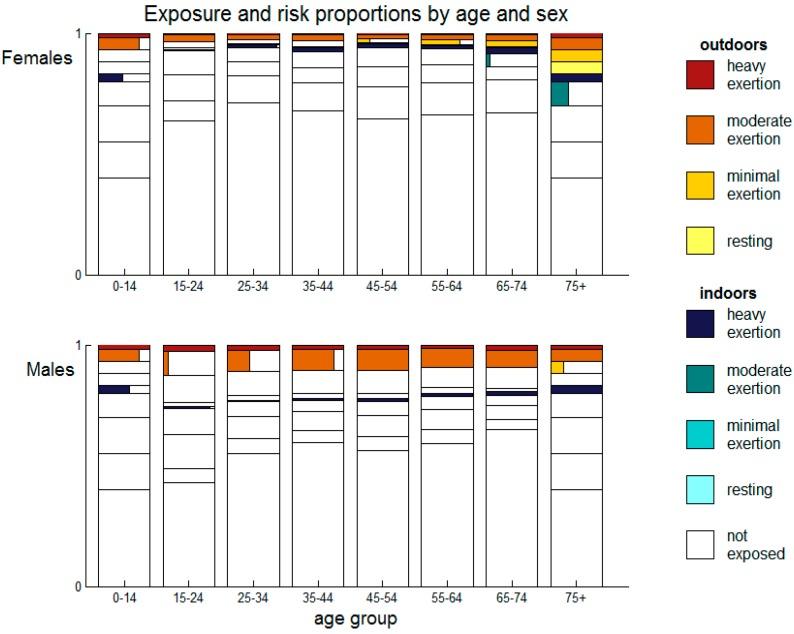
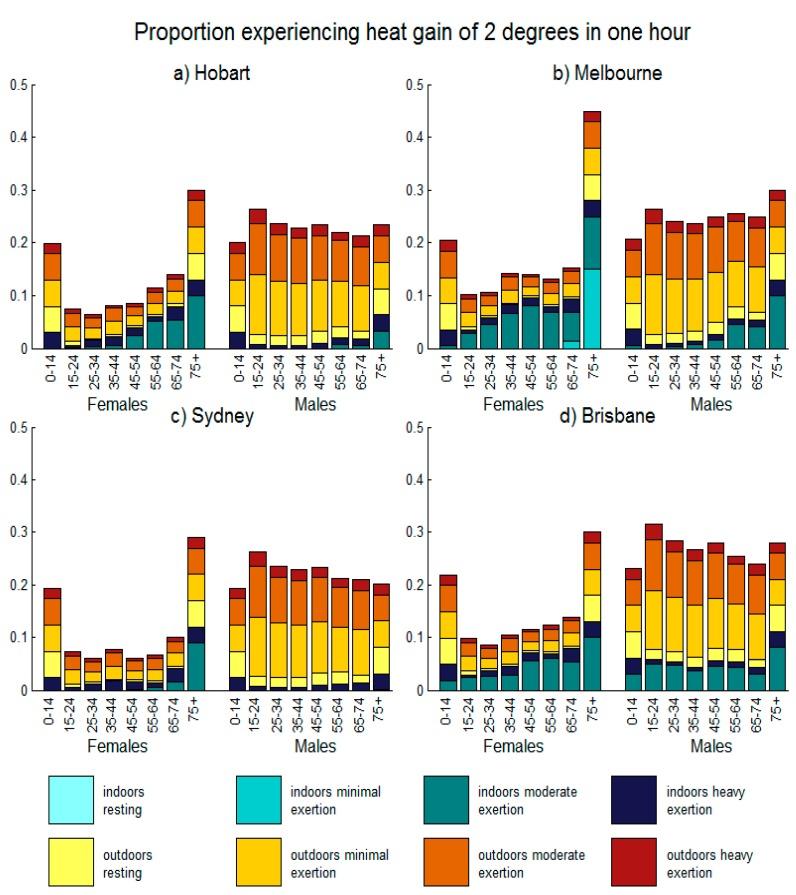
Individuals living in hot climates face health risks from hyperthermia due to excessive heat. Heat strain is influenced by weather exposure and by individual characteristics such as age, sex, body size, and occupation. To explore the population-level drivers of heat strain, we developed a simulation model that scales up individual risks of heat storage (estimated using Myrup and Morgan's man model "MANMO") to a large population. Using Australian weather data, we identify high-risk weather conditions together with individual characteristics that increase the risk of heat stress under these conditions. The model identifies elevated risks in children and the elderly, with females aged 75 and older those most likely to experience heat strain. Risk of heat strain in males does not increase as rapidly with age, but is greatest on hot days with high solar radiation. Although cloudy days are less dangerous for the wider population, older women still have an elevated risk of heat strain on hot cloudy days or when indoors during high temperatures. Simulation models provide a valuable method for exploring population level risks of heat strain, and a tool for evaluating public health and other government policy interventions.
生活在炎热气候中的人面临因过热导致体温过高的健康风险。热应激受天气暴露以及年龄、性别、体型和职业等个体特征的影响。为了探究热应激在人群层面的驱动因素,我们开发了一个模拟模型,该模型将个体的蓄热风险(使用米鲁普和摩根的人体模型“MANMO”估算)扩大到大量人群。利用澳大利亚的天气数据,我们确定了高风险天气状况以及在这些状况下会增加热应激风险的个体特征。该模型识别出儿童和老年人面临的风险较高,其中75岁及以上的女性最有可能经历热应激。男性的热应激风险不会随着年龄增长而迅速增加,但在太阳辐射强烈的炎热天气中风险最大。虽然阴天对更广泛的人群来说危险性较小,但老年女性在炎热多云的日子或高温期间待在室内时,热应激风险仍然较高。模拟模型为探究热应激在人群层面的风险提供了一种有价值的方法,也是评估公共卫生和其他政府政策干预措施的一种工具。


 Zotero 插件