Panáček Aleš, Smékalová Monika, Kilianová Martina, Prucek Robert, Bogdanová Kateřina, Večeřová Renata, Kolář Milan, Havrdová Markéta, Płaza Grażyna Anna, Chojniak Joanna, Zbořil Radek, Kvítek Libor
Regional Centre of Advanced Technologies and Materials, Department of Physical Chemistry, Faculty of Science, Palacký University in Olomouc, 17 listopadu 12, 771 46 Olomouc, Czech Republic.
Department of Microbiology, Faculty of Medicine and Dentistry, Palacký University in Olomouc, Hněvotínská 5, 775 15 Olomouc, Czech Republic.
Molecules. 2015 Dec 28;21(1):E26. doi: 10.3390/molecules21010026.
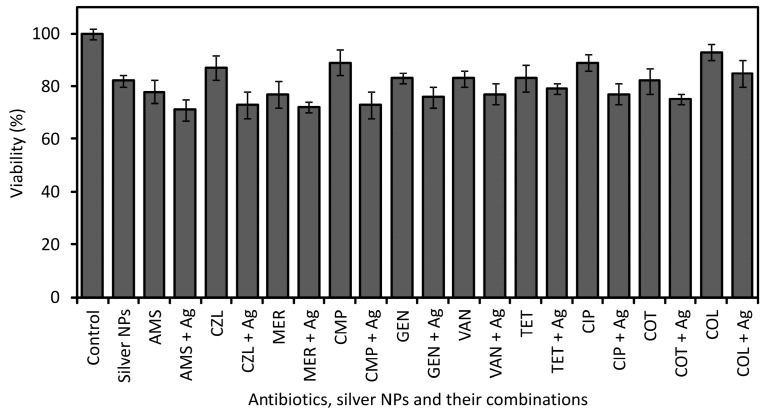
The resistance of bacteria towards traditional antibiotics currently constitutes one of the most important health care issues with serious negative impacts in practice. Overcoming this issue can be achieved by using antibacterial agents with multimode antibacterial action. Silver nano-particles (AgNPs) are one of the well-known antibacterial substances showing such multimode antibacterial action. Therefore, AgNPs are suitable candidates for use in combinations with traditional antibiotics in order to improve their antibacterial action. In this work, a systematic study quantifying the synergistic effects of antibiotics with different modes of action and different chemical structures in combination with AgNPs against Escherichia coli, Pseudomonas aeruginosa and Staphylococcus aureus was performed. Employing the microdilution method as more suitable and reliable than the disc diffusion method, strong synergistic effects were shown for all tested antibiotics combined with AgNPs at very low concentrations of both antibiotics and AgNPs. No trends were observed for synergistic effects of antibiotics with different modes of action and different chemical structures in combination with AgNPs, indicating non-specific synergistic effects. Moreover, a very low amount of silver is needed for effective antibacterial action of the antibiotics, which represents an important finding for potential medical applications due to the negligible cytotoxic effect of AgNPs towards human cells at these concentration levels.
目前,细菌对传统抗生素的耐药性已成为最重要的医疗保健问题之一,在实际应用中产生了严重的负面影响。通过使用具有多模式抗菌作用的抗菌剂可以解决这一问题。银纳米颗粒(AgNPs)是一种众所周知的具有这种多模式抗菌作用的抗菌物质。因此,AgNPs是与传统抗生素联合使用以增强其抗菌作用的合适候选物。在这项工作中,进行了一项系统研究,量化了具有不同作用模式和不同化学结构的抗生素与AgNPs联合对大肠杆菌、铜绿假单胞菌和金黄色葡萄球菌的协同效应。采用比纸片扩散法更合适、更可靠的微量稀释法,结果表明,在抗生素和AgNPs浓度都非常低的情况下,所有测试的抗生素与AgNPs联合使用均显示出很强的协同效应。未观察到具有不同作用模式和不同化学结构的抗生素与AgNPs联合使用时协同效应的趋势,这表明存在非特异性协同效应。此外,抗生素有效发挥抗菌作用所需的银量非常少,鉴于在这些浓度水平下AgNPs对人体细胞的细胞毒性可忽略不计,这一发现对潜在的医学应用具有重要意义。