Duan Cheng-Jie, Feng Yu-Liang, Cao Qi-Long, Huang Ming-Yue, Feng Jia-Xun
State Key Laboratory for Conservation and Utilization of Subtropical Agro-bioresources, The Key Laboratory of Ministry of Education for Microbial and Plant Genetic Engineering, and College of Life Science and Technology, Guangxi University, 100 Daxue Road, Nanning, Guangxi, 530004, China.
Sci Rep. 2016 Jan 14;6:19392. doi: 10.1038/srep19392.
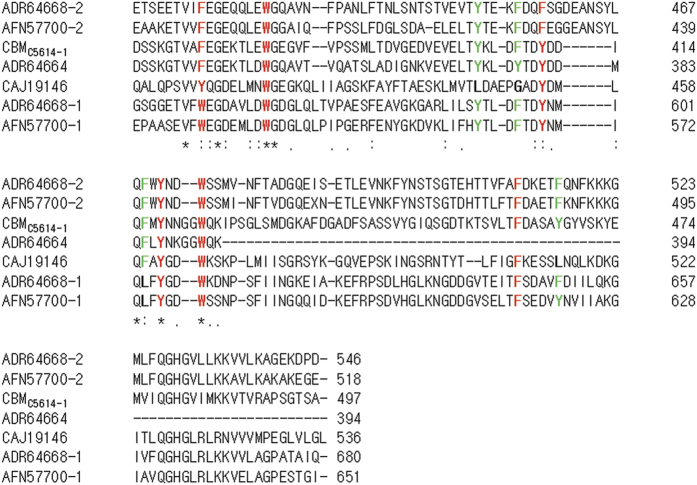
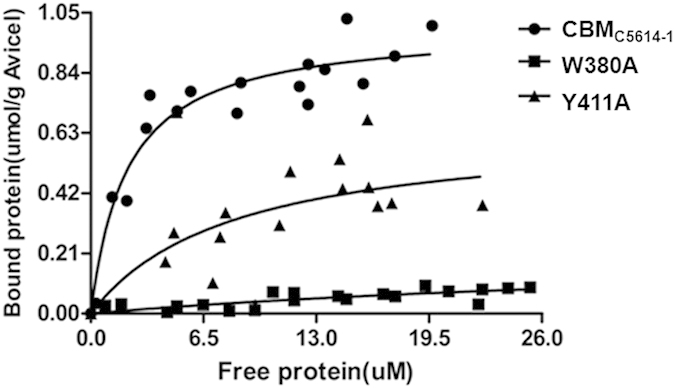
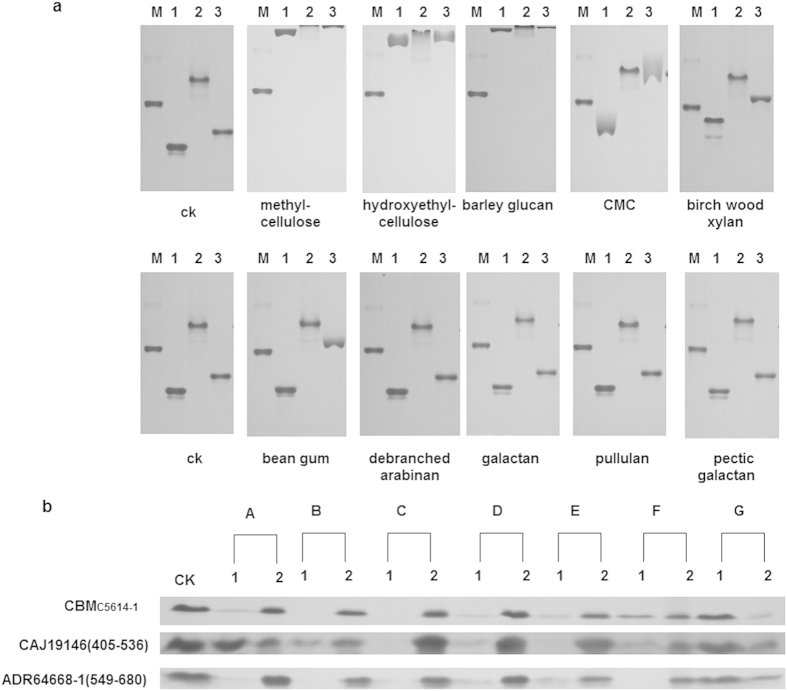
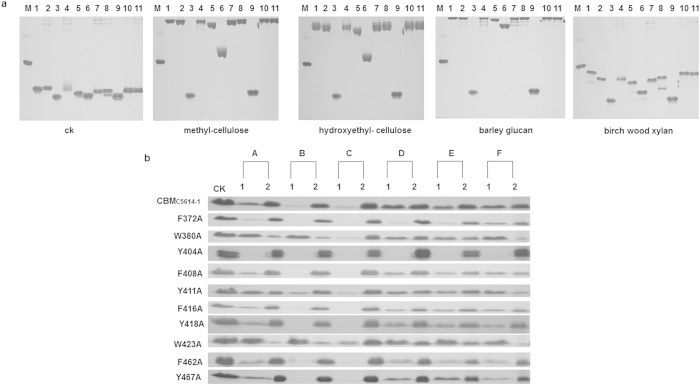
Most enzymes that act on carbohydrates include non-catalytic carbohydrate-binding modules (CBMs) that recognize and target carbohydrates. CBMs bring their appended catalytic modules into close proximity with the target substrate and increase the hydrolytic rate of enzymes acting on insoluble substrates. We previously identified a novel CBM (CBMC5614-1) at the C-terminus of endoglucanase C5614-1 from an uncultured microorganism present in buffalo rumen. In the present study, that the functional region of CBMC5614-1 involved in ligand binding was localized to 134 amino acids. Two representative homologs of CBMC5614-1, sharing the same ligand binding profile, targeted a range of β-linked polysaccharides that adopt very different conformations. Targeted substrates included soluble and insoluble cellulose, β-1,3/1,4-mixed linked glucans, xylan, and mannan. Mutagenesis revealed that three conserved aromatic residues (Trp-380, Tyr-411, and Trp-423) play an important role in ligand recognition and targeting. These results suggest that CBMC5614-1 and its homologs form a novel CBM family (CBM72) with a broad ligand-binding specificity. CBM72 members can provide new insight into CBM-ligand interactions and may have potential in protein engineering and biocatalysis.
大多数作用于碳水化合物的酶都包含非催化性的碳水化合物结合模块(CBMs),这些模块能够识别并靶向碳水化合物。CBMs将其附加的催化模块带到与目标底物紧密接近的位置,并提高作用于不溶性底物的酶的水解速率。我们之前从水牛瘤胃中存在的一种未培养微生物的内切葡聚糖酶C5614-1的C端鉴定出一种新型CBM(CBMC5614-1)。在本研究中,CBMC5614-1参与配体结合的功能区域被定位到134个氨基酸。CBMC5614-1的两个代表性同源物具有相同的配体结合模式,靶向一系列构象非常不同的β-连接多糖。靶向底物包括可溶性和不溶性纤维素、β-1,3/1,4-混合连接葡聚糖、木聚糖和甘露聚糖。诱变分析表明,三个保守的芳香族残基(Trp-380、Tyr-411和Trp-423)在配体识别和靶向中起重要作用。这些结果表明,CBMC5614-1及其同源物形成了一个具有广泛配体结合特异性的新型CBM家族(CBM72)。CBM72成员可以为CBM-配体相互作用提供新的见解,并且可能在蛋白质工程和生物催化方面具有潜力。