Hill Steven M, Heiser Laura M, Cokelaer Thomas, Unger Michael, Nesser Nicole K, Carlin Daniel E, Zhang Yang, Sokolov Artem, Paull Evan O, Wong Chris K, Graim Kiley, Bivol Adrian, Wang Haizhou, Zhu Fan, Afsari Bahman, Danilova Ludmila V, Favorov Alexander V, Lee Wai Shing, Taylor Dane, Hu Chenyue W, Long Byron L, Noren David P, Bisberg Alexander J, Mills Gordon B, Gray Joe W, Kellen Michael, Norman Thea, Friend Stephen, Qutub Amina A, Fertig Elana J, Guan Yuanfang, Song Mingzhou, Stuart Joshua M, Spellman Paul T, Koeppl Heinz, Stolovitzky Gustavo, Saez-Rodriguez Julio, Mukherjee Sach
MRC Biostatistics Unit, Cambridge Institute of Public Health, Cambridge, UK.
Department of Biomedical Engineering, Oregon Health and Science University, Portland, Oregon, USA.
Nat Methods. 2016 Apr;13(4):310-8. doi: 10.1038/nmeth.3773. Epub 2016 Feb 22.
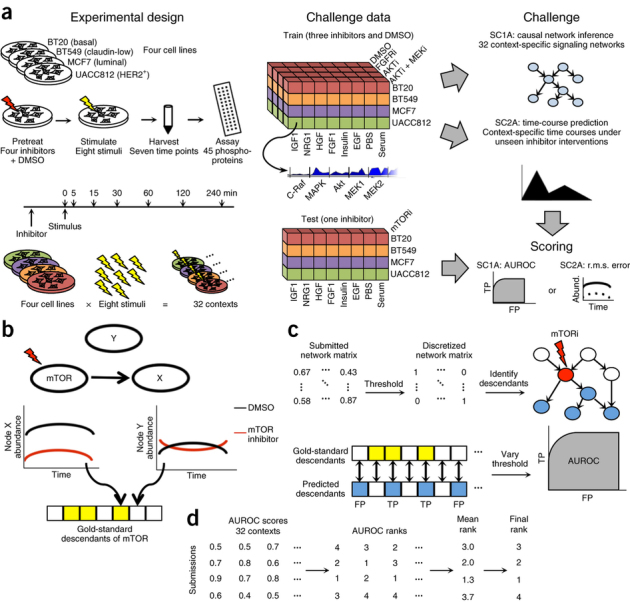
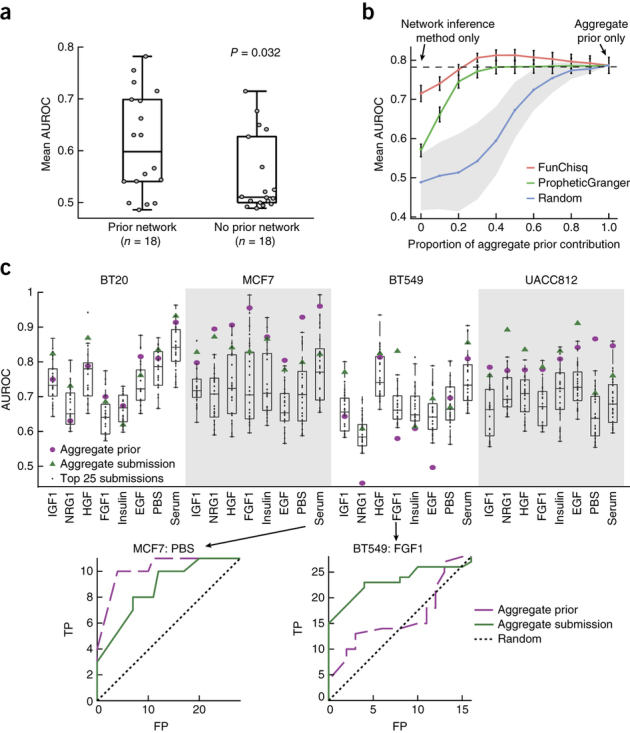
It remains unclear whether causal, rather than merely correlational, relationships in molecular networks can be inferred in complex biological settings. Here we describe the HPN-DREAM network inference challenge, which focused on learning causal influences in signaling networks. We used phosphoprotein data from cancer cell lines as well as in silico data from a nonlinear dynamical model. Using the phosphoprotein data, we scored more than 2,000 networks submitted by challenge participants. The networks spanned 32 biological contexts and were scored in terms of causal validity with respect to unseen interventional data. A number of approaches were effective, and incorporating known biology was generally advantageous. Additional sub-challenges considered time-course prediction and visualization. Our results suggest that learning causal relationships may be feasible in complex settings such as disease states. Furthermore, our scoring approach provides a practical way to empirically assess inferred molecular networks in a causal sense.
在复杂的生物环境中,分子网络中是否能推断出因果关系而非仅仅是相关关系,目前仍不清楚。在此,我们描述了HPN-DREAM网络推断挑战赛,该挑战赛聚焦于学习信号网络中的因果影响。我们使用了癌细胞系的磷酸化蛋白数据以及来自非线性动力学模型的计算机模拟数据。利用磷酸化蛋白数据,我们对挑战赛参与者提交的2000多个网络进行了评分。这些网络涵盖32种生物学背景,并根据对未见干预数据的因果有效性进行评分。多种方法是有效的,并且纳入已知生物学信息通常具有优势。额外的子挑战考虑了时间进程预测和可视化。我们的结果表明,在疾病状态等复杂环境中学习因果关系可能是可行的。此外,我们的评分方法提供了一种实用的方式,可从因果意义上实证评估推断出的分子网络。